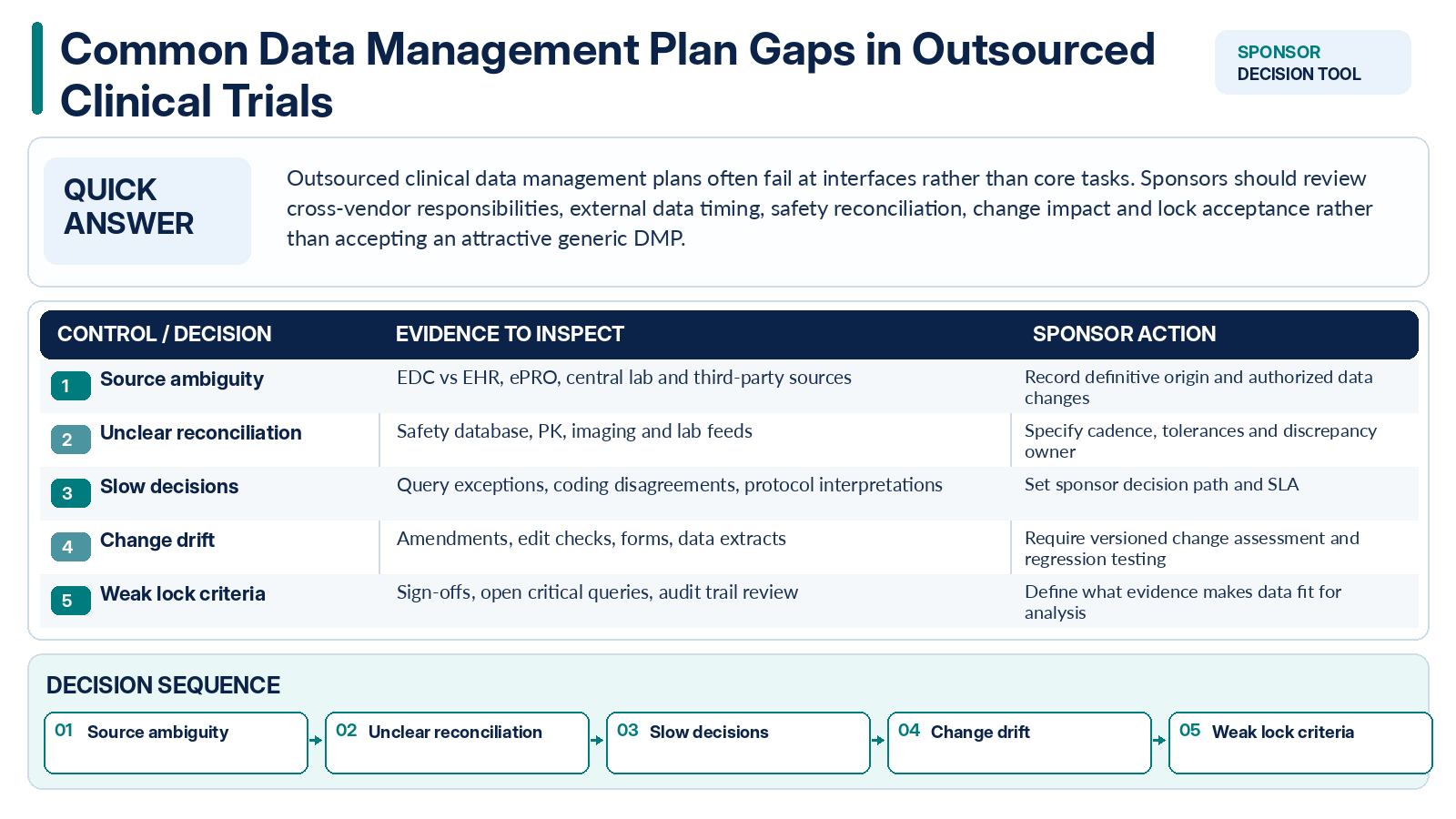
Outsourced clinical data management plans often fail at interfaces rather than core tasks. Sponsors should review cross-vendor responsibilities, external data timing, safety reconciliation, change impact and lock acceptance rather than accepting an attractive generic DMP.
How to apply this workflow in practice
Begin with the most consequential control and the evidence needed to resolve it. The following matrix connects each decision to records and an accountable action, rather than treating the list as a generic compliance checkbox.
| Control / question | Evidence to examine | Sponsor action |
|---|---|---|
| Source ambiguity | EDC vs EHR, ePRO, central lab and third-party sources | Record definitive origin and authorized data changes |
| Unclear reconciliation | Safety database, PK, imaging and lab feeds | Specify cadence, tolerances and discrepancy owner |
| Slow decisions | Query exceptions, coding disagreements, protocol interpretations | Set sponsor decision path and SLA |
| Change drift | Amendments, edit checks, forms, data extracts | Require versioned change assessment and regression testing |
| Weak lock criteria | Sign-offs, open critical queries, audit trail review | Define what evidence makes data fit for analysis |
For teams that need support implementing this across functions, BioBoston CRO Data Management Plan Review can help adapt the controls to the study, vendors, and decision calendar.
Working through the controls
1. Source ambiguity
Evidence: EDC vs EHR, ePRO, central lab and third-party sources. Decision: Record definitive origin and authorized data changes. Record the responsible function and the approved source version, and keep any remaining exceptions visible to the sponsor before this item is closed.
2. Unclear reconciliation
Evidence: Safety database, PK, imaging and lab feeds. Decision: Specify cadence, tolerances and discrepancy owner. Record the responsible function and the approved source version, and keep any remaining exceptions visible to the sponsor before this item is closed.
3. Slow decisions
Evidence: Query exceptions, coding disagreements, protocol interpretations. Decision: Set sponsor decision path and SLA. Record the responsible function and the approved source version, and keep any remaining exceptions visible to the sponsor before this item is closed.
4. Change drift
Evidence: Amendments, edit checks, forms, data extracts. Decision: Require versioned change assessment and regression testing. Record the responsible function and the approved source version, and keep any remaining exceptions visible to the sponsor before this item is closed.
5. Weak lock criteria
Evidence: Sign-offs, open critical queries, audit trail review. Decision: Define what evidence makes data fit for analysis. Record the responsible function and the approved source version, and keep any remaining exceptions visible to the sponsor before this item is closed.
Red flags that should change the plan
- Broad statements such as data will be cleaned.
- Vendor contract contradicts DMP ownership.
- Last-minute external data discovered before lock.
Decision gate and governance
Rate every gap by participant/data impact and cost of correction; turn the top gaps into specific contractual or DMP controls. The control owner should record the decision, evidence version, date, residual uncertainty and next re-review trigger. Where delegated providers perform the work, the sponsor should retain the relevant oversight and acceptance evidence.
Regulatory note: Determine which electronic records and signatures are regulated before applying 21 CFR Part 11 controls; FDA guidance supports risk- and intended-use-based implementation.
Need practical support?
Use BioBoston CRO Data Management Plan Review to review the evidence, define decision rights, and build a study-specific action plan for the next milestone.