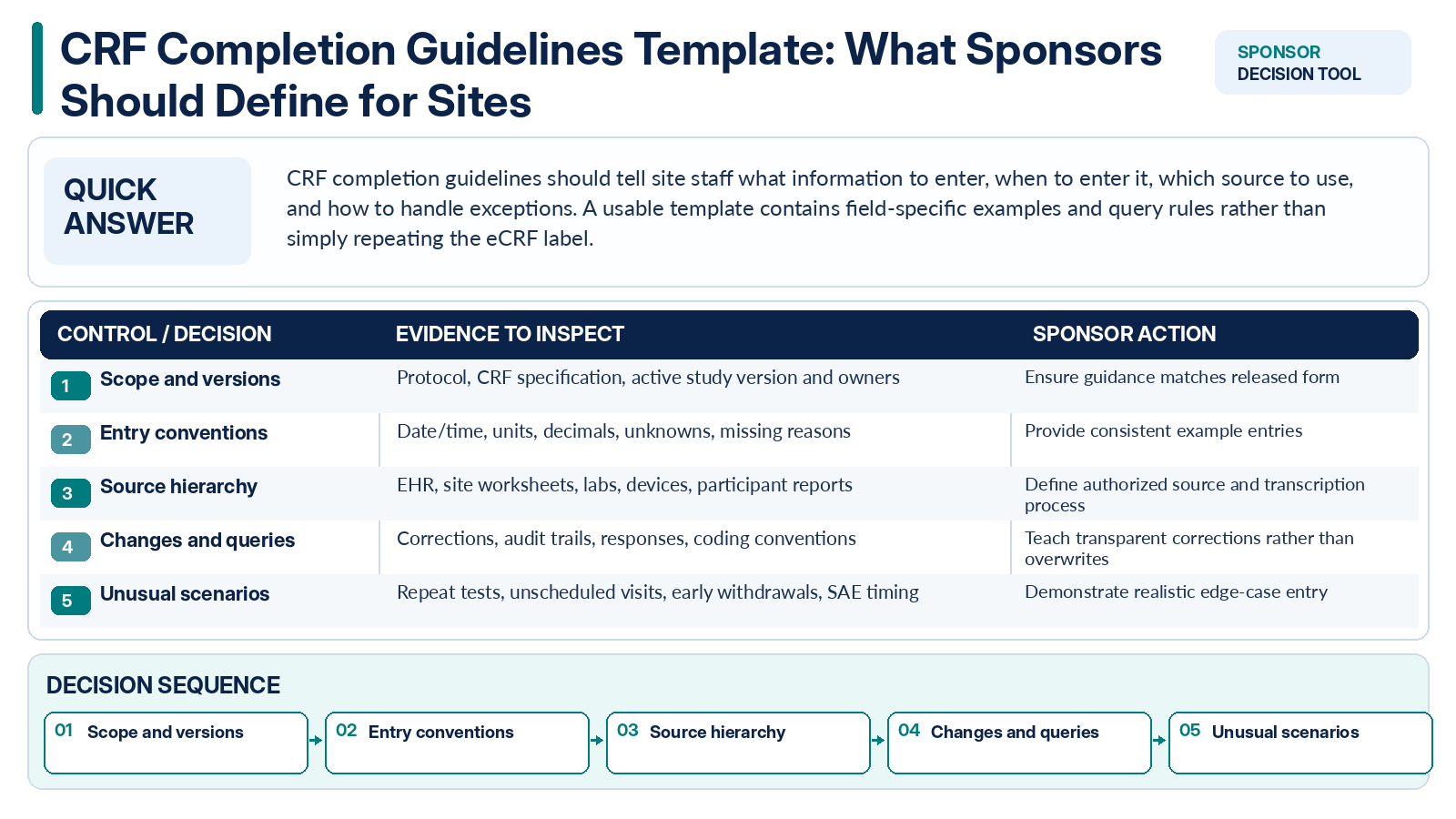
CRF completion guidelines should tell site staff what information to enter, when to enter it, which source to use, and how to handle exceptions. A usable template contains field-specific examples and query rules rather than simply repeating the eCRF label.
Reusable decision and evidence template
Begin with the most consequential control and the evidence needed to resolve it. The following matrix connects each decision to records and an accountable action, rather than treating the list as a generic compliance checkbox.
| Control / question | Evidence to examine | Sponsor action |
|---|---|---|
| Scope and versions | Protocol, CRF specification, active study version and owners | Ensure guidance matches released form |
| Entry conventions | Date/time, units, decimals, unknowns, missing reasons | Provide consistent example entries |
| Source hierarchy | EHR, site worksheets, labs, devices, participant reports | Define authorized source and transcription process |
| Changes and queries | Corrections, audit trails, responses, coding conventions | Teach transparent corrections rather than overwrites |
| Unusual scenarios | Repeat tests, unscheduled visits, early withdrawals, SAE timing | Demonstrate realistic edge-case entry |
For teams that need support implementing this across functions, BioBoston CRO eCRF Design and Review can help adapt the controls to the study, vendors, and decision calendar.
Working through the controls
1. Scope and versions
Evidence: Protocol, CRF specification, active study version and owners. Decision: Ensure guidance matches released form. Record the responsible function and the approved source version, and keep any remaining exceptions visible to the sponsor before this item is closed.
2. Entry conventions
Evidence: Date/time, units, decimals, unknowns, missing reasons. Decision: Provide consistent example entries. Record the responsible function and the approved source version, and keep any remaining exceptions visible to the sponsor before this item is closed.
3. Source hierarchy
Evidence: EHR, site worksheets, labs, devices, participant reports. Decision: Define authorized source and transcription process. Record the responsible function and the approved source version, and keep any remaining exceptions visible to the sponsor before this item is closed.
4. Changes and queries
Evidence: Corrections, audit trails, responses, coding conventions. Decision: Teach transparent corrections rather than overwrites. Record the responsible function and the approved source version, and keep any remaining exceptions visible to the sponsor before this item is closed.
5. Unusual scenarios
Evidence: Repeat tests, unscheduled visits, early withdrawals, SAE timing. Decision: Demonstrate realistic edge-case entry. Record the responsible function and the approved source version, and keep any remaining exceptions visible to the sponsor before this item is closed.
Red flags that should change the plan
- Generic instruction enter as appropriate.
- Contradictory units between forms.
- Sites use notes to bypass structured fields.
Decision gate and governance
Pilot the guidelines with a representative coordinator and revise any rule requiring an oral explanation. The control owner should record the decision, evidence version, date, residual uncertainty and next re-review trigger. Where delegated providers perform the work, the sponsor should retain the relevant oversight and acceptance evidence.
Regulatory note: Determine which electronic records and signatures are regulated before applying 21 CFR Part 11 controls; FDA guidance supports risk- and intended-use-based implementation.
Need practical support?
Use BioBoston CRO eCRF Design and Review to review the evidence, define decision rights, and build a study-specific action plan for the next milestone.