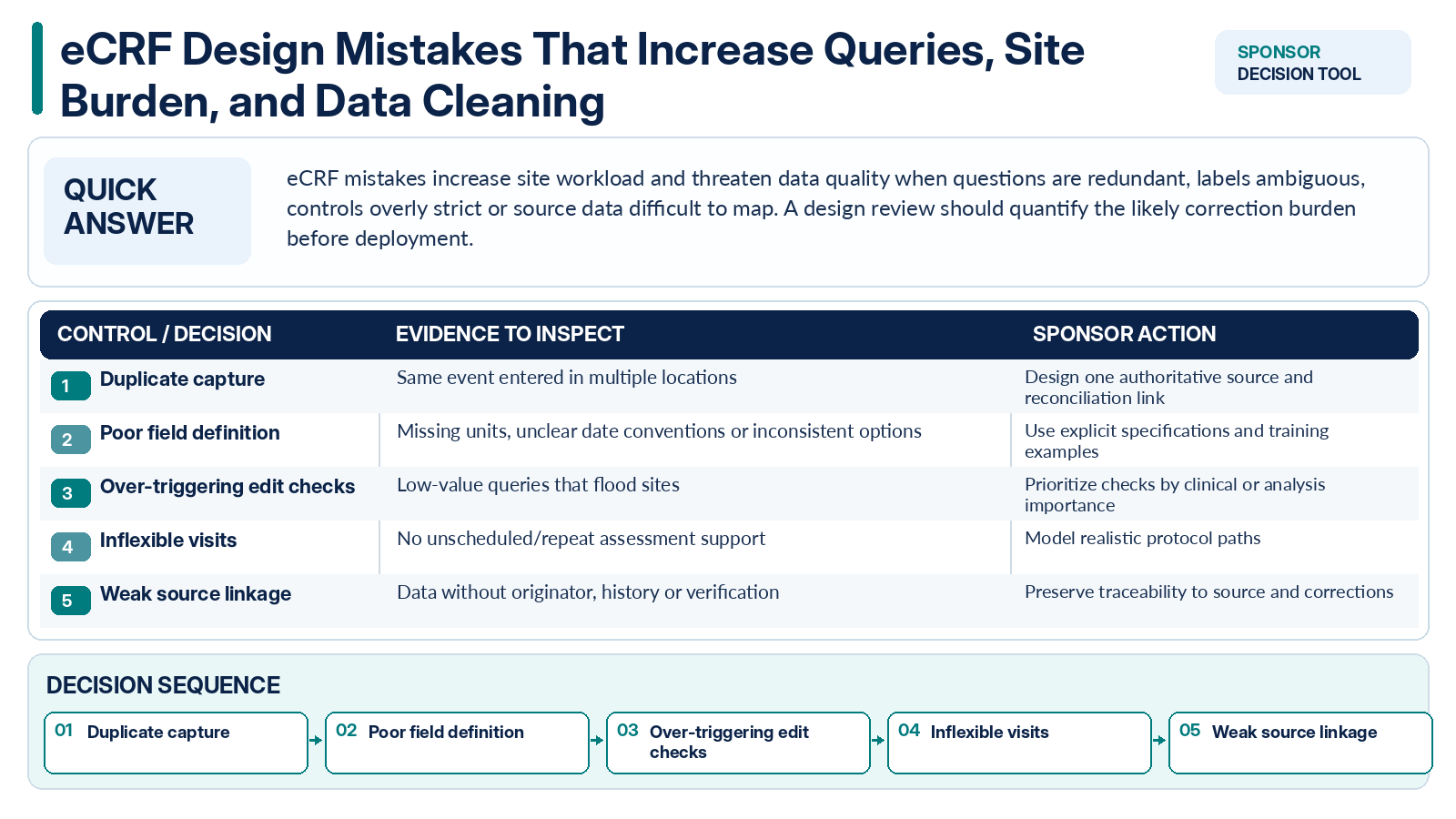
eCRF mistakes increase site workload and threaten data quality when questions are redundant, labels ambiguous, controls overly strict or source data difficult to map. A design review should quantify the likely correction burden before deployment.
How to apply this workflow in practice
Begin with the most consequential control and the evidence needed to resolve it. The following matrix connects each decision to records and an accountable action, rather than treating the list as a generic compliance checkbox.
| Control / question | Evidence to examine | Sponsor action |
|---|---|---|
| Duplicate capture | Same event entered in multiple locations | Design one authoritative source and reconciliation link |
| Poor field definition | Missing units, unclear date conventions or inconsistent options | Use explicit specifications and training examples |
| Over-triggering edit checks | Low-value queries that flood sites | Prioritize checks by clinical or analysis importance |
| Inflexible visits | No unscheduled/repeat assessment support | Model realistic protocol paths |
| Weak source linkage | Data without originator, history or verification | Preserve traceability to source and corrections |
For teams that need support implementing this across functions, BioBoston CRO eCRF Design and Review can help adapt the controls to the study, vendors, and decision calendar.
Working through the controls
1. Duplicate capture
Evidence: Same event entered in multiple locations. Decision: Design one authoritative source and reconciliation link. Record the responsible function and the approved source version, and keep any remaining exceptions visible to the sponsor before this item is closed.
2. Poor field definition
Evidence: Missing units, unclear date conventions or inconsistent options. Decision: Use explicit specifications and training examples. Record the responsible function and the approved source version, and keep any remaining exceptions visible to the sponsor before this item is closed.
3. Over-triggering edit checks
Evidence: Low-value queries that flood sites. Decision: Prioritize checks by clinical or analysis importance. Record the responsible function and the approved source version, and keep any remaining exceptions visible to the sponsor before this item is closed.
4. Inflexible visits
Evidence: No unscheduled/repeat assessment support. Decision: Model realistic protocol paths. Record the responsible function and the approved source version, and keep any remaining exceptions visible to the sponsor before this item is closed.
5. Weak source linkage
Evidence: Data without originator, history or verification. Decision: Preserve traceability to source and corrections. Record the responsible function and the approved source version, and keep any remaining exceptions visible to the sponsor before this item is closed.
Red flags that should change the plan
- Field labels copied from protocol prose.
- Missing reason codes are not collected.
- Critical edit-check alarms buried in low-value noise.
Decision gate and governance
Review query burden and error patterns in UAT; remove controls that add workload without reducing meaningful risk. The control owner should record the decision, evidence version, date, residual uncertainty and next re-review trigger. Where delegated providers perform the work, the sponsor should retain the relevant oversight and acceptance evidence.
Regulatory note: Determine which electronic records and signatures are regulated before applying 21 CFR Part 11 controls; FDA guidance supports risk- and intended-use-based implementation.
Need practical support?
Use BioBoston CRO eCRF Design and Review to review the evidence, define decision rights, and build a study-specific action plan for the next milestone.