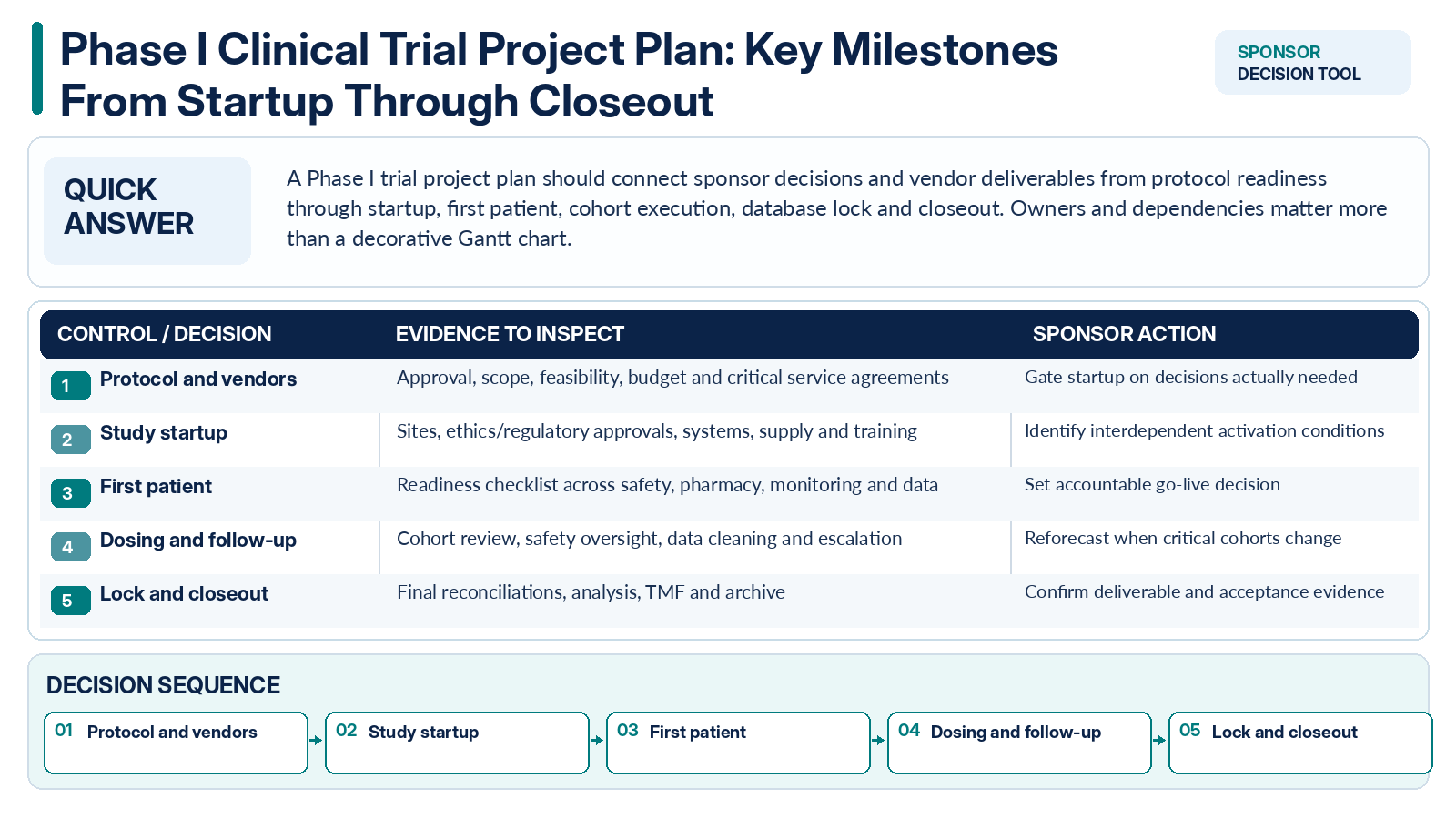
A Phase I trial project plan should connect sponsor decisions and vendor deliverables from protocol readiness through startup, first patient, cohort execution, database lock and closeout. Owners and dependencies matter more than a decorative Gantt chart.
Sponsor timeline and decision checkpoints
Begin with the most consequential control and the evidence needed to resolve it. The following matrix connects each decision to records and an accountable action, rather than treating the list as a generic compliance checkbox.
| Control / question | Evidence to examine | Sponsor action |
|---|---|---|
| Protocol and vendors | Approval, scope, feasibility, budget and critical service agreements | Gate startup on decisions actually needed |
| Study startup | Sites, ethics/regulatory approvals, systems, supply and training | Identify interdependent activation conditions |
| First patient | Readiness checklist across safety, pharmacy, monitoring and data | Set accountable go-live decision |
| Dosing and follow-up | Cohort review, safety oversight, data cleaning and escalation | Reforecast when critical cohorts change |
| Lock and closeout | Final reconciliations, analysis, TMF and archive | Confirm deliverable and acceptance evidence |
For teams that need support implementing this across functions, BioBoston CRO Clinical Project Management can help adapt the controls to the study, vendors, and decision calendar.
Working through the controls
1. Protocol and vendors
Evidence: Approval, scope, feasibility, budget and critical service agreements. Decision: Gate startup on decisions actually needed. Record the responsible function and the approved source version, and keep any remaining exceptions visible to the sponsor before this item is closed.
2. Study startup
Evidence: Sites, ethics/regulatory approvals, systems, supply and training. Decision: Identify interdependent activation conditions. Record the responsible function and the approved source version, and keep any remaining exceptions visible to the sponsor before this item is closed.
3. First patient
Evidence: Readiness checklist across safety, pharmacy, monitoring and data. Decision: Set accountable go-live decision. Record the responsible function and the approved source version, and keep any remaining exceptions visible to the sponsor before this item is closed.
4. Dosing and follow-up
Evidence: Cohort review, safety oversight, data cleaning and escalation. Decision: Reforecast when critical cohorts change. Record the responsible function and the approved source version, and keep any remaining exceptions visible to the sponsor before this item is closed.
5. Lock and closeout
Evidence: Final reconciliations, analysis, TMF and archive. Decision: Confirm deliverable and acceptance evidence. Record the responsible function and the approved source version, and keep any remaining exceptions visible to the sponsor before this item is closed.
Red flags that should change the plan
- Planning by dates without resource constraints.
- Treating FPI as a marketing milestone.
- Critical lab/vendor lead time unowned.
Decision gate and governance
Maintain an integrated dependency register and hold a decision gate before each irreversible patient-facing milestone. The control owner should record the decision, evidence version, date, residual uncertainty and next re-review trigger. Where delegated providers perform the work, the sponsor should retain the relevant oversight and acceptance evidence.
Scope note: The planning and budget fields above are sponsor-side operating recommendations. They are not FDA-prescribed schedules, prices, or numeric thresholds.
Need practical support?
Use BioBoston CRO Clinical Project Management to review the evidence, define decision rights, and build a study-specific action plan for the next milestone.