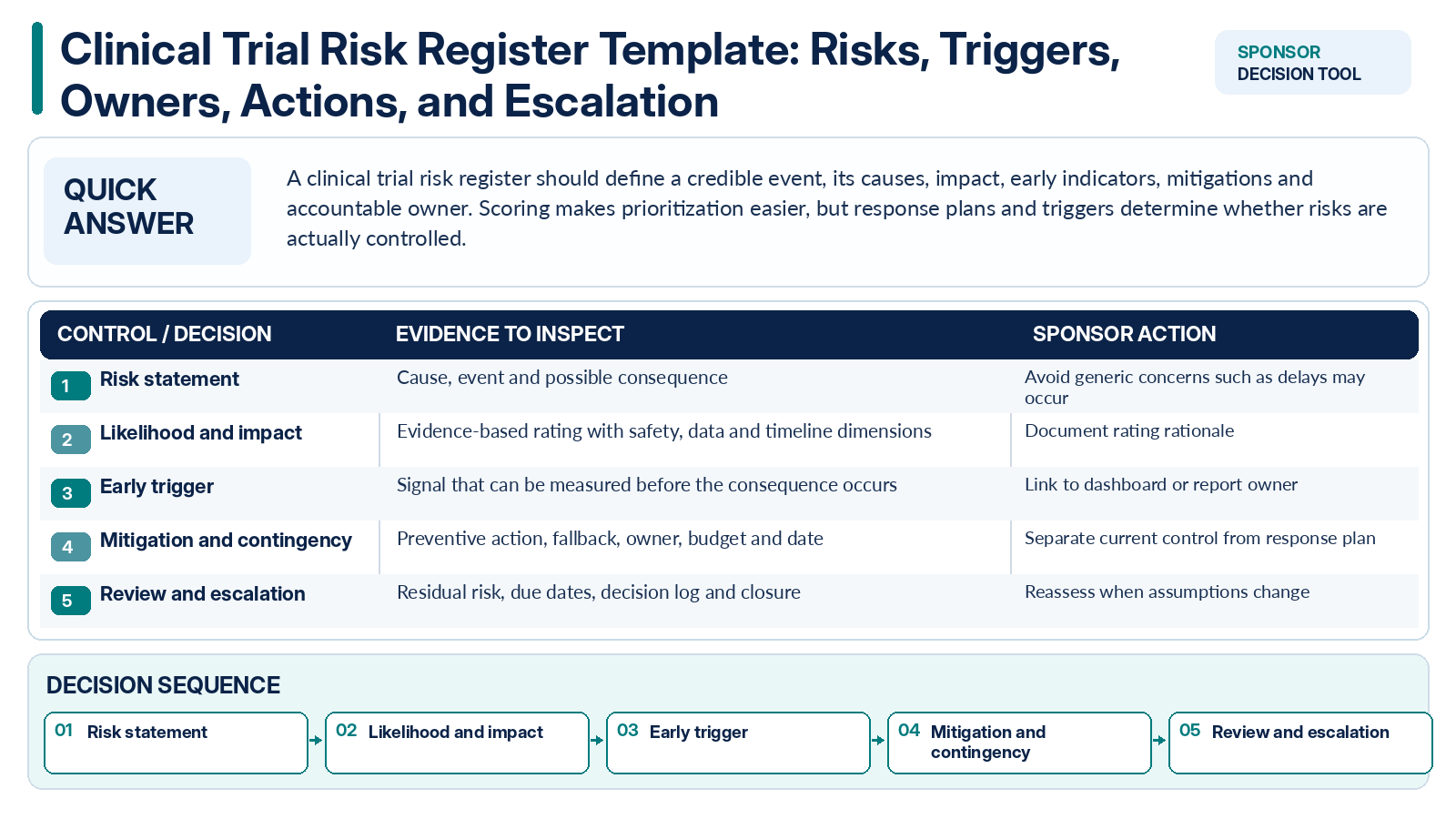
A clinical trial risk register should define a credible event, its causes, impact, early indicators, mitigations and accountable owner. Scoring makes prioritization easier, but response plans and triggers determine whether risks are actually controlled.
Reusable decision and evidence template
Begin with the most consequential control and the evidence needed to resolve it. The following matrix connects each decision to records and an accountable action, rather than treating the list as a generic compliance checkbox.
| Control / question | Evidence to examine | Sponsor action |
|---|---|---|
| Risk statement | Cause, event and possible consequence | Avoid generic concerns such as delays may occur |
| Likelihood and impact | Evidence-based rating with safety, data and timeline dimensions | Document rating rationale |
| Early trigger | Signal that can be measured before the consequence occurs | Link to dashboard or report owner |
| Mitigation and contingency | Preventive action, fallback, owner, budget and date | Separate current control from response plan |
| Review and escalation | Residual risk, due dates, decision log and closure | Reassess when assumptions change |
For teams that need support implementing this across functions, BioBoston CRO Clinical Project Management can help adapt the controls to the study, vendors, and decision calendar.
Working through the controls
1. Risk statement
Evidence: Cause, event and possible consequence. Decision: Avoid generic concerns such as delays may occur. Record the responsible function and the approved source version, and keep any remaining exceptions visible to the sponsor before this item is closed.
2. Likelihood and impact
Evidence: Evidence-based rating with safety, data and timeline dimensions. Decision: Document rating rationale. Record the responsible function and the approved source version, and keep any remaining exceptions visible to the sponsor before this item is closed.
3. Early trigger
Evidence: Signal that can be measured before the consequence occurs. Decision: Link to dashboard or report owner. Record the responsible function and the approved source version, and keep any remaining exceptions visible to the sponsor before this item is closed.
4. Mitigation and contingency
Evidence: Preventive action, fallback, owner, budget and date. Decision: Separate current control from response plan. Record the responsible function and the approved source version, and keep any remaining exceptions visible to the sponsor before this item is closed.
5. Review and escalation
Evidence: Residual risk, due dates, decision log and closure. Decision: Reassess when assumptions change. Record the responsible function and the approved source version, and keep any remaining exceptions visible to the sponsor before this item is closed.
Red flags that should change the plan
- Risk register never updated after kickoff.
- Probability score treated as objective truth.
- No contingency for catastrophic low-probability events.
Decision gate and governance
At every project review ask which trigger changed, which mitigation failed and what decision the sponsor must make now. The control owner should record the decision, evidence version, date, residual uncertainty and next re-review trigger. Where delegated providers perform the work, the sponsor should retain the relevant oversight and acceptance evidence.
Scope note: The planning and budget fields above are sponsor-side operating recommendations. They are not FDA-prescribed schedules, prices, or numeric thresholds.
Need practical support?
Use BioBoston CRO Clinical Project Management to review the evidence, define decision rights, and build a study-specific action plan for the next milestone.