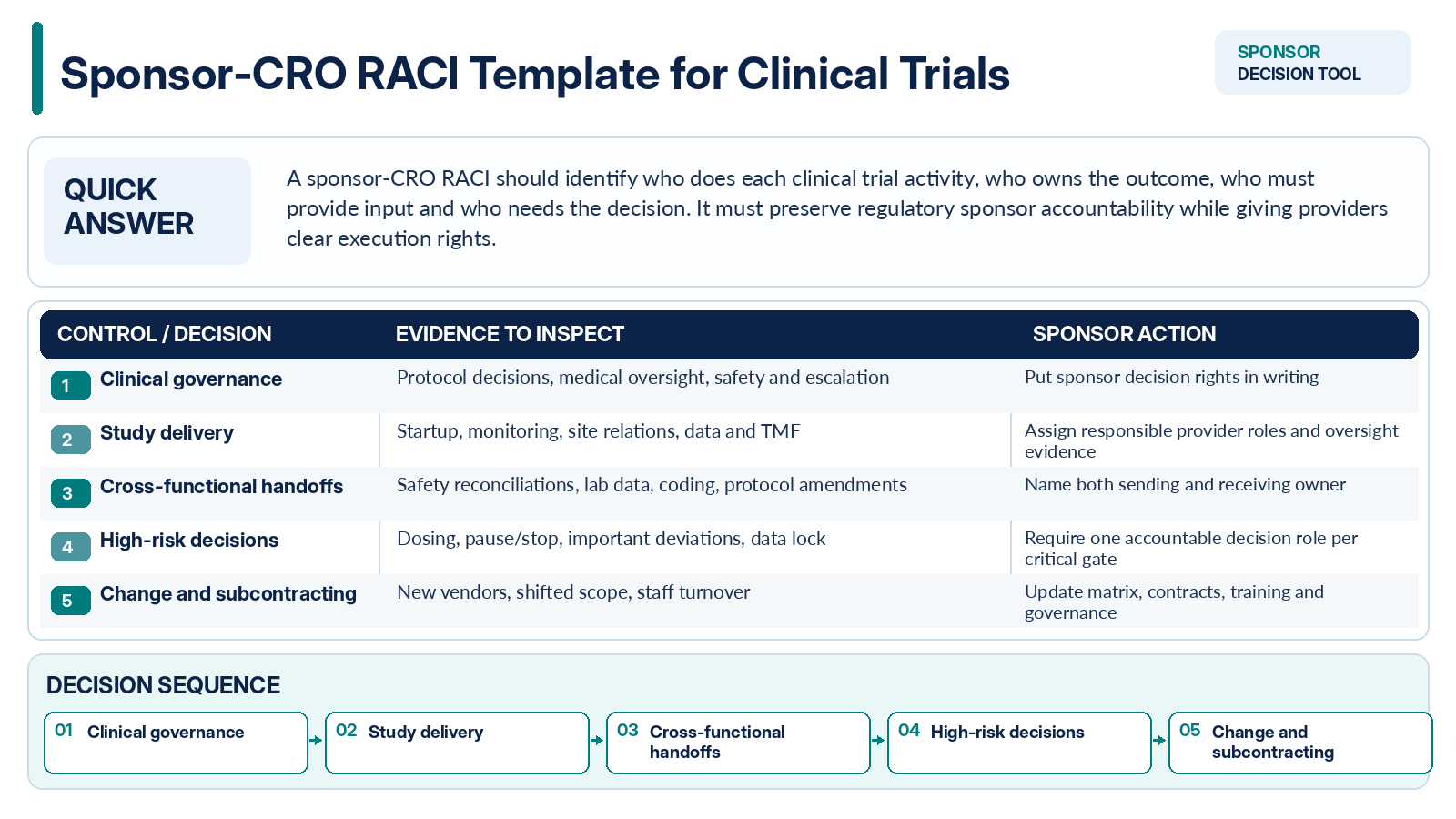
A sponsor-CRO RACI should identify who does each clinical trial activity, who owns the outcome, who must provide input and who needs the decision. It must preserve regulatory sponsor accountability while giving providers clear execution rights.
Reusable decision and evidence template
Begin with the most consequential control and the evidence needed to resolve it. The following matrix connects each decision to records and an accountable action, rather than treating the list as a generic compliance checkbox.
| Control / question | Evidence to examine | Sponsor action |
|---|---|---|
| Clinical governance | Protocol decisions, medical oversight, safety and escalation | Put sponsor decision rights in writing |
| Study delivery | Startup, monitoring, site relations, data and TMF | Assign responsible provider roles and oversight evidence |
| Cross-functional handoffs | Safety reconciliations, lab data, coding, protocol amendments | Name both sending and receiving owner |
| High-risk decisions | Dosing, pause/stop, important deviations, data lock | Require one accountable decision role per critical gate |
| Change and subcontracting | New vendors, shifted scope, staff turnover | Update matrix, contracts, training and governance |
For teams that need support implementing this across functions, BioBoston CRO Responsibility Matrix can help adapt the controls to the study, vendors, and decision calendar.
Working through the controls
1. Clinical governance
Evidence: Protocol decisions, medical oversight, safety and escalation. Decision: Put sponsor decision rights in writing. Record the responsible function and the approved source version, and keep any remaining exceptions visible to the sponsor before this item is closed.
2. Study delivery
Evidence: Startup, monitoring, site relations, data and TMF. Decision: Assign responsible provider roles and oversight evidence. Record the responsible function and the approved source version, and keep any remaining exceptions visible to the sponsor before this item is closed.
3. Cross-functional handoffs
Evidence: Safety reconciliations, lab data, coding, protocol amendments. Decision: Name both sending and receiving owner. Record the responsible function and the approved source version, and keep any remaining exceptions visible to the sponsor before this item is closed.
4. High-risk decisions
Evidence: Dosing, pause/stop, important deviations, data lock. Decision: Require one accountable decision role per critical gate. Record the responsible function and the approved source version, and keep any remaining exceptions visible to the sponsor before this item is closed.
5. Change and subcontracting
Evidence: New vendors, shifted scope, staff turnover. Decision: Update matrix, contracts, training and governance. Record the responsible function and the approved source version, and keep any remaining exceptions visible to the sponsor before this item is closed.
Red flags that should change the plan
- All functions marked accountable.
- RACI diverges from transfer-of-obligations schedule.
- Sponsor only informed after critical vendor decision.
Decision gate and governance
Walk through a major protocol deviation and a delayed safety report to test whether the RACI identifies the real decision route. The control owner should record the decision, evidence version, date, residual uncertainty and next re-review trigger. Where delegated providers perform the work, the sponsor should retain the relevant oversight and acceptance evidence.
Scope note: The planning and budget fields above are sponsor-side operating recommendations. They are not FDA-prescribed schedules, prices, or numeric thresholds.
Need practical support?
Use BioBoston CRO Responsibility Matrix to review the evidence, define decision rights, and build a study-specific action plan for the next milestone.