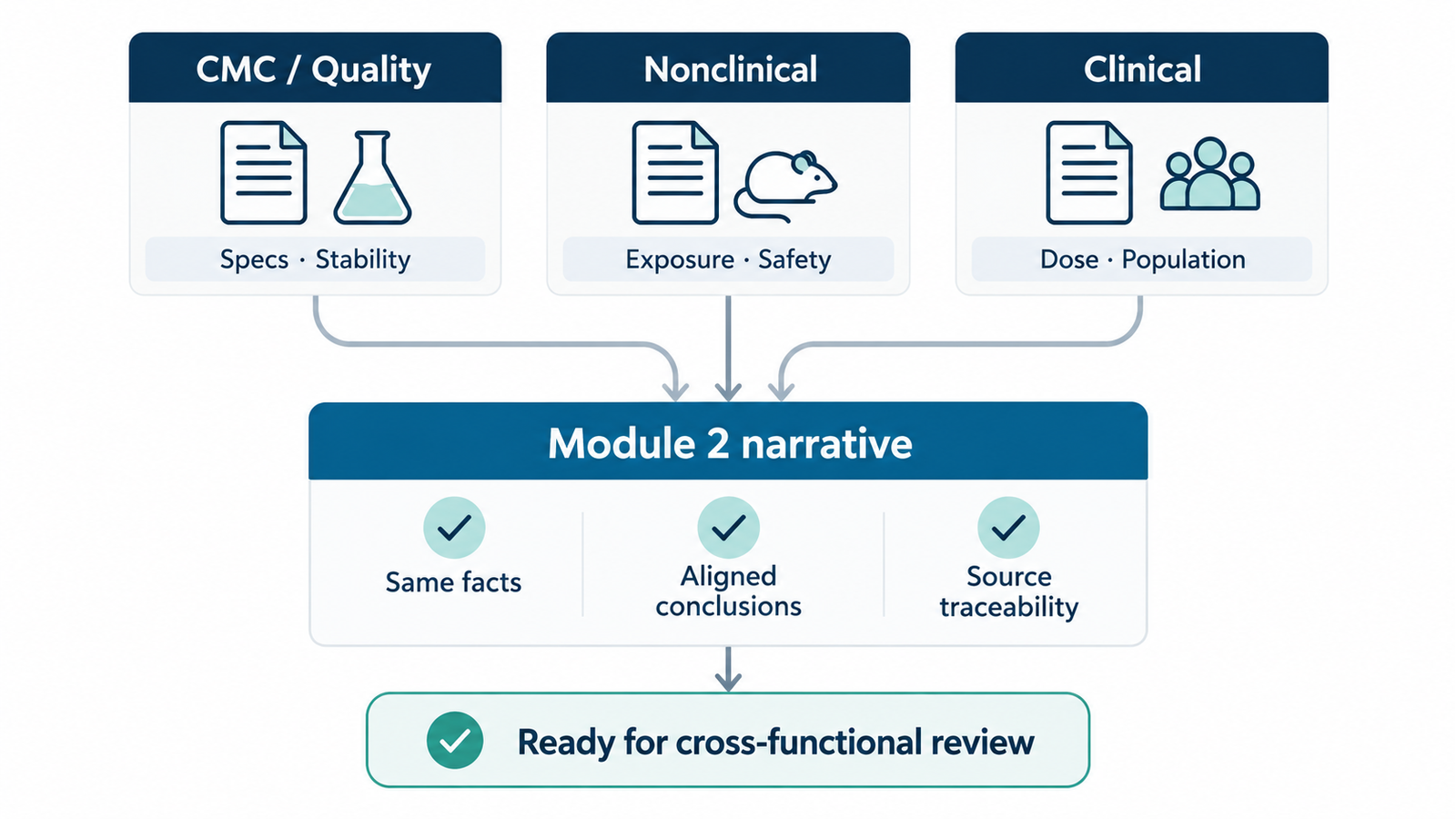
IND Module 2 writing succeeds when a sponsor can trace each major claim in its regulatory narrative to a current, approved source and show that the quality, nonclinical, and clinical teams are describing the same investigational product, exposure, and development plan. The writing task is not simply shortening reports. It is reconciling scientific conclusions, uncertainty, versions, and decisions before they appear in the submission.
This guide is for Regulatory Affairs leaders, medical writers, CMC and nonclinical leads, and clinical development teams preparing an IND or planning a later CTD-based application. It introduces a source-to-summary concordance matrix that can be used before drafting and again before publishing.
First, understand what Module 2 actually contains
The ICH Common Technical Document (CTD) organizes a drug application into five modules. Module 1 is region-specific; Modules 2 through 5 follow a common organization. Module 2 provides high-level summaries and critical interpretation supported by detailed quality, nonclinical, and clinical information elsewhere in the application. ICH M4Q, M4S, and M4E describe the quality, safety, and efficacy summary structures.
| Module 2 area | Writing question | Primary source partners |
|---|---|---|
| 2.3 Quality Overall Summary | What is the product, how is it controlled, and what quality uncertainties matter? | CMC / quality leads; Module 3 information |
| 2.4 Nonclinical Overview | What do the pharmacology, exposure, and toxicology data support or leave unresolved? | Nonclinical lead; Module 4 reports |
| 2.5 Clinical Overview | How does available clinical experience and the planned program relate to benefit and risk? | Clinical development, safety, statistics; Module 5 or current program documents |
| 2.6 Nonclinical Written and Tabulated Summaries | Are study findings consistently described and appropriately qualified? | Nonclinical pharmacology, PK and toxicology owners |
| 2.7 Clinical Summary | Are clinical results, exposure, and safety consistently summarized where applicable? | Clinical, safety, biostatistics and clinical writing teams |
Important scope distinction: An initial IND is not the same as a marketing application. The applicable IND content requirements are addressed in 21 CFR 312.23, and the precise CTD/eCTD content and level of detail should be determined for the product, phase, and submission type. Do not assume every initial IND needs a fully mature marketing-application Module 2 package. Confirm the dossier plan with the responsible regulatory lead.
The six facts that must agree across disciplines
A practical cross-functional review starts with six shared anchors, not with page-by-page proofreading:
- Product identity. Name, modality, formulation, strength, manufacturing state, and referenced version must mean the same thing in every overview.
- Route and regimen. Dose units, route, schedule, treatment duration, escalation concept, and rationale must align across CMC, toxicology, and protocol material.
- Exposure context. State whether a reported figure is nominal dose, concentration, systemic exposure, or another measure; do not treat them as interchangeable.
- Population and indication. Intended participants, disease stage, key exclusions, and special risk groups must match the current protocol strategy.
- Safety evidence and limits. Distinguish observed findings from interpretations, unresolved questions, and planned risk controls.
- Data cutoff and document version. Every conclusion must identify which source version and available-data window support it.
Copyable source-to-summary concordance matrix
Use one row per decision-critical claim. A shared spreadsheet is usually more useful than independent reviewer comments on multiple Word files.
| Field | Required entry | Example of a failure signal |
|---|---|---|
| Claim ID | Stable identifier for one cross-document statement | Same claim has two untracked versions |
| Proposed claim | Exact statement intended for the summary | Claim is stronger than the underlying evidence |
| Source and location | Controlled file, version, page/table, data cutoff | Citation refers to a superseded report |
| CMC / nonclinical / clinical impact | Which narratives must reproduce or qualify the claim | One function is unaware of a change |
| Scientific owner | Person accountable for source correctness | No named owner can confirm the figure |
| Regulatory writer | Person consolidating the approved narrative | Writers independently interpret raw source data |
| Resolution and approved wording | Decision, qualifier, or open issue with date | Comment closed without documented rationale |
| Final verification | Reviewer and check against publication version | Publisher used a prior PDF or sequence |
Start with the small number of claims that can change the risk narrative or planned trial conduct. Expand the matrix only where the added traceability serves a decision.
A six-gate writing and review workflow
Gate 1: Confirm the dossier map
Regulatory Operations and the regulatory lead agree the submission type, required sections, file structure, source inventory, and current electronic specifications. A document request list should distinguish approved source material from anticipated or draft evidence.
Gate 2: Freeze the common fact sheet
CMC, nonclinical, and clinical owners approve shared product, dose, indication, and data-cutoff definitions. Record unresolved assumptions as explicit issues rather than hiding them in provisional prose.
Gate 3: Draft in parallel, reconcile together
Writers may work in parallel, but each uses the common fact sheet. Cross-functional reconciliation should occur while changes are inexpensive, before three summaries become independently polished.
Gate 4: Challenge claims against source evidence
Ask for the report/table behind each high-consequence claim. Verify units, comparators, route, dose normalizations, subject/animal populations, source versions, and appropriate qualifiers. A secondary reader should be able to reproduce the stated result from the referenced source.
Gate 5: Confirm regulatory interpretation
Have Regulatory Affairs explicitly adjudicate conclusions that connect functions: what nonclinical exposure supports the proposed regimen, whether a CMC change affects clinical assumptions, and how identified risks are reflected in protocol controls. Scientific reviewers confirm the evidence; the regulatory lead confirms the submission narrative and placement.
Gate 6: Lock, publish, and retain evidence
Control the approved files, document the approval chain, and have Regulatory Operations check the current eCTD specifications, file names, navigation, hyperlinks, granularity, and technical validation. Preserve the final traceability sheet, not just the finished PDFs.
Hypothetical example: a formulation change before an IND
Consider a sponsor that changes its intended clinical formulation after nonclinical studies were completed. This is a hypothetical coordination example, not a regulatory determination. The change can create four related questions: Is the quality description current? Does the nonclinical exposure interpretation still apply? Is the protocol regimen still accurately described? Do the summaries explain the relationship and residual uncertainty without overstating comparability?
The right response is not an automatic statement that the change is acceptable or unacceptable. The owner documents the facts, identifies the supporting assessments, obtains the relevant scientific and regulatory judgment, and updates affected narrative sections consistently. If the support is incomplete, record the gap and its decision owner.
What commonly causes a Module 2 rewrite
- The product name, formulation, or route differs between the latest protocol and the quality narrative.
- A nonclinical exposure figure is copied without specifying analyte, units, study conditions, or relevant comparator.
- An overview reaches a benefit-risk conclusion not supported by the underlying reports.
- A writer imports text from an earlier milestone without rechecking the data cutoff.
- CMC, nonclinical, and clinical comments close independently and leave conflicting language.
- The publishing team receives files before a documented scientific/regulatory freeze.
Sponsor sign-off checklist
Before approving the packet, require evidence that the dossier map is agreed; each critical claim has a current source and owner; key product and exposure facts align; exceptions are documented; the regulatory narrative has a named decision owner; and the publication package is checked against current FDA technical specifications. This is a sponsor-side control, not a substitute for product-specific regulatory review.
For related planning decisions, see BioBoston CRO Submission Planning and Regulatory Pathway support. For protocol-to-summary consistency, see Protocol Writing.
Need coordinated submission authorship?
If your sponsor is preparing source documents, Module 2 narratives, and review handoffs in parallel, explore BioBoston CRO Submission Writing support to establish a defensible source-to-summary review process before publication.