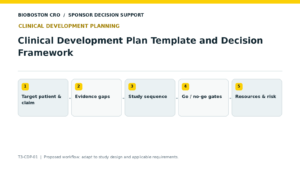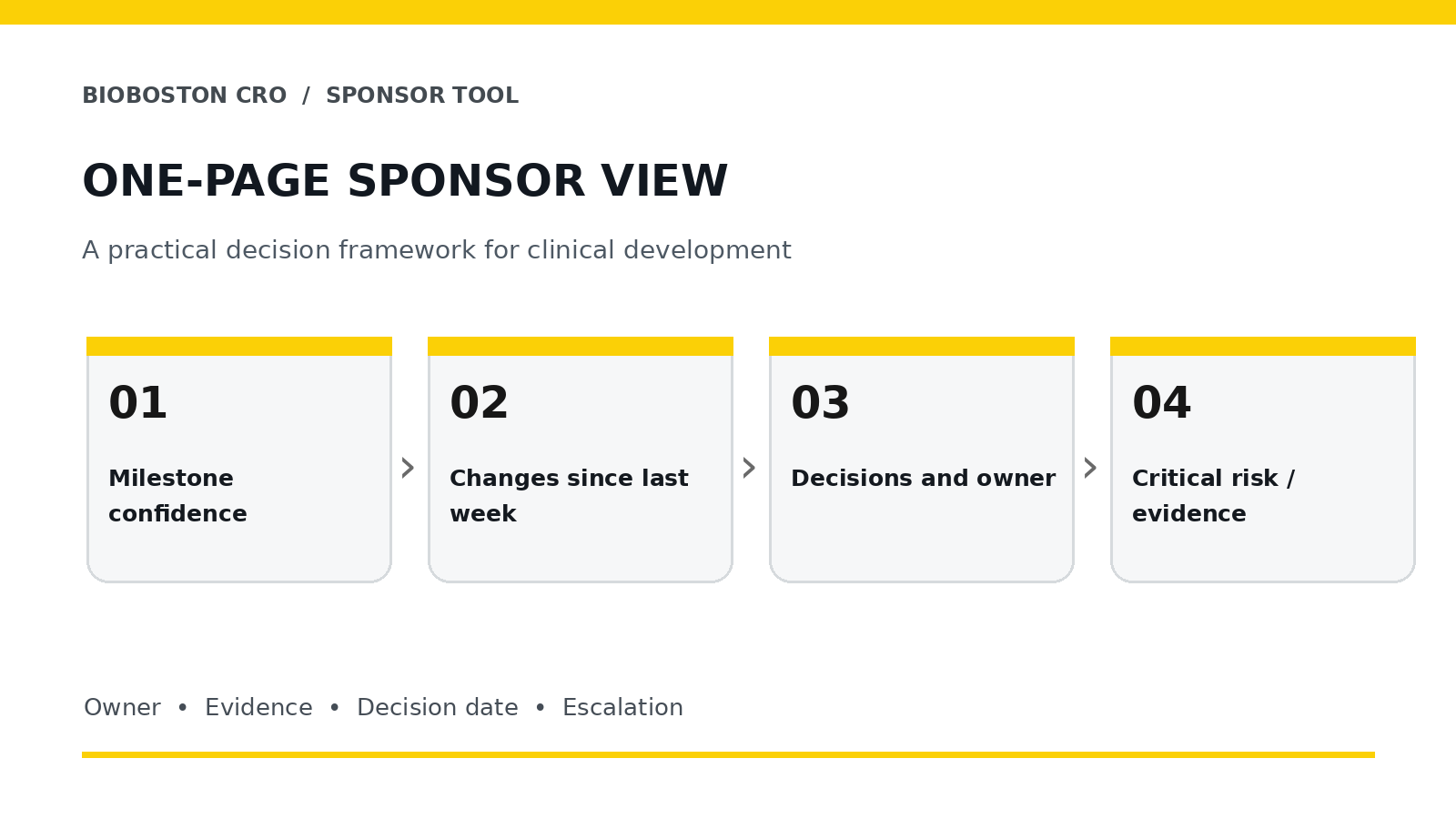
A clinical trial status report template should give sponsor leadership a weekly view of milestone confidence, critical risks, decisions required, and accountable owners. Use a one-page decision summary backed by an issue log, rather than a long collection of disconnected activity updates.
Copyable sponsor working matrix
| Workstream | Actual / forecast | Risk or evidence | Owner / decision |
|---|---|---|---|
| Sponsor decisions | Pending: approve lab agreement | Contract signature not evidenced | COO · Friday |
| Regulatory / ethics | Country/site permissions by plan | Track approval documents | Regulatory lead |
| Sites and enrollment | FPI forecast: week 8 (at risk) | SIV and activation dependencies | Clinical Ops |
| Data / EDC | UAT in progress | Open critical test cases | Data lead |
| Vendors / supply | Lab setup at risk | Lab manual and logistics sign-off | Vendor lead |
| Safety / quality | Review open findings | Escalate critical items separately | QA / Medical |
What belongs on the leadership page
Start every reporting period with the reporting week, study identifier, sponsor lead, overall confidence, planned next milestone and its evidence-based forecast. Include a concise change since last week. Use red/amber/green as a visual shorthand only; define what each rating means and always provide the actual underlying status.
Copyable weekly report template
Use the following working fields as a reusable sponsor reporting form. Keep the previous version archived so that changes to forecast dates and risk ratings are traceable.
Status rules and decision thresholds
Define Green as delivery supported by current evidence, Amber as a credible threat requiring mitigation, and Red as a material missed commitment or an immediate sponsor decision. These are suggested governance definitions, not regulatory categories. Avoid aggregating a red patient-safety or data-integrity issue into an overall green score.
Owner and evidence requirements
For each workstream, assign one accountable reporting owner, source system, last evidence date, and forecast confidence. Require the owner to distinguish committed deliverables from assumptions. An item is not complete merely because a vendor reports it at 100%; confirm objective evidence such as approval, release, activation, or reconciled documentation.
How to run a weekly sponsor review
Distribute the report before the meeting; open with changed risks and decisions; work backward from the next irreversible milestone. Document each decision with the decision-maker, due date, rationale, downstream impact, and follow-up confirmation. Archive superseded plans and record re-baselining approvals.
Illustrative use case—hypothetical
Imagine an early-phase study with first patient in planned for week 8. A central-laboratory agreement remains unsigned, the EDC test script is incomplete, and a site initiation visit is planned. A credible report flags the unresolved contract as Amber, records the dependency on lab manual sign-off, identifies the executive decision date, and does not claim a viable FPI forecast until dependencies close.
What the template does not replace
The report supplements, rather than replaces, the study risk register, approved project plan, safety escalation procedures, protocol deviation management, vendor agreements, and essential-record repository. Escalate urgent participant-safety and critical-quality events through their applicable processes without waiting for the weekly meeting.
Field-by-field completion instructions
Study identifier and reporting cut-off should match the controlled project plan. The summary owner should reconcile inputs from clinical operations, regulatory, data management, vendors and QA before distributing an executive view. Each owner must link the decision or risk to an underlying record: an approved plan, signed contract, data-system release, site activation evidence or controlled correspondence.
A decision-first meeting agenda
Open with participant safety or critical data-integrity issues requiring immediate handling through dedicated pathways. Next review decisions due within seven days, milestones with changed forecasts, and unresolved predecessor tasks. Discuss routine green items by exception. Close by reading back owners, dates, decisions and the person who will verify completion.
Separate issue, risk and decision records
An issue has occurred; a risk is uncertain; a decision needs authorized action. A delayed ethics approval is an issue; possibility of further site delay is a risk; authorization to resequence sites is a decision. Use separate IDs and cross-references to prevent the weekly report from burying accountability.
Sponsor reporting quality control
Before issue, test whether every red or amber flag has a clear owner, dated evidence, impact, action and escalation. Check that totals agree with the current source systems and that forecast change is explained. Identify stale data explicitly. Store each signed-off snapshot with its cut-off date and do not retroactively rewrite a distributed report.
Copy-and-use decision log fields
Decision ID | sponsor decision needed | options and consequences | recommendation | accountable decision maker | decision due | approval date | evidence location | next verification. If authority or budget is uncertain, state the approval route; do not present recommendation as consent to spend.
Reporting limitations and escalation
A weekly summary is not a substitute for adverse-event reporting, deviation escalation, protocol change control, or the risk-management process. Study teams must invoke appropriate immediate safety and quality procedures when triggered. Sponsor oversight should be tailored to critical-to-quality factors, as described in FDA’s nonbinding ICH E6(R3) guidance.
Apply to your program
For sponsor support with milestones, evidence and decision ownership, explore BioBoston CRO Clinical Project Management.