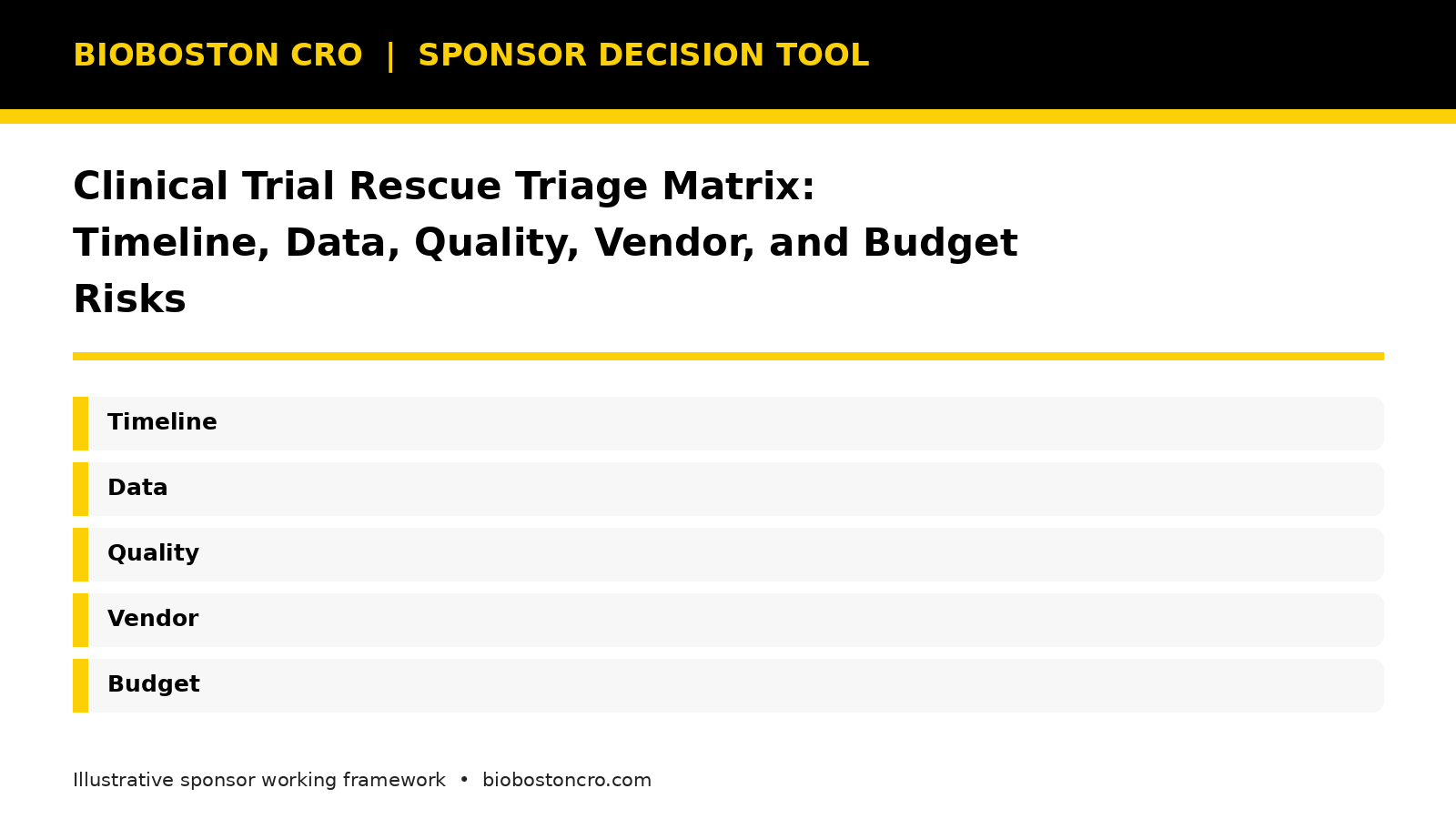
Clinical Trial Rescue Triage Matrix: Timeline, Data, Quality, Vendor, and Budget Risks helps clinical development sponsors turn an unstable operating situation into a controlled sequence of evidence, accountability, and explicit decisions. The purpose is to assess what is known, identify what remains uncertain, and choose actions that protect participants and data while making the project executable.
Why sponsors need a decision tool
Clinical Trial Rescue Triage Matrix: Timeline, Data, Quality, Vendor, and Budget Risks helps clinical development sponsors turn an unstable operating situation into a controlled sequence of evidence, accountability, and explicit decisions. The purpose is to assess what is known, identify what remains uncertain, and choose actions that protect participants and data while making the project executable. Use the triage matrix to distinguish urgent safety and data-integrity concerns from scheduling and commercial concerns. A sponsor should never average a critical quality red flag into a reassuring overall score.
Who should use it
This framework is intended for sponsor clinical operations leaders, quality and regulatory staff, vendor owners, and executives responsible for outsourced development. It is a working governance aid rather than a substitute for a protocol, contract, safety procedure, CAPA system, or legal assessment.
Start with containment and verifiable facts
Classify any immediate participant-safety, critical-quality, or serious data-integrity concern first and apply existing urgent escalation procedures. Then establish a reporting cut-off, freeze a dated current-state snapshot, and identify the authoritative source for each unresolved issue. Separate an issue that has occurred from a future risk and from a decision requiring authority.
Use the working framework
Copy the matrix below into a controlled sponsor document or project workspace. For every row record status (green/amber/red), source evidence and date, a single accountable owner, dependency, next action, decision-maker, and the next review date. Status colors are suggested internal conventions, not regulatory classifications.
| Workstream / criterion | Trigger or question | Evidence to check | Accountable owner | Next action / decision |
|---|---|---|---|---|
| Timeline | Critical path date missed or next milestone lacks verified predecessor | Baseline schedule, actual completion evidence, contract handoffs, critical-path network | Sponsor PM | Identify the missing predecessor and decide whether sequencing or re-baselining is needed |
| Data | Unresolved critical EDC issues or delayed reconciliation | Data review listings, query aging, transfer/reconciliation logs, validation evidence | Data lead | Assess critical-to-quality impact; protect release and cleaning gates |
| Quality | Serious deviation or repeated corrective actions fail | Deviation records, CAPA effectiveness, audit findings, safety issue reports | Quality lead | Use immediate escalation processes as appropriate; separate containment from root-cause work |
| Vendor | Missed deliverables or unverifiable percentage complete | Statement of work, service levels, meeting decisions, deliverable acceptance | Vendor owner | Document contractual notice and remediation options |
| Budget | Committed work no longer matches approved funds | Burn report, forecast-to-complete, change orders, funding authority | Finance lead | Escalate before authorizing spending outside approvals |
Field-by-field instructions
Define the trigger in observable terms; cite its source document, not a recollection from a meeting. Record severity and participant/data implications separately from schedule or budget impact. Distinguish responsible task owner from authorized approver. State the decision deadline as the last date action can be taken without affecting an irreversible milestone.
How to interpret confidence and urgency
Green requires recent, corroborated evidence that an action is complete or a milestone remains plausible. Amber means a specific dependency could jeopardize the commitment; it needs a named mitigation and decision date. Red indicates an actual critical failure or a material miss requiring sponsor action. Do not downgrade a patient-safety concern simply because the broader timeline appears healthy.
Review cadence and governance
Use more frequent operational reviews while instability persists; tailor frequency to actual risks. Keep decisions in a dated log with options, approving authority, rationale, implementation owner, and effectiveness check. Escalate to a different decision route when contracts, budget, protocol changes, data systems, quality or patient safety exceed the current forum’s authority.
A worked example, not a client case
Hypothetical trial: site activation is delayed two weeks, data reconciliation has unresolved critical fields, and the CRO asks for a change order. The sponsor rates timeline and data separately, opens a documented decision log, requests evidence, and withholds any spending approval until the correct authority reviews the options.
Failure modes to avoid
Do not accept percentage-complete statements without deliverable evidence. Avoid assigning multiple people as jointly accountable without one clear decision owner. Do not silently revise baselines, treat an unsigned change order as authorized work, replace a vendor before defining continuity controls, or defer urgent quality escalations until a routine meeting.
Practical next-action checklist
Confirm: (1) current-state evidence is dated; (2) critical risks are separated; (3) open decisions have names and deadlines; (4) mitigations address root causes rather than optics; (5) the receiving team and budget authority can execute; (6) verification criteria are agreed; and (7) the updated plan is communicated to dependent teams.
Regulatory perspective
ICH E6(R3) discusses proportionate, risk-based quality management and service-provider oversight. FDA guidance is nonbinding; actual sponsor, investigator, human-subject protection, and other responsibilities depend on the study and applicable law, such as relevant provisions of 21 CFR Part 312. Use current approved procedures and expert regulatory review for program-specific decisions.
When to seek outside support
Seek independent cross-functional help when source information conflicts, governance has stalled, quality concerns affect participant protection or reliable results, the vendor cannot provide a credible action plan, or transition decisions would create significant operational risk. External support should provide facts and options, not displace sponsor decision authority.
Sponsor oversight evidence package
Maintain a one-page executive summary, source-system extracts, an issue and decision log, a record of dated forecast changes, vendor deliverable acceptance criteria, and a current responsibility matrix. Keep a link to the authoritative document rather than copying uncontrolled versions into emails. When a finding changes priority, record what evidence changed and who approved the new action. This package allows a newly appointed sponsor executive or independent reviewer to reconstruct the decision history without depending on verbal recollection.
An operational 30-minute review agenda
Minute 0–5: confirm immediate safety and data-integrity issues have reached their proper escalation routes. Minute 5–10: review new material facts and changed confidence. Minute 10–20: decide action on the top critical-path or contractual dependencies. Minute 20–25: review forecast, resourcing and budget authority. Minute 25–30: read back approved decisions, their accountable owners, expected evidence and next checkpoint. Meeting times are illustrative; select a cadence appropriate to risk.
What to measure after action
Choose a small number of objective leading indicators. Examples include overdue critical actions, age of unresolved issues, percentage of high-risk vendor deliverables with accepted evidence, days of unapproved forecast variance, data-transfer reconciliation exceptions, and completion of effectiveness checks. Define numerator, denominator, evidence source, owner and threshold. A trend without a stable definition can appear reassuring while the underlying work deteriorates.
Document control and update triggers
Archive prior versions with a reporting date. Update the framework when the protocol, vendor scope, project baseline, risk profile, ownership, approval status, or critical system changes. Validate the revision through the sponsor authority required by its procedures. Keep factual sponsor documentation separate from hypothetical illustrations or advisory examples, and never represent a draft risk decision as an approved action.
For coordinated sponsor oversight and execution, explore BioBoston CRO Trial Rescue Management.