A Phase I to Phase II transition succeeds when the sponsor can support the next trial’s scientific questions, participant safeguards, operational scale and decision-making with verified evidence. Phase I completion alone does not establish Phase II readiness. The sponsor should confirm the available safety, pharmacokinetic, pharmacodynamic and dose-selection evidence; agree on the Phase II protocol strategy; and prove that vendors, sites, supply, data systems and governance can execute it.
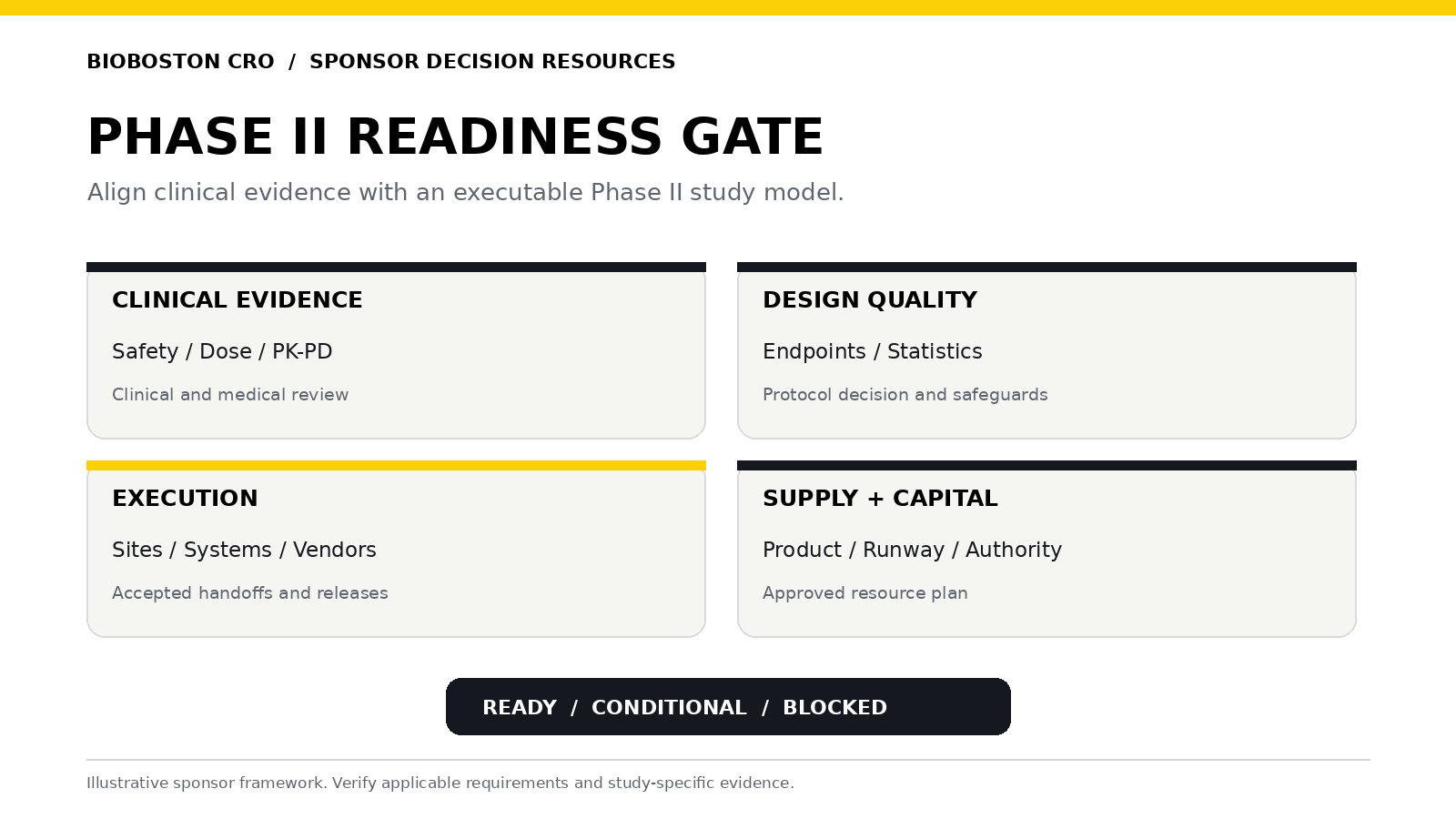
For a lean biotechnology company, this is a decision gate rather than a ceremonial handover. It may occur while Phase I follow-up and data cleaning continue. A structured readiness review identifies what is known, which uncertainties are acceptable with safeguards, what must be resolved before a new study begins, and which work can run in parallel.
Define the Phase II decision the sponsor needs to make
The governing question is not “Are we finished with Phase I?” but “What evidence justifies the next study design and what operating conditions must exist to conduct it responsibly?” Set out the intended Phase II population, endpoints, dose regimen, treatment duration, safety assessments, geographic and site footprint, and expected decision from its results. Each choice should trace to the data or rationale reviewed by the appropriate expert.
Distinguish scientific readiness from operational readiness. A program can have a compelling signal but lack qualified sites, product supply or data-collection plans; alternatively, a well-prepared vendor team cannot compensate for a major unresolved safety or dose-selection question. Put both dimensions on the same sponsor gate agenda, but allow medical, statistical, regulatory and quality leads to record their conclusions independently.
FDA’s September 2025 ICH E6(R3) Good Clinical Practice is nonbinding guidance advocating quality-by-design and fit-for-purpose risk-based oversight. It does not create a one-size-fits-all Phase I-to-II checklist. For an applicable US IND, 21 CFR 312.30 addresses when a new protocol or a significant change requires a protocol amendment. A new Phase II protocol not already in the IND must be submitted to FDA for review and have the responsible IRB’s approval before the study begins. Do not impose the initial IND 30-day waiting period automatically on every later new-protocol amendment.
Use an evidence-first readiness board
This sponsor board is a practical template. Score each row by the adequacy of current evidence, not the confidence of a presentation. Suggested statuses are: Ready when required evidence and acceptance have been verified; Conditional when an identified gap has a bounded, approved mitigation; and Blocked when an unresolved issue could invalidate the intended design, participant safeguards or compliant execution. These labels are sponsor governance conventions, not FDA categories.
| Gate / decision | Evidence the sponsor should inspect | Accountable reviewer | Block or escalation signal |
|---|---|---|---|
| Dose and regimen | Phase I exposure, tolerability, PK/PD and dose rationale | Medical / clinical pharmacology | Regimen unsupported by available evidence |
| Participant protection | Safety signals, monitoring plan, stopping rules, medical coverage | Safety / Medical / Quality | Unresolved material risk or weak mitigation |
| Phase II protocol | Endpoints, estimands, visits, feasibility, amendment strategy | Medical / Statistics / Regulatory | Primary question cannot be answered reliably |
| Data and analysis | Data provenance, coding, cleaning, Phase I analysis status | Data Management / Biostatistics | Critical data unreliable or untraceable |
| Sites and feasibility | Population, eligibility impact, region, enrollment assumptions | Clinical Operations | Target patient pool unsupported by evidence |
| Vendors and systems | Task allocation, qualified providers, EDC/IRT/lab handoffs | Vendor / Data / Quality | Critical handoff has no receiving owner |
| Clinical supply | Material availability, formulation, release, packaging and labeling | CMC / Supply | Supply or stability does not support plan |
| Budget and controls | Approved resources, cash runway, contracts, decision cadence | Program / Finance / Leadership | Unfunded critical work or unauthorized scope |
A review does not need every possible Phase I analysis completed to start legitimate planning. The sponsor does need to know which findings are preliminary, which are decision-grade, and what uncertainty could change the dose, safety safeguards or endpoint interpretation. Record the data cut, assumptions, reviewer and date of approval for each decision.
Connect Phase I evidence to Phase II protocol choices
Safety: Review adverse events, clinically significant laboratory or ECG findings, exposure-related effects, emerging risks and follow-up completeness as relevant to the molecule and design. Verify that planned Phase II eligibility, monitoring and stopping criteria address the identified concerns. Escalate unresolved participant-protection issues through the applicable medical and regulatory pathways; they are not ordinary project-plan defects.
Dose and regimen: Document the selected dose range, rationale, schedule and any uncertainty in pharmacology or exposure-response. Specify whether additional data or studies are needed before using a proposed regimen. Have the clinical pharmacology and medical leads evaluate any extrapolation from healthy volunteers to the intended patient population.
Endpoints and design: Check whether planned endpoints are meaningful and operationally measurable, whether visit schedules match disease characteristics, and whether the proposed statistical strategy can answer the Phase II objective. Engage biostatistics early; downstream data review cannot repair a weak estimand or impractical endpoint collection plan.
Data maturity: Separate analysis-ready datasets from open queries, ongoing follow-up and preliminary summaries. Log which decisions rely on the current data cut and what could change after reconciliation. A final Clinical Study Report may be important to the program, but the operational gate should be based on the specific evidence needed for the next study decision rather than a blanket rule that every document must be final first.
Assess the new population, sites and recruitment assumptions
Phase I site strengths may not transfer to Phase II. A healthy-volunteer unit can be operationally excellent yet lack the patient population, referral pathways, assessments or longitudinal follow-up needed for a proof-of-concept trial. Validate eligibility criteria with realistic screening histories and site input; do not build enrollment dates from a market-size slide.
Ask each prospective site to demonstrate access to participants, capacity for protocol-specific procedures, experience with the intended monitoring intensity, referral or recruitment pathways, equipment, and personnel. Where appropriate, test the impact of competing studies and exclusion criteria. Use ranges and documented assumptions for enrollment forecasts. If study execution will be partner-supported, identify the actual site and partner responsibilities transparently rather than describing them as BioBoston CRO in-house delivery.
A strong readiness decision accounts for activation duration, observed recruitment feasibility, screen failures, dropouts, geographic variation, and what would trigger corrective action. Record who can approve a protocol feasibility change versus who may merely suggest one.
Confirm clinical supply and CMC continuity
Phase II may require larger quantities, different packaging, a revised formulation, more countries or longer storage than Phase I. The supply lead should verify batch planning, release and stability assumptions, labeling requirements, randomization supplies, import arrangements where applicable, and resupply scenarios. A contract for packaging is not evidence that usable product will reach the first site in time.
Tie the supply plan to the dosing schedule and enrollment sensitivity analysis. If patients may receive a longer treatment duration, check whether existing stability data and inventory support it. When Phase I manufacturing changes have implications for the clinical product or IND content, bring Regulatory Affairs and CMC into the assessment early. Record the trigger for formal change control and any required submission.
Use the protocol to drive data-system and vendor preparation
Do not begin with the existing Phase I EDC database and assume a copy will suffice. Trace each Phase II endpoint and safety assessment into the schedule of activities, CRF specifications, external data feeds, coding plans, reconciliation needs, edit checks and statistical dataset requirements. Identify who will accept those outputs. Version-control the traceability map as the protocol changes.
Reconfirm responsibilities across the CRO, central laboratory, imaging, safety, IRT/RTSM, EDC and other providers actually used by the study. A vendor may remain qualified but need a modified scope or capability for Phase II. Cross-check SOWs, written transfers of regulatory obligations where applicable, quality agreements and data-processing responsibilities. Use one handoff owner for a critical interface, backed by a named accepting receiver.
The sponsor should be able to show when an interface is production-ready, not merely developed. That means accepted specifications, appropriate testing and release evidence, training, access and a way to reconcile mismatched records. The related Vendor Governance service can support ownership and acceptance pathways across providers.
A weighted decision board without false precision
For program governance, a sponsor may prioritize gaps by consequence, time to resolve and effect on the next irreversible milestone. Avoid pretending that an arithmetic average can wash out a serious safety or data-integrity issue. Use a non-compensatory stop rule: a material participant-protection, regulatory, or critical-data concern must be escalated on its own merits, regardless of how many other rows are green.
For other gaps, ask whether the evidence is available and accepted; whether a mitigation exists; the last responsible decision date; and the accountable approver. A conditional Phase II launch plan should name the conditions, their deadlines, and the authority to stop or re-sequence work. Place the decision in a controlled record so a change of CRO or personnel does not erase the rationale.
| Readiness state | Evidence position | Sponsor action |
|---|---|---|
| Ready | Key evidence accepted by accountable reviewers | Approve the specific transition activity |
| Conditional | Bounded gap with named mitigation and decision date | Permit only agreed planning or work, with controls |
| Blocked | Critical evidence, approval or safeguarding requirement missing | Defer affected execution; escalate immediately as appropriate |
| Reassess | New Phase I finding or material protocol change | Reopen affected decisions and downstream dependencies |
These are internal decision states, not clinical-trial authorization categories. Record the approval route and applicable regulatory requirements separately.
A hypothetical case: operational plan exceeds data maturity
Imagine a small biotech with a promising preliminary activity signal and a desire to start Phase II in the next quarter. Clinical operations has identified sites and a CRO has priced startup. However, safety follow-up remains incomplete for a relevant cohort, the regimen has not been reviewed against the available exposure data, and the final endpoint definition depends on an unfinished statistical assessment.
The sponsor should permit appropriate non-subject-facing feasibility and planning work within approved limits but mark dose selection, protocol finalization and affected execution decisions as blocked or conditional until the correct experts review the evidence. The timeline should show each decision deadline and what would be affected if a finding changes the study design. This is a fictional planning illustration, not an actual program or reported BioBoston result.
A practical readiness meeting sequence
Begin with an evidence summary from Medical, Safety and Clinical Pharmacology. Review what is final and what is preliminary; identify any risk that would change the Phase II rationale. Next, have Statistics and Data Management confirm that endpoints and analysis plans are aligned with the information needed for the proof-of-concept decision. Regulatory Affairs then maps the protocol and submission requirements, including applicable IRB approvals and any consultation needs.
Only then should Clinical Operations present executable scenarios for sites, vendors, data systems, supply and enrollment. Finance shows the committed versus prospective spend and the resources needed at each gate. Close with a sponsor leadership read-back of approved actions, blocked items, owners, evidence due dates and re-review triggers. Archive the decision with the current version of the development plan.
Eight questions for the sponsor’s final gate
Can clinical and safety reviewers defend the selected population and dose? Is the Phase II objective supported by an endpoint and statistical design that can answer it? Does the team understand which Phase I findings could still change the plan? Are required protocol, IRB and regulatory steps owned and sequenced correctly? Can sites realistically recruit and execute the visit schedule? Can vendors and systems deliver and reconcile the critical data? Is sufficient qualified product available for the planned treatment? Is the financial and decision authority for the next milestone documented?
If the response to a critical question is unknown, name the owner, evidence and date when the gate will be revisited. Phase II readiness is more useful when it is candid than when it is uniformly green.
Build a sponsor-owned Phase II transition plan
BioBoston CRO can help structure cross-functional readiness, responsibility mapping and decision controls for lean clinical development teams. Explore Clinical Project Management services to discuss a sponsor-specific operational readiness review and next-phase execution plan.
Regulatory note: 21 CFR 312.30 and relevant IRB requirements are binding where applicable; FDA’s September 2025 ICH E6(R3) is nonbinding guidance. This is a sponsor working framework rather than a universal clinical-development standard. Recommended review: senior Clinical Operations/Project Management SME with Medical, Statistics, Regulatory, QA and Supply input. Re-review on new safety signals, protocol changes, material vendor or supply changes, or guidance updates.