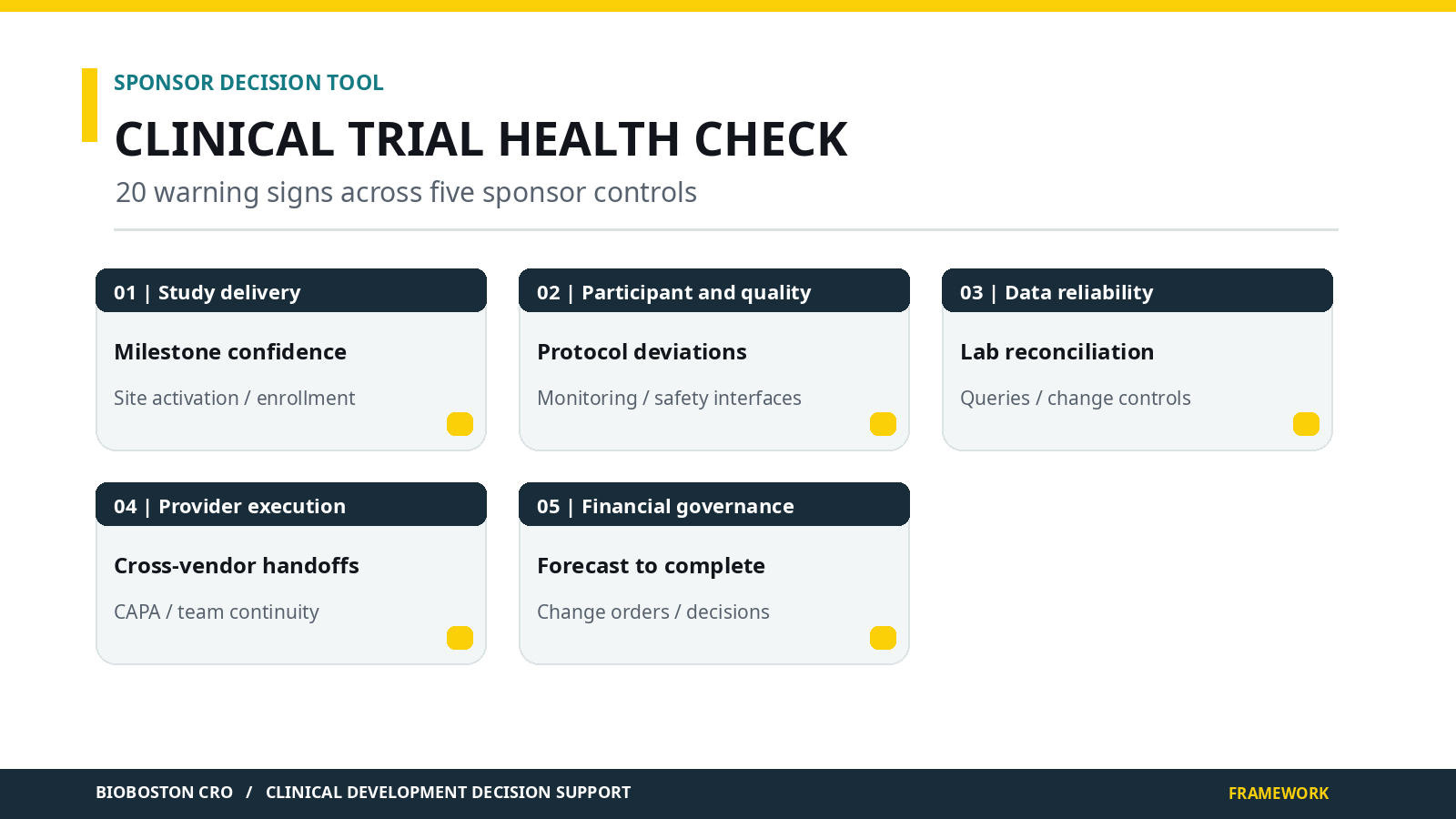
A clinical trial health check should expose weak signals before they become a missed milestone, a preventable participant risk, a data-integrity problem, or an unplanned funding request. A sponsor should not rely on one traffic-light dashboard. Compare what vendors report with dated source evidence, identify the dependency or control that is failing, and name the sponsor decision that would change the outcome.
This guide is for the CEO, COO, CMO, or Clinical Operations lead of a biotech company whose outsourced Phase I or II trial has become unpredictable. It combines 20 diagnostic warning signs with evidence requests, potential causes and escalation logic. The proposed thresholds and scoring are illustrative sponsor operating tools, not FDA-mandated KPIs. Safety, participant rights, applicable regulatory reporting and critical data must be handled through the study’s established procedures regardless of any score.
First distinguish a risk, an issue and an incident
A risk is a future uncertain event with an owner and an early trigger. An issue is a problem already affecting work. An incident may require immediate action under the protocol, safety system, quality procedures or law. An unanticipated serious safety problem should not wait for a routine health-check meeting. Likewise, an audit-trail anomaly should be routed to the appropriate Data Management and Quality owners for investigation, rather than classified only as a schedule variance.
Use a single observation date for all functions. Obtain source data for the same reporting cut and keep differences between a vendor’s self-assessment and the sponsor’s evidence visible. The health check is a triage tool: it identifies where deeper root-cause work belongs. It is not a substitute for a qualified GCP audit, medical review, statistical assessment or safety evaluation.
The 20 early-warning signs: a sponsor evidence matrix
Each signal below names the record to examine and the action to consider. Adapt indicators to study design, phase, geography, critical-to-quality factors and enrolled-patient risk. Do not automatically mark a workstream red simply because a metric moved; distinguish a changed scope, an expected variation and a genuine loss of control.
| # / Warning sign | Evidence to inspect | Likely diagnostic question and sponsor owner |
|---|---|---|
| 1. FPI, interim analysis or lock dates repeatedly move | Approved baseline, change log, dependency graph | Which predecessor is truly critical? Project Management |
| 2. Forecast dates have no confidence range | Updated milestone assumptions, historical throughput | What uncertainty has been hidden? Study Lead |
| 3. Site activation is reported as complete without proof | Site approvals, essential document and training status | What site activity is actually authorized? Clinical Operations |
| 4. Enrollment forecasts use outdated conversion rates | Screened, eligible, consented, randomized counts by site | Is the recruitment funnel credible? Clinical Operations |
| 5. Screen failures cluster without explanation | Screening logs, protocol criteria, medical assessment | Are criteria, site screening or data capture driving the trend? Medical/Clinical |
| 6. Monitoring findings recur at the same sites | Visit reports, follow-up letters, issue closure evidence | Is an underlying control failing? Monitoring Lead |
| 7. Critical protocol deviations are rising | Deviation categorization, root causes, CAPA links | Is participant protection or endpoint validity affected? QA/Medical |
| 8. Safety case handoffs are late or unclear | Case receipt/transfer records, reconciliation exceptions | Can medical and safety teams act promptly? Safety Lead |
| 9. External laboratory transfers fail reconciliation | Transfer specifications, rejected files, query log | Who owns the correction across vendors? Data Management |
| 10. Open critical queries age beyond the agreed plan | EDC query aging, site action and data review plans | Is an upcoming analysis or decision at risk? Data Management |
| 11. Database or system changes bypass impact review | Change controls, testing, release and access records | Could an unreviewed change impair critical data? Data/IT/QA |
| 12. TMF completeness appears high but quality is weak | Expected document list, dates, signatures and QC results | Are essential records usable and contemporaneous? TMF/QA |
| 13. Vendor dashboards disagree on the same milestone | Reporting extracts, contract deliverables and status logs | Which system and owner is authoritative? Sponsor PM |
| 14. Cross-vendor dependencies lack acceptance criteria | Handoff logs, data agreements, workflow maps | Who confirms receipt and fitness for use? Vendor Governance |
| 15. Repeated escalations close without effectiveness checks | Issue log, CAPA or corrective-action evidence | Did the action fix the original failure? Clinical QA |
| 16. Team turnover removes critical institutional knowledge | Staffing plan, handover records, training and access | Who holds backup ownership for critical tasks? Study Lead |
| 17. Change orders arrive after work has started | Contract assumptions, variations and approval dates | Is scope or spend being authorized retroactively? Finance/Legal |
| 18. Accruals and vendor invoices diverge from progress | Deliverable evidence, invoices, accruals and forecasts | Is the study paying for work not actually accepted? Finance |
| 19. Forecast-to-complete omits recovery activities | Integrated milestone and cost-to-complete forecast | What is the full remaining exposure? Finance/PM |
| 20. Steering meetings end without decisions or owners | Decision log, actions, unresolved items, authority map | Who can decide and by when? Executive Sponsor |
The strongest signal is often a pattern across two workstreams. For example, site activation may be late, while supply is also late and the sponsor’s enrollment model still assumes the original first-patient date. Treat the shared dependency as the problem. A single good-looking dashboard must not cancel out contrary evidence from another source.
Score urgency without hiding patient and data risk
For routine operational issues, use two sponsor-defined dimensions: impact (1 = local/noncritical; 2 = workstream; 3 = critical milestone or material financial exposure) and confidence in the evidence (1 = verified; 2 = incomplete; 3 = conflicting or missing). Multiply them for an illustrative review priority from 1 to 9. A score of 6 or higher can trigger an expedited sponsor review if that threshold is appropriate to the program. A high-quality evidence gap can matter as much as a known delay.
Apply a separate non-compensatory safety/critical-data flag. Suspected participant harm, a serious unresolved safety-reporting interface, unauthorized trial activity, or potentially compromised critical data should go directly to Medical/Safety/Quality and the relevant procedures. Do not average it into an executive score. The sponsor’s clinical and regulatory experts decide required actions and notifications; a generic dashboard does not determine legal reportability.
Conduct the health check in two working sessions
Session one: verify facts. Ask each function to provide its data source, date, owner and the latest accepted baseline. Reconcile enrollment, site activation, safety interfaces, data, vendor issues, TMF, milestones and costs. Capture each disagreement as an evidence gap with a due date. Avoid spending the session negotiating whether a report should be yellow or red.
Session two: decide. Convene only people whose authority is needed. For each material issue, document the affected critical-to-quality factor or milestone, root-cause hypothesis, immediate containment (if any), alternative actions, resource implication, decision maker and next evidence check. If a vendor needs additional time to validate a fact, record a provisional forecast and an expiration date rather than silently changing the baseline.
Make the outcome tangible: one dated triage register and one sponsor decision log. Do not replace controlled CAPA, safety or audit systems with a meeting spreadsheet. Use references from the triage register to those authoritative records and preserve their ownership.
Hypothetical example: three signals, one underlying bottleneck
Illustrative only: A small Phase II sponsor sees site activation 21 days late, laboratory kits not fully released and enrollment below forecast. The CRO reports the study as ‘on track’ because the first expected visit is still entered in a slide. The sponsor reconciles the site essential-document list, supply release record and enrollment assumptions. Both dependencies now point to the same first-patient milestone.
The study lead updates the integrated critical path, labels the forecast provisional, assigns a supply owner and a site startup owner, and asks the CMO to review participant-facing implications. Finance reviews whether continued vendor standby and extended startup work affect cost-to-complete. An executive decides whether to rebaseline, accelerate a recoverable dependency or reduce the site footprint. The decision is only final when the underlying evidence and budget impact are documented. No outcome or timescale in this example is a BioBoston project result.
Common ways sponsor health checks fail
Averages hide outlier sites. A green TMF percentage hides missing critical records. A top-level CRO metric hides subcontractor failures. Finance reports cash rather than accepted work. Project reports treat a new forecast as an unchanged baseline. Meeting attendees agree that ‘someone will follow up’ but leave no empowered owner. These are governance design problems; producing more slides will rarely repair them.
Avoid unrealistic action plans. A recovery action requiring a new vendor contract, protocol amendment, system validation or investigational product release cannot be marked complete just because a leader assigned it. Record prerequisites, evidence, the earliest credible date, and the decision needed to release downstream work. If two functions dispute a date, keep the competing assumptions visible until a sponsor-approved decision resolves them.
A seven-field sponsor triage record
Use this compact register to move from diagnosis to controlled action:
| Field | Required entry |
|---|---|
| Signal and date | What changed, where, and which reporting cut is used |
| Authoritative evidence | System, document version, owner and any contradiction |
| Participant/data flag | Yes/no/pending, routed separately to competent owners |
| Cause and dependency | Working hypothesis and upstream/downstream consequences |
| Response options | Contain, investigate, remediate, rebaseline, pause or transition |
| Sponsor decision | Named authority, deadline, approved choice and rationale |
| Verification | Effectiveness test, due date, evidence link and closure approval |
The practical next step is to select the highest-consequence three unresolved issues, not to launch 20 parallel projects. Each should have a verified fact, a decision owner and a measurable next event. Review critical exceptions as they arise and revisit the complete picture on a cadence justified by study risk.
Regulatory and source boundaries
For applicable US drug investigations, 21 CFR 312.50 describes general sponsor responsibilities; 21 CFR 312.52 addresses written transfer of sponsor obligations to a CRO. FDA’s September 2025 ICH E6(R3) Good Clinical Practice guidance presents nonbinding, risk-proportionate quality and oversight recommendations. The scoring scheme, categories and example thresholds above are BioBoston CRO editorial recommendations, not regulatory requirements. Apply protocol-specific safety and reporting rules with qualified experts.
When a health check reveals an at-risk program, connect the evidence to a structured recovery choice. BioBoston CRO’s Trial Rescue Management services can support current-state assessment, dependency mapping and sponsor-side recovery governance. If the primary issue is with a provider’s deliverables, Vendor Governance is a related route.
Need to turn warning signs into a sponsor-owned recovery decision? Explore BioBoston CRO Trial Rescue Management.