A CRO transition plan for an active clinical trial must protect participant safety, critical data, essential records and operational continuity while sponsor leadership changes a provider. The decision to replace a CRO is only the start. An uncontrolled handoff can create more risk than the performance problem that triggered it. Establish a sponsor-owned transition command structure, identify time-sensitive obligations, preserve access to records and verify every receiving function before the outgoing team disengages.
This playbook is for an executive, CMO or Head of Clinical Operations managing a failing or incompatible CRO relationship during Phase I or II. It provides a phased plan, a handoff acceptance ledger and defined decision gates. Timing windows below are planning examples, not FDA-prescribed deadlines. A safety concern, urgent reporting obligation or legal notice may require immediate action under specific applicable rules and agreements; consult Medical/Safety, Regulatory, Quality and Legal promptly.
Decide what actually needs to change
A whole-CRO replacement may be appropriate when structural capacity, quality controls, management or trust cannot be restored in the time available. But a targeted replacement of one function, enhanced independent oversight, an amended responsibility map or a remediation agreement may be safer if the rest of the study is operating adequately. Compare those options with written evidence before committing to a broad transfer.
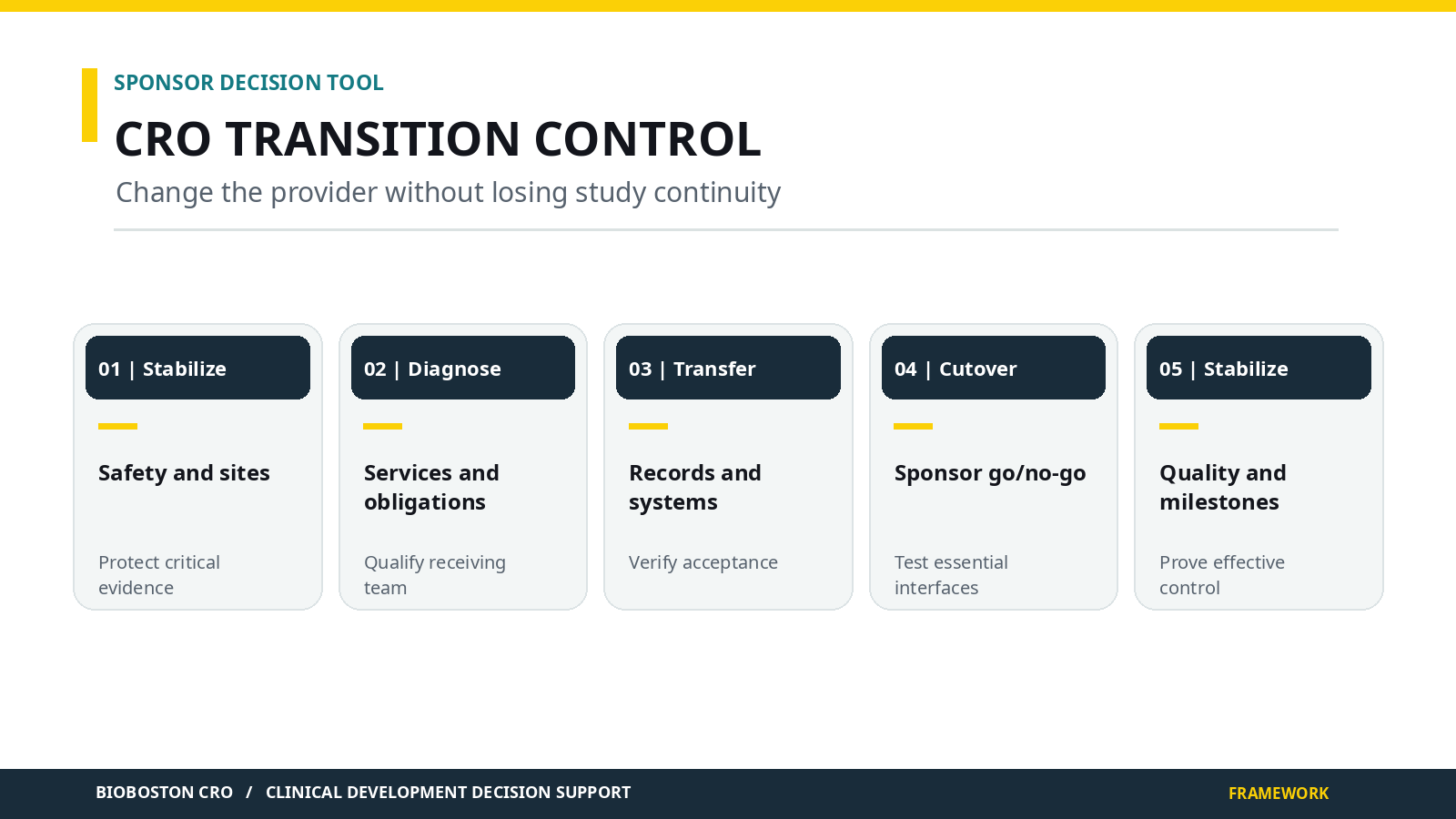
Build the decision around five questions: What participant or critical-data risks exist now? Which obligations and contracts can move? What activities can continue safely during the gap? Is a qualified receiving team available? How much study knowledge, system access and record integrity would be lost in a rapid cutover? A new vendor’s sales commitment is not proof it can assume the work at a given time. Treat receiving readiness as a formal sponsor decision gate.
For a US IND, 21 CFR 312.52 requires transfers of sponsor obligations to a CRO to be described in writing and treats obligations not described as not transferred. When the actual responsibility holder changes, verify the written allocation, contracts, quality agreements and controlled operating records. 21 CFR 312.50 sets out general sponsor responsibilities. FDA’s September 2025 ICH E6(R3) guidance is nonbinding and supports appropriate risk-based oversight and service-provider management. Legal and Regulatory Affairs must determine whether other jurisdiction, product and study-specific notifications or amendments are needed; there is no universal single ‘CRO switch’ deadline.
Phase 0: stabilize participants and preserve the evidence
Before commercial confrontation or termination instructions, the sponsor’s Medical/Safety and Quality owners should determine whether any clinical activity needs immediate containment. Confirm investigator/site communication routes, access to safety reports, investigational product accountability, urgent data queries and emergency medical contacts. Protect participants and avoid abrupt interruption of essential clinical care or monitoring. Do not delete records, disable systems or cut off an outgoing vendor’s access before determining what must remain accessible under law, contract and continuity plans.
Create a factual snapshot: current enrolled participants, upcoming visits, open safety cases, outstanding monitoring findings, protocol deviations, data transfers, query backlogs, supply and depot status, current TMF/eTMF availability, key analyses and unresolved regulator/site commitments. Preserve dates, system versions and evidence owners. Information received from an outgoing provider may be disputed; document uncertainty without treating all provider staff as unreliable.
First 48 hours: establish sponsor transition control
Appoint an executive decision owner, clinical transition lead, Medical/Safety authority, Quality lead, Data Management/IT lead and Legal/Procurement owner. Decide who can approve interim work, incident containment, staffing or commercial changes. Freeze nonessential scope changes where appropriate while maintaining required care, safety processing and data protection.
Set one secure transition issue log. Classify work by impact: safety/participant continuity, critical-data integrity, regulatory responsibilities, site operations, supply, finance and records. State the next required action, due date, sponsor accountable person, receiving contact and evidence of acceptance. Keep safety cases and CAPA in their controlled systems; the transition log references them rather than replacing the source records.
Days 3-10: complete the gap and receiving-readiness assessment
Map services at the level of actual obligations, not just departments. Split monitoring, site startup, data management, medical monitoring, safety case processing, central laboratory, statistical programming, EDC/IRT, TMF management, drug supply, document retention and vendor subcontractors as applicable. For each workstream, identify the currently accountable party, legal transfer status, systems and credentials, licenses, data exports, contract exit terms, onsite access and downstream recipients.
Qualify the proposed replacement or internal bridge according to the work it will perform. Require named leads, documented capabilities, training, operating procedures, system access, transition bandwidth and evidence that subcontractor arrangements are understood. A short overlap in which both providers participate may help, but it needs clear boundaries. Avoid two organizations simultaneously believing they have sole responsibility for the same participant-safety or critical-data task.
Weeks 2-4: execute controlled handoffs and prove acceptance
Use a handoff acceptance ledger with acceptance criteria, not a file-transfer checklist that merely says ‘sent’. A data extract is not accepted until the recipient confirms completeness, readability and reconciliation; a TMF transfer is not accepted until essential-record inventories and quality exceptions are addressed; a site communication transfer is not accepted until contacts and escalation routes work.
| Handoff workstream | Evidence the outgoing party supplies | Receiving acceptance and sponsor decision |
|---|---|---|
| Active participant and site continuity | Site roster, visit schedule, open site actions, contact/escalation logs | Clinical/Medical verifies coverage for every active site and critical visit |
| Safety and medical | Open case log, reconciliation, narratives/contacts, medical coverage | Safety lead validates case ownership, reporting route, handover and backup |
| Monitoring and deviations | Monitoring plan and visit status, critical findings, CAPA references | Clinical QA/Operations verifies outstanding action ownership and next visits |
| EDC, external data and IRT | Data-flow map, exports, access rights, interface status, validation evidence as applicable | Data/IT verifies test access, reconciliation and audit-trail continuity |
| Essential records and TMF | Current document inventory, missing records, QC exception log, archive/export format | Sponsor TMF/QA accepts inventory, gaps and retention/access arrangement |
| Supply and vendors | IMP accountability, resupply, lab/logistics contracts, service contacts | Supply/Clinical confirms no unsupported gap in dosing, sampling or shipping |
| Contracts, scope and obligations | SOWs, transfer documentation, change orders, termination/transition provisions | Legal/Regulatory confirms written allocation and effective decision dates |
| Financial and project baseline | Milestones, commitments, accruals, remaining invoices and open change orders | Finance/PM accepts forecast and documented exit cost exposure |
For each row record owner, exported record/version, cutover date, access check, unresolved exception, decision authority and signed/dated acceptance. An unresolved high-consequence item is a transition blocker unless a qualified sponsor authority approves an appropriate documented interim control. An open low-impact discrepancy may be tracked with a defined closure date, depending on the study risk.
Cutover is a decision, not a calendar event
The sponsor should issue a cutover approval only after verifying critical site coverage, safety contacts, record and data access, written responsibilities, vendor and system handoffs, appropriate training and interim issue management. Run a scenario test: simulate an urgent safety report, a site call about a missed visit and an external laboratory transfer failure. If nobody can show who receives, decides and documents the response, the new process is not operationally ready.
Plan for dual running only where beneficial and permitted. Agree on the authoritative system of record and a cutover time for each function, then restrict obsolete access using change-controlled processes. Maintain enough outgoing support to resolve unresolved legacy questions when contractually possible. Include a contingency if the replacement vendor cannot perform a critical activity at the promised date.
First 30-60 days after transition: demonstrate control
Use a short stabilization dashboard: participant visit continuity, safety case reconciliation, critical monitoring actions, data transfer acceptance, TMF exception closure, open protocol deviations, milestone confidence, vendor performance and budget-to-complete. The sponsor should review early results more frequently when risk warrants, then normalize cadence as controls demonstrate effectiveness.
An independent quality review may be warranted for a high-risk transition. Verify that interim workarounds have been converted into controlled procedures, that deviations and CAPA follow established processes, and that actual system and record access matches the approved responsibility matrix. The receiving vendor should not certify its own performance as the sole source of assurance for critical issues.
Hypothetical example: a data-management change during enrollment
Illustrative only: A sponsor considers replacing a CRO that also manages EDC and central-lab transfers. Site monitoring continues reasonably, but data reconciliation repeatedly fails. Instead of terminating every function immediately, the sponsor evaluates whether to replace data management only, preserve monitoring continuity and create an interim integration lead. The receiving data team demonstrates sample exports, data dictionary comprehension, system permissions, reconciled records and a defined route for remaining queries. The sponsor approves the limited cutover only after those checks pass and updates the obligations and agreements where applicable.
If a wider transition later becomes necessary, the team can use the same accepted evidence ledger rather than starting from incomplete file folders. This example demonstrates decision logic, not a BioBoston client case or guaranteed result.
Five mistakes that can compromise a CRO switch
Terminating access before extracting validated records. Assuming the receiving CRO automatically inherits all regulatory obligations. Negotiating price without pricing study downtime and record conversion. Leaving the sites unsure which medical/safety contact is authoritative. Treating ‘all files delivered’ as equivalent to ‘all critical functions accepted’. Each mistake can be mitigated by named sponsor ownership, tested interfaces, dated approval and objective evidence.
Take special care with protected information, cybersecurity and vendor rights to systems or data. A transition package should define permitted recipients, secure delivery methods and retention obligations. An outgoing relationship dispute does not justify bypassing confidentiality, privacy or data-integrity controls. Legal counsel and regulatory specialists should evaluate specific jurisdictions and contractual constraints.
Decision pack and service route
An executive-ready transition decision should show: reason for change; risk of remaining with the provider; alternatives considered; participant/data continuity controls; receiving provider readiness; written obligation and contract implications; integrated schedule and financial scenarios; blockers; accountable approver; and the next verification point. Sponsor approval should be traceable to the actual evidence rather than an undated status deck.
BioBoston CRO Trial Rescue Management may help assess the current state, compare remediation/transition options and coordinate sponsor-side recovery governance. See also the CRO replacement decision framework for the preceding go/no-go evaluation.
Need a controlled CRO transition and recovery plan? Explore BioBoston CRO Trial Rescue Management.