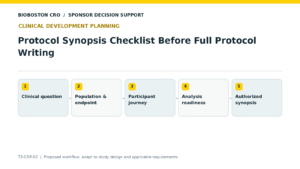
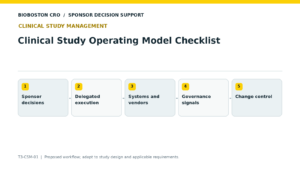
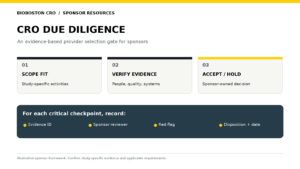
A statistical analysis plan review checklist should test whether the proposed analyses answer the protocol’s clinical questions using prespecified and reproducible methods. Merely checking that the SAP has the standard sections is insufficient. Sponsor review should expose unresolved estimand choices, contradictory populations, ambiguous endpoints and undocumented decisions before database lock.
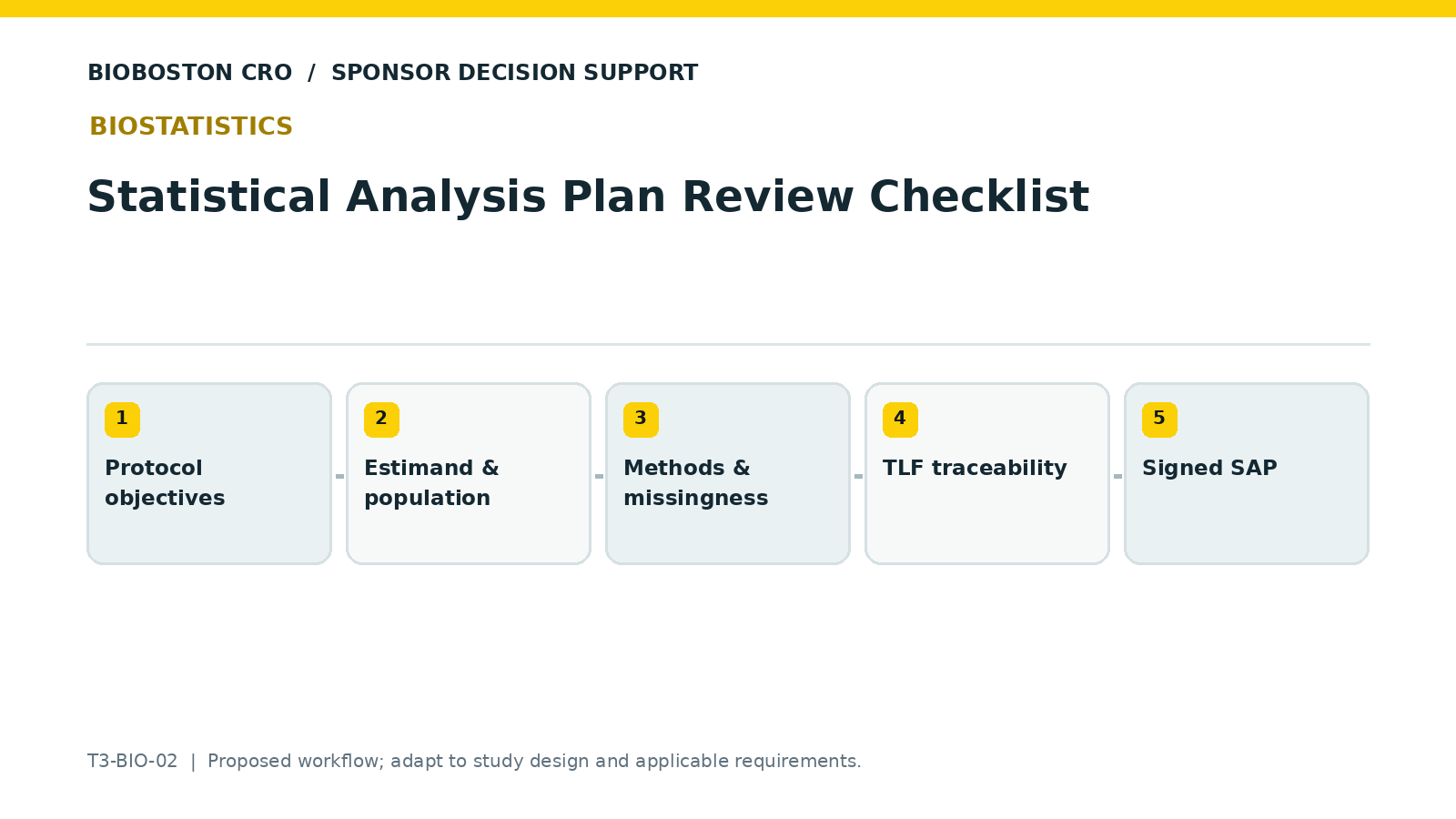
The checklist below is intended for sponsor statistics, clinical development, medical, safety and data-management reviewers. Use it at SAP draft review and again after any amendment, data-standard change or safety decision that can affect analysis. The goal is a documented disposition log, not a superficial approval signature.
What the sponsor needs to decide
Make the approved protocol and amendment history the controlling inputs. Each checklist row should name the SAP section, the source requirement, the reviewer, the deficiency if any, the disposition and the evidence for closure. Escalate disagreements that change the treatment effect, not only programming details.
Statistical Analysis Plan Review Checklist: evidence and decision matrix
| Review point | Evidence to collect | Sponsor decision or acceptance criterion |
|---|---|---|
| Objectives and estimands | Objective, treatment contrast, population, endpoint, intercurrent events and summary measure | Each primary and key secondary objective has a coherent estimand and analysis. |
| Analysis populations | Randomized, treated, safety, evaluable and per-protocol definitions with inclusion/exclusion rules | Every population has a defensible purpose and derivation logic. |
| Endpoints and visit windows | Definitions, units, assessment timepoints, baselines and derived variables | Protocol, eCRF, vendor data and SAP describe the same outcome. |
| Statistical methods and covariates | Model, factors, stratification, covariates, assumptions and alternatives | Prespecification supports reproducibility and interpretability. |
| Multiplicity and interim decisions | Hypothesis family, alpha control, hierarchy and any interim boundaries | Avoid unintended confirmatory claims for exploratory analyses. |
| Missing data and sensitivity | Missingness scenarios, estimand implications, imputation assumptions and sensitivity analyses | Sensitivity addresses assumptions of primary analysis rather than merely repeating it. |
| Safety and exposure | Safety set, exposure derivations, adverse events, labs and coding conventions | Medical and Safety reviewers approve meaningful categorizations and cutoffs. |
| Data, TLF shells and QC | Dataset specifications, TLF shells, programming validation and version control | Every display has a source, population, analysis rule and reviewer. |
How to apply this framework to a real sponsor decision
Start with a discrepancy map
For each primary endpoint, write protocol text beside the SAP decision. Flag differences in population, measurement window, handling of intercurrent events, covariate adjustment and interpretation. Establish whether each difference is an error, a permitted operational detail, or a protocol-level decision.
Treat missing data as a clinical question
Ask how discontinuation, rescue therapy and missed measurements relate to the estimand. The analysis method, sensitivity analysis and data collection strategy should tell a consistent story. Avoid a default imputation technique with no explicit assumptions.
Review analysis populations independently
Safety and efficacy populations are not interchangeable. Ask for a subject-level population derivation specification and reconcile it to protocol rules. Record special-case handling before blinded data review or unblinding, as applicable.
Make TLF shells part of review
A blank table can reveal missing visit definitions, incompatible denominator rules or a lack of safety interpretation earlier than prose. Require each high-priority shell to reference its endpoint or safety objective and dataset origin.
Separate execution QC from sponsor scientific approval
Programming validation can establish that code implements a specification. It cannot establish that the specification asks the right clinical question. Preserve explicit Clinical, Medical, Statistics and Data review roles.
Warning signs that need intervention
- The SAP introduces a new primary population without documented protocol and regulatory assessment.
- Sensitivity analyses use the same missingness assumption as the primary analysis.
- Covariates are selected after reviewing outcome data without an approved plan.
- Tables mix safety and efficacy denominators or inconsistent cutoffs.
- Final SAP signature is recorded before queries about endpoints and derivations are closed.
First-week sponsor action plan
- Build a protocol-to-SAP issue log with owners and severity.
- Review the primary estimand and analysis populations in a cross-functional meeting.
- Run a sample TLF-shell walk-through from raw data source to display.
- Freeze an approved SAP version with controlled change and unblinding rules.
To connect this decision framework to actual study responsibilities, see BioBoston CRO Biostatistics Services support. The service team can help structure sponsor oversight and the evidence needed to make a documented decision; site-facing or other specialized execution may be coordinated with qualified partners where appropriate.
Frequently asked sponsor questions
Can a sponsor approve a SAP while details are open?
It is better to distinguish editorial issues from unresolved scientific choices. Material open choices should have documented resolution before final approval.
Are TLF shells required to be final before database lock?
The needed maturity depends on the trial and analysis workflow, but early shell review reduces avoidable specification rework.
Does ICH E9(R1) prescribe one estimand?
No. It offers a framework to specify treatment effects and align design, conduct, analysis and interpretation.
Technical and regulatory context
The framework reflects relevant FDA/ICH principles, including ICH E9, ICH E9(R1), FDA. Guidance documents contain nonbinding recommendations and should not be described as universal legal requirements. Applicable binding obligations and study-specific authority expectations should be assessed separately; retain current source/version records in the internal quality file.
Next step for the sponsor
If your team is resolving the decisions above, explore BioBoston CRO Biostatistics Services services for a scoped assessment, responsibility map or expert-supported working plan. Keep the decision record and supporting evidence even if you ultimately use another delivery model.