A CRO due diligence checklist should help an emerging biotech sponsor decide whether a provider can perform the specific trial activities it proposes to accept, whether its evidence supports those claims, and what oversight the sponsor will retain. A capability presentation or a competitive price is not enough. Before committing an outsourced Phase I or II program, request documents, challenge assumptions, identify who will verify the evidence, and record unresolved risks in a sponsor-controlled decision log.
This checklist is designed for a Head of Clinical Operations, Clinical Quality lead, COO or CMO comparing CRO proposals or qualifying a significant new service provider. It is also useful when the proposed provider will subcontract monitoring, laboratories, data management or safety activities. It supports the selection decision; it does not replace formal vendor qualification, GCP auditing, procurement, legal review or study-specific quality oversight.
Start with the scope you intend to transfer
Write a one-page sponsor requirements profile before requesting evidence. Name the therapeutic context, product modality, phase, country footprint, intended population, critical-to-quality factors, first-patient and data milestones, essential vendors, and internal personnel available to oversee the work. Distinguish optional services from work that will affect participant protection, safety decisions or the reliability of trial results.
Describe the contracting model. A single full-service CRO, a functional-service provider and a CRO coordinating specialist providers present different interface risks. Do not assume a company that can provide a service has already accepted regulatory responsibility for it. For an applicable US IND, 21 CFR 312.52 requires transfer of sponsor obligations to a CRO to be described in writing; obligations not covered by the written description are deemed not transferred. 21 CFR 312.50 sets out general sponsor responsibilities. FDA’s September 2025 ICH E6(R3) Good Clinical Practice is nonbinding guidance that recommends assessing service-provider suitability and maintaining appropriate oversight, including important subcontracted activities.
The commercial SOW, written transfer of obligations where applicable, quality agreement and responsibility matrix should be consistent. Do not treat a signed purchase order as proof that every interface, escalation path or retained obligation is understood.
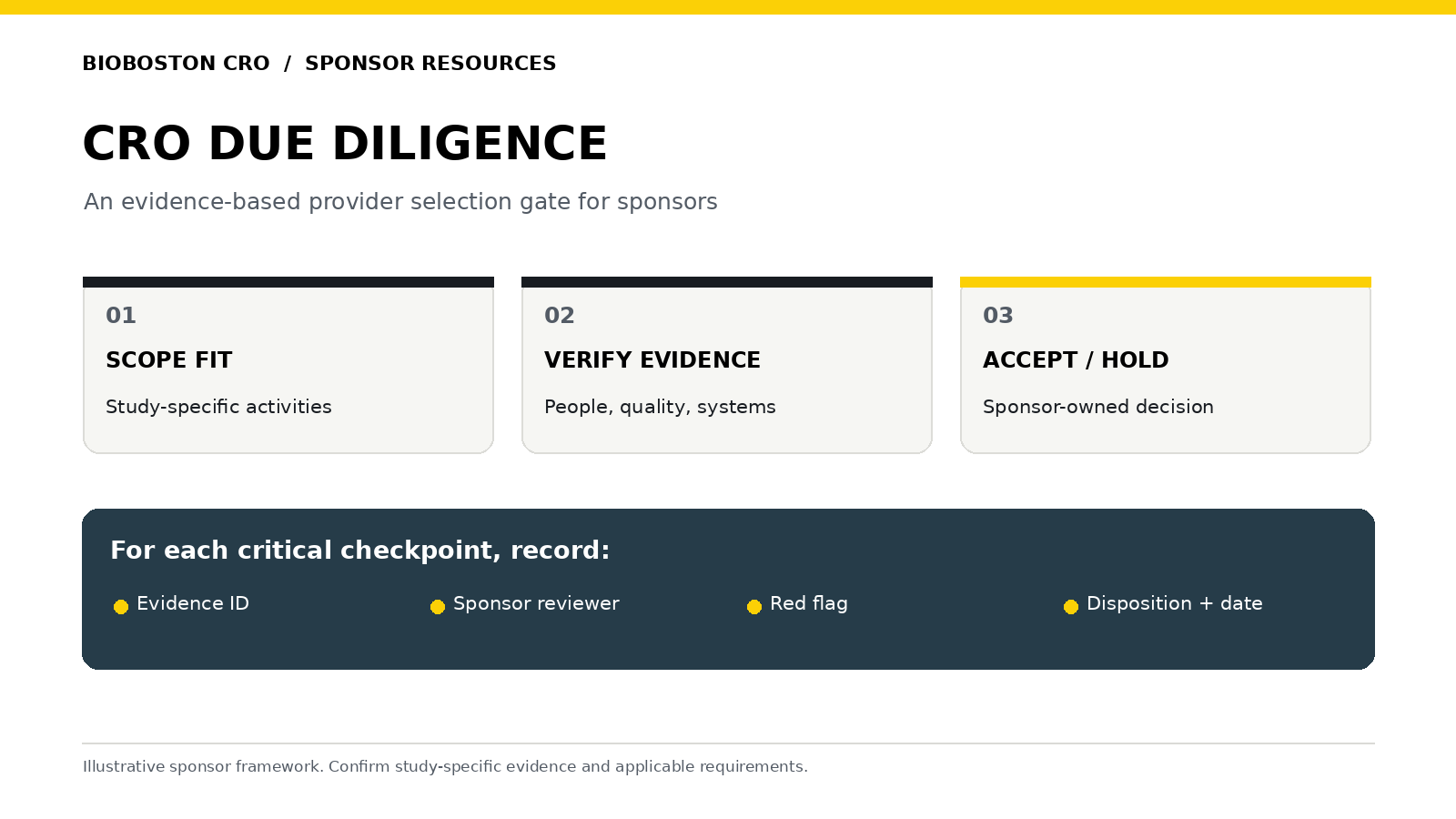
Use three due-diligence gates, not one vendor score
Gate 1 — fit to the actual study. Confirm the provider’s capabilities, geography, protocol experience and proposed operating model. Reject an obvious mismatch before demanding a large documentation package. A small CRO with relevant experts may outperform a larger firm on a narrow assignment; the right comparison is suitability for the defined work.
Gate 2 — verifiable evidence and controls. Ask for the named delivery team, representative study outcomes with appropriate confidentiality, training and qualification evidence, quality procedures, system validation or qualification evidence as applicable, subcontractor visibility, and escalation records. Evaluate whether documents are current, controlled, relevant and attributable to the team that will actually work on the trial.
Gate 3 — sponsor acceptance and conditional contracting. Separate observations into accepted, conditional, unresolved and blocking. Assign a named sponsor owner and decision date. An attractive proposal may be acceptable with documented conditions; a missing safety-escalation pathway or material data-integrity gap cannot be erased by a low total price.
Copyable CRO due-diligence evidence checklist
Use one row per provider and workstream. The following columns are a suggested sponsor tool, not mandated regulatory forms. Add document location, version, review date and acceptance decision in your controlled vendor record.
| Checkpoint | Evidence to request | Sponsor reviewer | Red flag or hold trigger |
|---|---|---|---|
| Relevant delivery experience | Comparable trial types, phase, procedures and lessons learned, with permissible references | Clinical Operations and Medical | Broad therapeutic claims with no study-relevant evidence |
| Proposed team and capacity | Named functional leads, credentials, availability and replacement method | Functional sponsor lead | Proposal relies on unavailable or unnamed critical staff |
| Quality system and CAPA | Controlled procedures, deviation/CAPA pathway, training and audit approach | Clinical QA | Serious finding without credible corrective action or access to supporting records |
| Monitoring and site execution | Monitoring strategy, oversight of sites, visit coverage and escalation examples | Clinical Operations | No clear pathway for critical protocol or participant-safety issues |
| Safety and medical interfaces | Medical coverage model, safety reporting handoffs, backup roles and out-of-hours escalation | Medical and Safety | Ambiguous responsibility for time-critical safety information |
| Data and computerized systems | Access controls, data-flow map, system validation/qualification as applicable, reconciliation plan | Data Management and IT/CSV | Unowned external-data interface or inaccessible audit trail |
| Subcontractors and essential partners | Named subcontractors, locations, scope, selection and oversight approach | Clinical QA and Procurement | Material work subcontracted without sponsor visibility |
| Budget, scope and transition | Assumptions, exclusions, change control, termination and data/record return provisions | Finance, Legal, Clinical Ops | Low bid hides key services, costs or exit dependencies |
A red flag is a reason to investigate, not automatically proof of noncompliance. Document the evidence you reviewed and the impact on this program. Different sponsors may reasonably apply different risk tolerances to commercial issues; participant-safety and critical-data concerns deserve separate escalation.
Ask questions that reveal how the CRO actually works
A rehearsed demonstration can show polished technology without proving delivery discipline. Ask a proposed project manager to walk through the last material milestone forecast change, explaining what triggered the escalation, who made the decision, and what was recorded. For monitoring, ask what occurs when a significant protocol deviation is detected, who sees it, and how unresolved actions are followed to closure. For data management, trace one external laboratory result from generation to accepted database record and final reconciliation.
Ask to meet the personnel who would carry the responsibility, not only the business-development team. Explore how replacements are approved, how knowledge transfers between staff, and whether the sponsor receives notice when a critical subcontractor changes. Request evidence with patient and client information appropriately protected; declining to share confidential data is not itself a quality deficiency, but the provider should offer a reasonable way to establish capability.
For early-phase projects, probe first-patient critical-path assumptions: approval lead times, site readiness, investigational product, laboratory manuals, EDC/IRT setup and safety workflow. An aggressive forecast without dependencies, named owners or acceptance evidence should remain a forecast, not a contractual promise.
Distinguish qualification, audit and contracting decisions
Qualification is a sponsor decision about the suitability of a provider for particular assigned work. An audit examines evidence against defined criteria and may be planned according to risk and existing information. Contracting establishes commercial scope and, where applicable, written transfer of specified sponsor obligations. These decisions inform one another but are not interchangeable.
Decide which evidence the sponsor needs before signature, which issues may be resolved before the first affected activity, and what ongoing oversight conditions must be included in the relationship. A QA reviewer should identify any required quality agreement, audit follow-up or critical-system control. Legal and Regulatory Affairs should confirm applicable written-transfer and data/record-access provisions. Procurement should not close a substantive quality issue simply because a vendor is approved commercially.
For a broader comparison of CRO operating models and procurement questions, see BioBoston CRO’s Phase I CRO selection guide. This checklist adds an evidence acceptance gate: the person who checked each claim and what remains unresolved.
Record a decision with non-compensatory stop rules
A weighted vendor comparison may be useful for commercial factors such as proposal clarity, staffing flexibility or total cost. Do not allow a high aggregate score to conceal a material safety, critical-data or regulatory problem. Put a separate stop/go field next to each critical item. The sponsor should know who has authority to pause selection or affected study activities and who can accept a mitigation.
Use this decision register for each unresolved checkpoint:
| Field | Sponsor entry or instruction |
|---|---|
| Evidence ID and version | Link to the reviewed controlled record, not a marketing summary |
| Risk statement | State the specific potential impact on participants, data or delivery |
| Acceptance status | Accepted / conditional / unresolved / blocking |
| Action and owner | One accountable sponsor-side owner plus CRO action owner |
| Due date and dependency | When the evidence is required and which activity depends on it |
| Approval record | Authorized reviewer, decision rationale and subsequent verification |
An unresolved budget exclusion might be addressed through a revised SOW. A critical laboratory interface with no agreed acceptance criteria may need a controlled design review before system release. An insufficient safety-reporting interface requires escalation through appropriate medical, safety and quality channels rather than waiting for a monthly governance meeting.
Hypothetical bid defense: attractive price, weak interfaces
Imagine a lean biotech selecting a CRO for a first-in-patient study. Candidate A offers lower startup costs and presents strong monitoring credentials. However, its central laboratory is subcontracted; the data-transfer specification, sample-to-patient matching reconciliation and acceptance owner are not identified. Candidate B costs more but provides a verified interface plan, named operational leads and a change-control pathway.
The sponsor should not automatically pick B or dismiss A. It should ask A for a time-bound, sponsor-reviewed interface remediation plan and price the scope consistently across both bidders. If the affected system cannot be responsibly accepted before use, that is a real operational dependency, not a minor questionnaire gap. The example is fictional and illustrates decision logic, not BioBoston CRO project experience.
After selection, convert the checklist into oversight
The accepted due-diligence evidence should become a baseline for startup and governance: agreed team, subcontractor register, critical services, performance reports, quality actions, record access, escalation ownership and handoff tests. Revisit qualification when scope changes, a material subcontractor is replaced, important systems change or a serious quality signal emerges. File the decision, not just the provider’s questionnaire.
A CRO due diligence checklist is most useful when it gives an incoming sponsor team the ability to reconstruct why a provider was selected and which conditions still need follow-up. Where lean internal capacity makes ongoing independent review difficult, the sponsor can establish a proportionate retained oversight role without creating a parallel CRO project team.
BioBoston CRO’s Sponsor Oversight services can support a structured evidence review, risk-based provider oversight planning and follow-through for the activities in your program. Explore Sponsor Oversight support to discuss your outsourced study and the controls you want to retain.
Regulatory distinction: 21 CFR 312.50 and 312.52 are binding requirements where applicable to US IND studies. FDA’s September 2025 ICH E6(R3) is nonbinding guidance. The suggested gates, registers and classifications above are BioBoston CRO working recommendations, not required FDA templates. Recommended reviewer: senior Clinical QA/GCP auditor with Clinical Operations, Medical/Safety, Data Management, Legal and Procurement input as needed. Update on regulatory or service changes and at least annually.