How to Choose a CRO for a Phase I Clinical Trial: A Sponsor Due-Diligence Guide
Choosing a CRO for a Phase I clinical trial should not begin with a comparison of company size, geographic reach, or headline price.
Start with a more practical question:
Can this CRO execute your specific study while giving your sponsor team enough evidence, visibility, and control to manage the relationship after the contract is signed?
That distinction matters in Phase I. Under 21 CFR 312.21, Phase I includes the initial introduction of an investigational drug into humans. These studies are typically closely monitored and may involve healthy volunteers or patients, with objectives that can include understanding pharmacologic actions, pharmacokinetics, and side effects associated with increasing doses.
For an emerging biotech, CRO selection therefore needs to test both technical fit and operating-model fit.
A strong proposal is not enough. Sponsors should understand who will actually deliver the study, how critical interfaces will work, which activities will be subcontracted, what information the sponsor will receive, and how performance or safety issues will be escalated.
Quick answer: what should you evaluate?
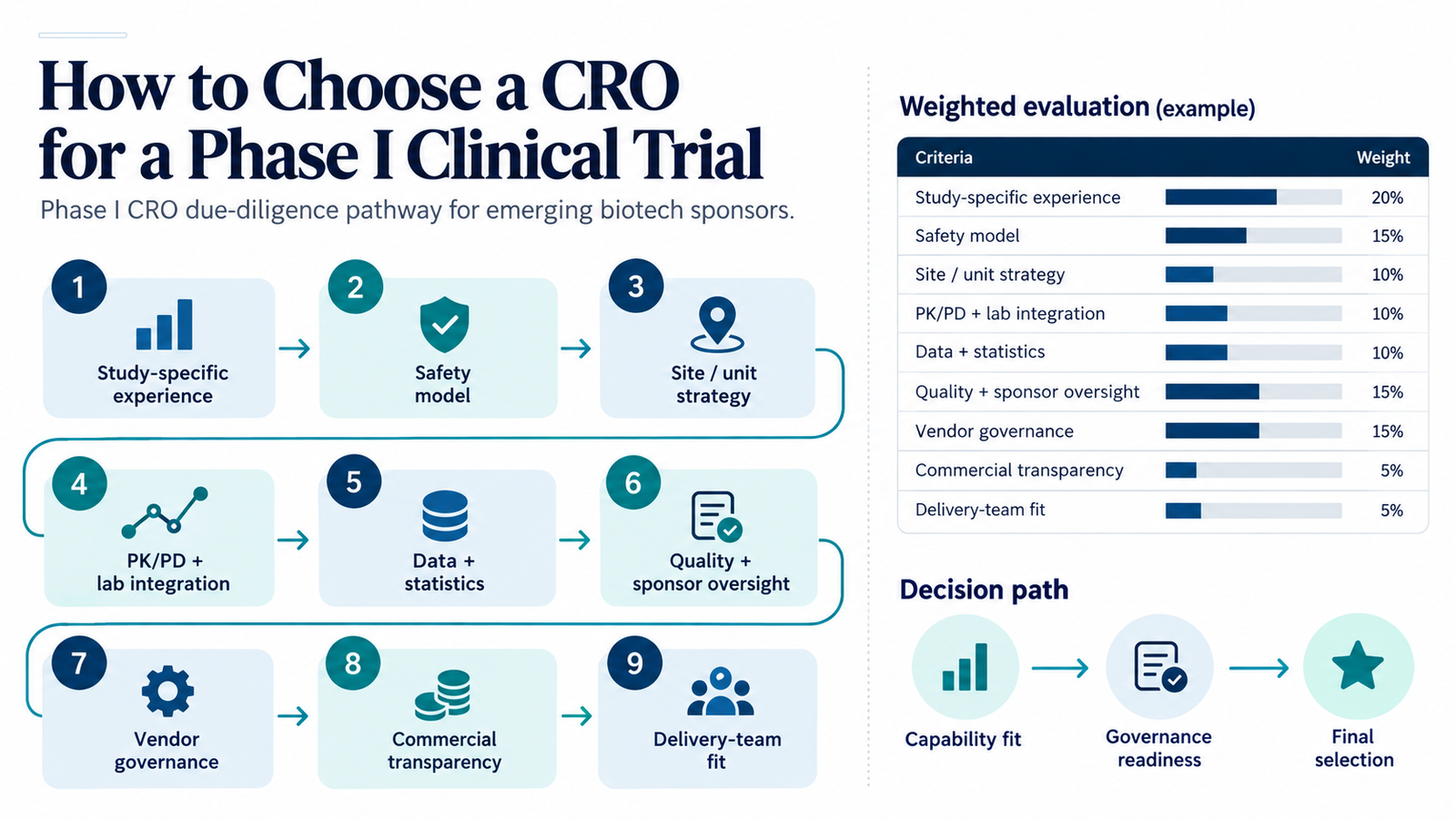
Before selecting a Phase I CRO, evaluate at least these nine areas:
- Relevant Phase I and first-in-human experience
- Medical and safety operating model
- Site or Phase I unit strategy
- PK/PD, laboratory, and bioanalytical interfaces
- Data management and biostatistical capability
- Quality systems and service-provider oversight
- Project management and vendor governance
- Budget, assumptions, and change-control transparency
- The actual team assigned to your study
Do not score capabilities only from presentation slides.
For each area, ask:
What is the CRO claiming?
Who will actually perform it?
What evidence supports the claim?
How will the sponsor know whether it is working once the study begins?
That fourth question is often the one that separates vendor selection from effective vendor governance.
Phase I CRO due-diligence matrix
Use this matrix during RFP review and bid-defense meetings.
| Area | What to evaluate | Evidence to request | Red flag |
| Phase I experience | Similar study design, product type, population and operational complexity | Relevant study examples, proposed team experience, lessons learned | Generic company experience with little relevant experience on the proposed team |
| Safety model | Medical coverage, safety review, escalation, dose-decision support | Safety workflow, escalation path, roles, committee interfaces | Unclear ownership or response path for important safety information |
| Sites / Phase I units | Access, capabilities, capacity, population fit and oversight | Site/unit model, qualification approach, expected capacity, responsibilities | CRO claims “site access” but cannot explain qualification, availability or governance |
| PK/PD and labs | Sample collection, processing, shipping, bioanalysis and data transfer | Laboratory responsibilities, specifications, timelines, handoff map | Critical lab interfaces remain outside the integrated plan |
| Data / statistics | EDC, data review, PK data flow, interim decisions, programming | Data flow, standards, review model, statistician involvement | Biometrics is introduced only after operational decisions are already fixed |
| Quality / GCP | Quality management, SOP access, deviations, CAPA, audit model | Relevant SOPs/process summaries, metrics, quality escalation | Sponsor cannot obtain information needed to assess performance |
| Project governance | Meetings, decisions, KPIs, risks, dependencies and escalation | Governance model, sample dashboard, decision/issue structure | Governance consists primarily of recurring status meetings |
| Commercial model | Assumptions, exclusions, pass-throughs and change triggers | Detailed budget assumptions and change-order rules | Low headline price supported by unclear exclusions or assumptions |
| Delivery team | Availability, seniority, continuity and authority | Named team, CVs/profiles, roles, allocation, replacement process | Bid-defense team is materially different from delivery team |
This is a sponsor-side due-diligence framework, not a regulatory checklist.
1. Start with study-specific Phase I experience
Do not ask only:
“How many Phase I studies has your CRO conducted?”
That number has limited value without context.
Instead determine whether the proposed CRO and team understand the characteristics that make your program difficult.
Consider:
- first-in-human versus later Phase I;
- healthy volunteers versus patients;
- single-ascending-dose or multiple-ascending-dose components;
- food-effect or other pharmacology components;
- intensive PK/PD sampling;
- biomarkers;
- complex administration;
- sentinel dosing;
- dose-escalation decisions;
- specialized safety monitoring;
- therapeutic-area requirements; and
- laboratory or technology dependencies.
The most useful evidence is not simply corporate experience. It is relevant experience among the people and partners proposed for your study.
2. Test the safety and escalation model
Phase I studies are typically closely monitored, making the operational path for safety information especially important.
Ask the CRO to walk through a realistic scenario:
A potentially important safety finding emerges before the next planned dose escalation. What happens?
You should be able to identify:
- who receives the information;
- who performs medical review;
- who determines whether escalation is required;
- what information reaches the sponsor;
- who convenes any applicable review group;
- how decisions are documented; and
- how the resulting action reaches sites, data teams, laboratories, and other affected functions.
Do not accept “our medical team handles that” as a complete answer.
The workflow should be understandable before the trial begins.
3. Understand the Phase I unit and site model
A CRO does not need to own a Phase I unit to be a good choice.
But the sponsor should understand the model.
Determine whether the CRO:
- owns or operates the unit;
- uses preferred external sites;
- selects sites specifically for the study;
- relies on another service provider;
- manages healthy-volunteer recruitment through the unit; or
- uses disease-specific sites for patient-based Phase I work.
If sites or clinical units are external, evaluate how qualification, contracting, capacity, performance, data, safety information, and escalation will be managed.
The important issue is not ownership.
It is operational control and visibility across the interface.
4. Follow the PK/PD and laboratory data path
For many Phase I programs, critical decisions depend on information moving efficiently among:
site → sample processing → laboratory → data systems → statistics/clinical pharmacology → medical/sponsor decision makers.
Ask the CRO to map that path.
For each handoff, identify:
- responsible party;
- expected timing;
- specifications;
- data format;
- review responsibility;
- exception handling; and
- escalation.
A laboratory can perform its contracted work correctly while the study still experiences problems because the interface with the CRO, site, data team, or sponsor was poorly defined.
This is one reason CRO selection should evaluate the vendor ecosystem, not just the primary CRO.
5. Evaluate the data and statistical model early
Do not treat Data Management and Biostatistics as downstream services.
For a Phase I program, data structure and review may affect:
- safety evaluation;
- PK/PD outputs;
- dose decisions;
- cohort progression;
- interim analyses; and
- preparation for subsequent development.
Ask who will be involved before database build and study startup.
Confirm:
- data-management ownership;
- EDC responsibilities;
- external-data integration;
- coding and reconciliation responsibilities where applicable;
- statistical leadership;
- programming model;
- review cadence; and
- critical data-transfer dependencies.
A CRO’s functional departments should not appear integrated only on the organization chart.
Test how they actually work together.
6. Due diligence should assess future sponsor oversight
This is one of the most important 2026 considerations.
Current ICH E6(R3) states that sponsors are responsible for assessing the suitability of service providers and should have access to relevant information, including appropriate SOP and performance information, for provider selection and oversight. It also calls for appropriate oversight of important activities transferred to service providers, including subcontracted activities.
For U.S. IND studies, 21 CFR 312.50 establishes sponsor responsibilities, while 21 CFR 312.52 permits transfer of applicable obligations to a CRO when that transfer is documented in writing. Obligations not covered by the written transfer remain with the sponsor.
That means due diligence should ask not only:
“Can this CRO perform the activity?”
but also:
“Will our sponsor team be able to oversee it appropriately?”
Look for:
- meaningful performance metrics;
- quality and issue visibility;
- access to relevant documentation;
- subcontractor transparency;
- clear decision authority;
- defined escalation; and
- retained evidence of sponsor review and decisions.
7. Evaluate governance before contract signature
The best time to discover that the CRO’s governance model does not fit your organization is before award.
Ask the CRO to describe:
- study-team meeting structure;
- executive governance;
- KPI definitions;
- risk and issue management;
- decision logging;
- action tracking;
- escalation thresholds;
- cross-vendor coordination;
- change management; and
- sponsor approval points.
BioBoston’s current Vendor Governance model is built around these same operational controls: contracts, responsibilities, deliverables, milestones, metrics, dependencies, decisions, issues and escalation across CROs and specialist vendors. BioBoston CRO
This is where CRO due diligence connects directly to post-award performance.
A sponsor should select a CRO that it can govern, not merely one that presents well during procurement.
BioBoston Phase I CRO selection scorecard
Use the following 100-point framework to compare shortlisted providers.
This is a BioBoston CRO decision-support tool, not an FDA requirement or validated regulatory scoring system.
| Category | Weight |
| Relevant Phase I / FIH experience | 15 |
| Safety and medical operating model | 15 |
| Site/unit strategy and population access | 10 |
| PK/PD, bioanalytical and laboratory integration | 10 |
| Quality systems and sponsor-oversight readiness | 15 |
| Project management and vendor governance | 15 |
| Data management, statistics and systems | 10 |
| Budget and commercial transparency | 5 |
| Delivery-team fit and continuity | 5 |
| Total | 100 |
Score each category from 1 to 5
1 — Significant concern: major capability or evidence gap
2 — Weak: important limitations requiring mitigation
3 — Acceptable: requirements appear supportable
4 — Strong: clear relevant capability and evidence
5 — Excellent: highly relevant capability, strong evidence, and well-defined operating model
Multiply the category rating by its weighting proportion to produce the comparative score.
But do not allow the final number to override a critical failure.
Use pass/fail gates before selecting the highest score
A CRO should not win simply because its weighted score is highest.
Before final selection, ask whether the provider passes these gates:
Relevant capability
Can the proposed team credibly support the actual Phase I design?
Safety
Is the safety-review and escalation model clear?
Operational feasibility
Can the CRO demonstrate a credible site/unit and vendor strategy?
Responsibilities
Can sponsor, CRO, sites, laboratories, and specialist-provider responsibilities be clearly assigned?
BioBoston’s current Responsibility Matrix service addresses this exact need by mapping responsibilities, decisions, approvals, handoffs, evidence, and escalation across sponsor and vendor processes. BioBoston CRO
Visibility
Will the sponsor have sufficient information to evaluate performance and important risks?
Governance
Can issues move from identification to accountable action and escalation?
If a provider fails one of these critical gates, resolve the gap before relying on the overall score.
Red flags during bid defense
Watch for these patterns:
1. Corporate experience replaces team experience.
The CRO describes impressive Phase I credentials but cannot identify who on the proposed team has the relevant experience.
2. Critical work is subcontracted but poorly explained.
A laboratory, site network, technology provider, or other third party performs important activities, but responsibilities and oversight remain vague.
3. Safety escalation is described at a high level.
The team cannot walk through who receives, evaluates, decides, communicates, and documents an important safety signal.
4. Governance means meetings.
The CRO can show meeting schedules but not decision rights, thresholds, metrics, issues, actions, or escalation rules.
5. The proposal and responsibility model do not align.
Tasks appear in one document but ownership is unclear elsewhere.
6. Budget differences cannot be traced to assumptions.
A lower proposal may simply contain different exclusions, pass-through assumptions, resourcing, or scope.
7. The proposed team is not the delivery team.
Senior experts lead the bid defense while the actual study team remains unknown.
Questions to ask in the CRO bid defense
Use questions that require evidence rather than yes/no answers.
Experience
- Walk us through the most comparable Phase I studies supported by the proposed team.
- What aspects of our protocol create the greatest operational risk?
- Which capabilities will be delivered directly and which will be subcontracted?
Safety
- Walk us through an unexpected safety issue before a cohort or dose decision.
- Who has decision authority at each step?
- How will the sponsor receive and document the information?
Sites and laboratories
- How will sites or Phase I units be selected and qualified?
- What evidence supports their capacity for our population and procedures?
- How are laboratory and bioanalytical dependencies incorporated into the study plan?
Data and statistics
- When do Data Management and Biostatistics enter study planning?
- How will external data be transferred, reconciled, reviewed, and escalated?
- Which data are critical to cohort or dose decisions?
Governance
- Show us how an issue becomes an escalation.
- Which KPIs would you recommend for this study and why?
- How do you manage cross-vendor dependencies?
- How are decisions and overdue actions controlled?
Commercial
- Which assumptions have the greatest potential to create a change order?
- Which costs are pass-throughs or estimates?
- What would cause the staffing model to change?
Practical CRO-selection decision path
1. Does the CRO have relevant Phase I capability for this specific program?
No → Do not advance based solely on broad CRO experience.
Yes → Continue.
2. Can the proposed team explain the critical safety, site, laboratory, data, and decision workflows?
No → Clarify before scoring.
Yes → Continue.
3. Are important subcontractors and interfaces visible?
No → Require an integrated responsibility and vendor map.
Yes → Continue.
4. Can the sponsor obtain meaningful performance and quality information after award?
No → Resolve the oversight model before contracting.
Yes → Continue.
5. Are scope, assumptions, responsibilities, budget, and governance aligned?
No → Reconcile them before comparing final bids.
Yes → Apply the weighted scorecard, perform final due diligence, and document the selection rationale.
What should happen after CRO selection?
Do not allow the selection process to end with contract signature.
Before study execution begins:
- Finalize the responsibility model.
- Confirm transferred activities and applicable obligations.
- Establish governance levels and meeting cadence.
- Define meaningful KPIs and thresholds.
- Map critical vendor dependencies.
- Establish decision and escalation pathways.
- Confirm sponsor review and approval responsibilities.
- Baseline scope, assumptions, timeline, budget, and deliverables.
- Establish issue, action, decision, risk, and change controls.
- Confirm what evidence the sponsor will retain for oversight.
For sponsors moving from CRO selection into execution, BioBoston CRO Vendor Governance support can help turn the selected proposal and contracts into a practical operating model covering responsibilities, deliverables, metrics, dependencies, decisions, issues, and escalation.
Final takeaway
The best Phase I CRO is not necessarily the largest provider, the lowest-cost bidder, or the company with the longest list of completed studies.
It is the provider whose relevant team, operating model, specialist network, responsibilities, controls, and governance structure fit your specific program.
The selection process should therefore answer two questions:
Can this CRO execute our Phase I study?
and
Can we govern the relationship effectively once execution begins?
If either answer is uncertain, due diligence is not finished.
Need help applying this to your program? Explore BioBoston CRO Vendor Governance support.
FAQ
What should a sponsor look for when choosing a Phase I CRO?
Prioritize relevant study experience, safety and medical processes, site or unit capability, PK/PD and laboratory interfaces, data and statistical support, quality systems, the proposed delivery team, commercial transparency, and the governance model. Evaluate evidence for the specific study rather than relying only on corporate capability statements.
Does a Phase I CRO need to own a Phase I unit?
No. A CRO may work successfully with external Phase I units or clinical sites. The sponsor should understand how those sites are selected, qualified, contracted, integrated, and governed.
Is the lowest CRO bid usually the best choice?
Not necessarily. Compare scope, resourcing, assumptions, exclusions, pass-through costs, timelines, and change-order triggers before treating proposal totals as comparable.
Does outsourcing a Phase I study remove sponsor responsibilities?
No. Applicable activities and certain regulatory obligations may be transferred, but sponsor responsibilities and appropriate oversight remain important. Under 21 CFR 312.52, applicable transferred obligations must be documented in writing.