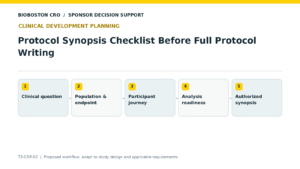
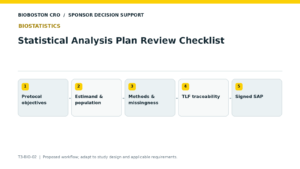
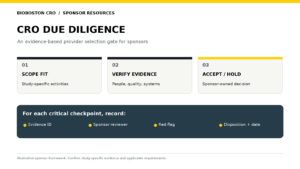
A clinical study operating model checklist should make clear who performs trial activities, who can make decisions, where reliable evidence is retained, and how the sponsor detects emerging problems. An org chart or vendor statement of work alone does not answer those questions. A workable model connects people, procedures, systems, handoffs, governance forums and escalation thresholds.
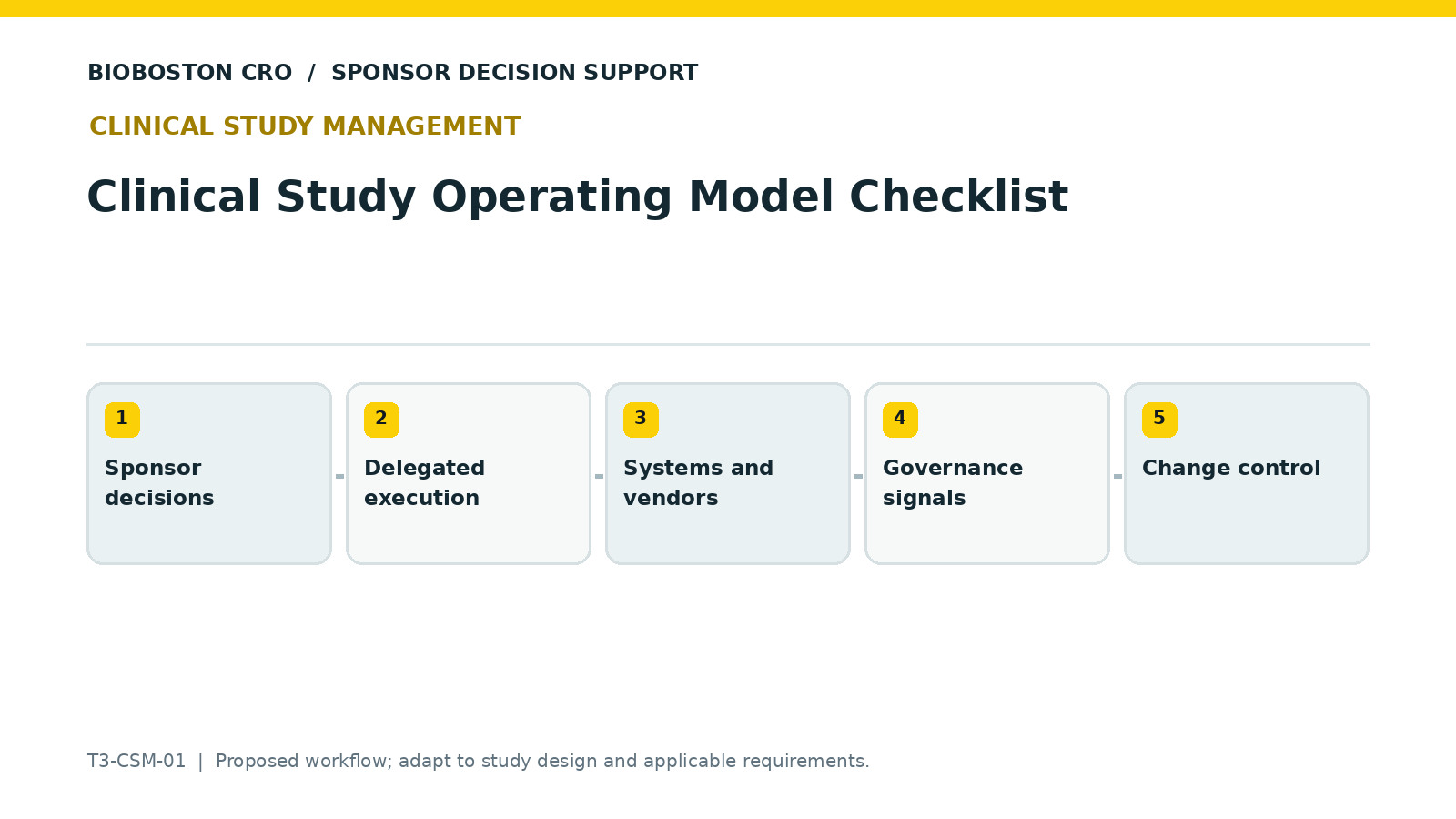
This checklist is designed for emerging biotech sponsors using a lean internal team and one or more CROs and specialist vendors. Apply it before kickoff, after a major vendor or protocol change, and when quality or timeline signals show that informal coordination is no longer sufficient.
What the sponsor needs to decide
Begin with activities critical to participant protection and credible results. For every key activity, name the accountable sponsor decision-maker, operational owner, qualified backup, retained record, expected reporting interval and escalation condition. Some on-site or patient-facing delivery may be performed by qualified partners rather than BioBoston CRO directly.
Clinical Study Operating Model Checklist: evidence and decision matrix
| Review point | Evidence to collect | Sponsor decision or acceptance criterion |
|---|---|---|
| Retained sponsor accountability | Sponsor decision charter, delegated-duty list, governance terms | The sponsor identifies decisions it must retain and documentation that proves oversight. |
| Delegation and contracts | CRO scope, signed transfer descriptions where applicable, vendor agreements | Activities, limits and interfaces align across contract, responsibility matrix and SOPs. |
| Clinical and medical roles | Medical oversight, safety escalation, investigator support and operational ownership | Coverage includes qualified primary and backup contacts, with clear urgent paths. |
| Trial systems and access | CTMS, eTMF, EDC, safety, IRT and vendor portals; access roster | Each system has an owner, access rules, data handoffs and inspection retrieval plan. |
| Sites and external providers | Site startup, monitoring, lab, imaging, supply and recruitment interfaces | Every handoff has acceptance criteria, quality evidence and an escalation owner. |
| Governance and reporting | Operating meetings, quality review, KPIs/KRIs, issue and decision logs | Meetings lead to recorded actions and accountable decisions, not only slide updates. |
| Change and recovery | Protocol amendments, scope changes, staffing gaps and rescue triggers | The model stays usable when vendors, timelines or risk profiles change. |
How to apply this framework to a real sponsor decision
Draw the decision map
For the study’s critical milestones, record who recommends, who decides, who executes and who supplies evidence. Differentiate authority to approve a protocol amendment from the task of implementing it at sites or in systems.
Make interfaces explicit
A laboratory result, urgent safety report or randomization exception can pass between several providers. Define a receiving owner and a confirmation record at every interface. Unassigned interfaces are frequent sources of delays and inconsistent records.
Avoid invisible single-person dependencies
Lean sponsors should name qualified backup coverage for medical, regulatory, safety and critical operational decisions. Document what a substitute can approve and how urgent issues are escalated.
Use governance to resolve, not rehearse
Set meeting cadence according to trial risk and milestones. Require a current decision log, thresholds, due dates, owners and the evidence necessary to close an issue. Keep commercial change orders separate from quality and participant-safety decisions.
Reconcile reality to the contract
When the operating model changes, update delegated responsibilities, system access, training, vendor governance and oversight records together. A contract amendment without operational control changes leaves a real gap.
Warning signs that need intervention
- The sponsor assumes outsourced execution removes its need for oversight.
- Medical and safety decisions have no qualified backup.
- The RACI does not describe handoffs between vendors and systems.
- Governance presentations show status without decisions or action owners.
- An amendment changes the work but not responsibility or access records.
First-week sponsor action plan
- Map ten critical sponsor decisions and identify accountable signers.
- Reconcile contract scope, RACI, system access and governance terms.
- Test one safety escalation and one data-interface exception as a tabletop exercise.
- Approve a change-control trigger list for the operating model.
To connect this decision framework to actual study responsibilities, see BioBoston CRO Clinical Study Management support. The service team can help structure sponsor oversight and the evidence needed to make a documented decision; site-facing or other specialized execution may be coordinated with qualified partners where appropriate.
Frequently asked sponsor questions
Does a CRO contract transfer every sponsor responsibility?
No. Specific obligations can be transferred under applicable rules, but appropriate sponsor oversight and clearly documented accountability remain essential.
Can one individual hold multiple roles?
Sometimes, if qualified, available and conflicts are managed. Critical decisions and backups should still be explicit.
Is a single RACI sufficient?
A RACI is a starting point; operational handoff evidence, contracts, escalation and system permissions must agree with it.
Technical and regulatory context
The framework reflects relevant FDA/ICH principles, including ICH E6(R3), 21 CFR 312.50, 21 CFR 312.52. Guidance documents contain nonbinding recommendations and should not be described as universal legal requirements. Applicable binding obligations and study-specific authority expectations should be assessed separately; retain current source/version records in the internal quality file.
Next step for the sponsor
If your team is resolving the decisions above, explore BioBoston CRO Clinical Study Management services for a scoped assessment, responsibility map or expert-supported working plan. Keep the decision record and supporting evidence even if you ultimately use another delivery model.