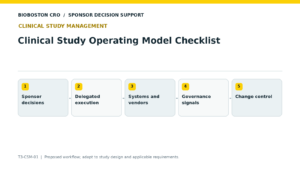
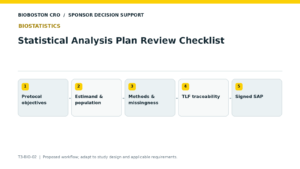
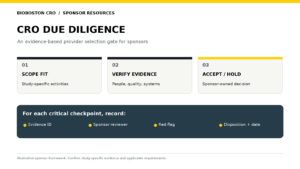
A protocol synopsis checklist helps sponsors decide whether a trial concept is sufficiently mature for full protocol authoring. The synopsis should resolve the choices that could change study purpose, population, endpoint interpretation, participant safety or operational feasibility. Expanding unstable assumptions into dozens of pages creates a longer document, not a stronger design.
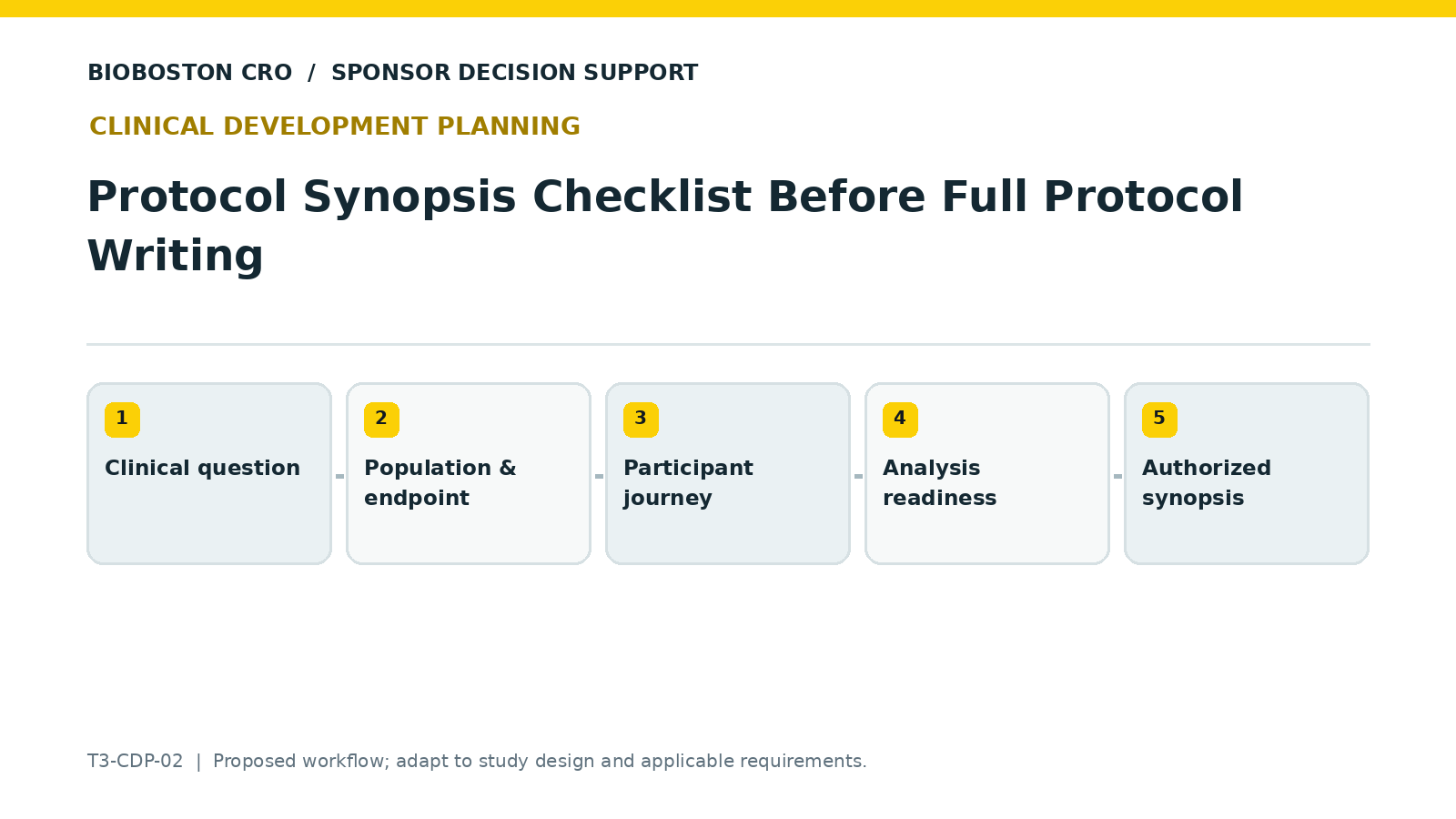
This checklist is most useful when Medical, Clinical Development, Statistics, Clinical Operations, Data Management and Regulatory disagree about whether the concept is ready. It uses an explicit stop/resolve/advance gate to keep critical design questions visible before authoring begins.
What the sponsor needs to decide
Use one row per unresolved design decision, with an accountable owner, evidence source, preferred option and impact if delayed. Label details that may safely remain open for full-protocol development separately from decisions that change design feasibility or the clinical question.
Protocol Synopsis Checklist Before Full Protocol Writing: evidence and decision matrix
| Review point | Evidence to collect | Sponsor decision or acceptance criterion |
|---|---|---|
| Clinical objective and rationale | Target condition, scientific hypothesis, purpose and contextual evidence | A named clinical decision exists for every major objective. |
| Population and eligibility | Inclusion/exclusion rationale, prevalence, recruitment burden and safety considerations | Eligibility supports the objectives and feasible enrollment. |
| Endpoints and estimands | Definitions, timing, instrument, clinical relevance and intercurrent events | The primary treatment question is unambiguous and measurable. |
| Design, arms and dose | Controls, allocation, escalation, treatment period and stopping criteria | Clinical and statistical rationale is coherent with available safety evidence. |
| Safety and participant pathway | Key assessments, monitoring, stopping/escalation signals and visit burden | Medical and operations agree the proposed schedule is safe and executable. |
| Analysis concepts | Populations, sample-size assumptions, key analyses and missing-data approach | Statistics confirms that the design can answer the defined objective. |
| Systems, vendors and supply | Critical data origin, site procedures, central labs, dose supply and dependencies | No unassigned dependency would invalidate the schedule or endpoint. |
| Governance and authorization | Decision log, cross-functional review, required advice and open questions | Only acceptable residual decisions are deferred, with owner and deadline. |
How to apply this framework to a real sponsor decision
Resolve the primary clinical question first
A synopsis should not alternate between several incompatible versions of its primary objective. Decide whether the study is exploratory, dose-finding or intended to support a specific inference, then connect endpoint and sample-size assumptions.
Walk through one participant’s journey
Simulate screening, consent, dosing, safety checks, visits, data collection and end-of-study follow-up. Note where eligibility, staffing or participant burden makes the proposed pathway unrealistic.
Cross-check endpoint collection and analysis
Ask whether a planned endpoint has a defined measurement, device, reader, schedule and handling of missed data. A proposed analysis is not a substitute for specifying how the necessary information will be captured.
Separate decisions from drafting details
Minor wording, template numbering and formatting can remain for authoring. Population, dose rules, key endpoint timing and material safety safeguards cannot be deferred without a decision owner and documented risk.
Record the readiness verdict
Use Go, Conditional Go with named open items, or Hold. Document why, which functions approved, and how significant new information reopens the gate. Revisit after regulatory feedback or feasibility evidence changes.
Warning signs that need intervention
- Eligibility criteria are copied without checking recruitment feasibility.
- Endpoint terminology changes between clinical concept and statistical assumptions.
- A safety visit is omitted because nobody has mapped the full participant pathway.
- The synopsis calls a regulatory strategy “agreed” before seeking the relevant advice.
- Drafting begins with critical design choices hidden in tracked comments.
First-week sponsor action plan
- Run the eight-section readiness checklist in one cross-functional meeting.
- Assign owners and due dates to every Hold or Conditional Go issue.
- Confirm that the primary endpoint can be collected and analyzed as described.
- Release a controlled synopsis version as the full-protocol authoring baseline.
To connect this decision framework to actual study responsibilities, see BioBoston CRO Clinical Development Planning support. The service team can help structure sponsor oversight and the evidence needed to make a documented decision; site-facing or other specialized execution may be coordinated with qualified partners where appropriate.
Frequently asked sponsor questions
Is a synopsis mandatory before every clinical protocol?
There is no universal requirement to use this particular synopsis format; it is a practical sponsor design-control tool.
Can the synopsis change during protocol writing?
Yes, through controlled review, but a change affecting objective, population, endpoint or safety should receive explicit cross-functional assessment.
What should block progression?
Unresolved choices that affect participant protection, the primary clinical question, statistical validity or basic operational feasibility.
Technical and regulatory context
The framework reflects relevant FDA/ICH principles, including ICH E8(R1), ICH E6(R3), ICH E9(R1). Guidance documents contain nonbinding recommendations and should not be described as universal legal requirements. Applicable binding obligations and study-specific authority expectations should be assessed separately; retain current source/version records in the internal quality file.
Next step for the sponsor
If your team is resolving the decisions above, explore BioBoston CRO Clinical Development Planning services for a scoped assessment, responsibility map or expert-supported working plan. Keep the decision record and supporting evidence even if you ultimately use another delivery model.