For an early-stage sponsor approaching an IND, the question is often framed as “Should we prepare a CTD or an eCTD?”
For most commercial U.S. development programs, that is the wrong decision.
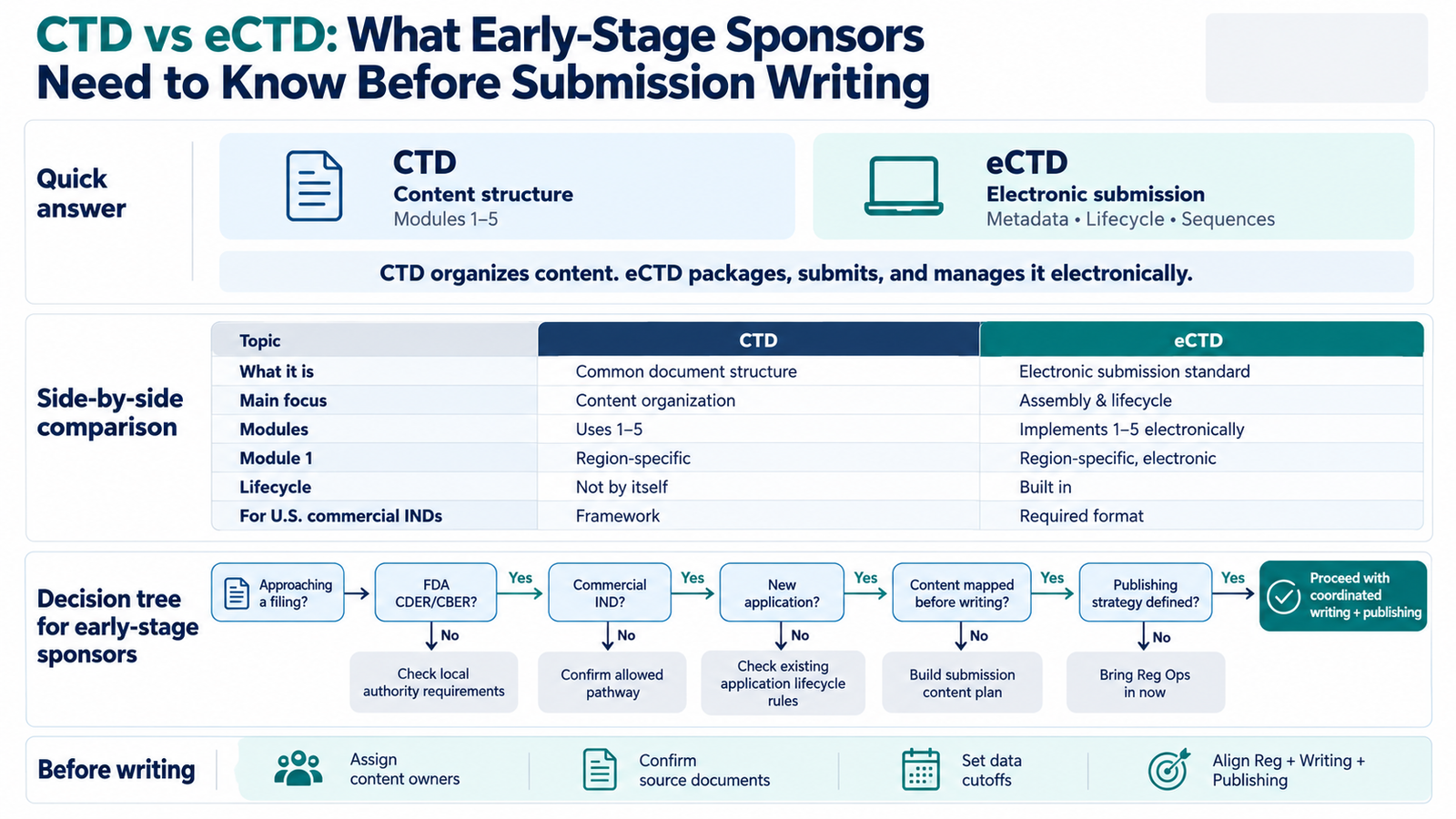
The Common Technical Document (CTD) describes how regulatory information is organized into a common structure. The electronic Common Technical Document (eCTD) is the electronic submission standard used to assemble, transmit, navigate and maintain that regulatory information over time.
In practical terms:
CTD helps determine where the content belongs.
eCTD determines how that content is electronically packaged and managed as a regulatory submission.
For commercial INDs submitted to FDA’s CDER or CBER, eCTD requirements apply. Sponsors therefore generally should not choose between CTD and eCTD. They should develop submission content with the correct regulatory structure in mind while planning the eCTD publishing strategy early enough to avoid problems at the end.
That distinction matters before submission writing begins.
CTD vs eCTD at a glance
| Question | CTD | eCTD |
| What is it? | A harmonized framework for organizing regulatory information | An electronic standard for submitting and managing regulatory information |
| Primary focus | Content organization | Electronic structure, metadata, navigation, transmission and lifecycle |
| Developed through | ICH M4 | ICH M8 plus regional implementation requirements |
| Uses Modules 1–5? | Yes | Yes; eCTD implements the CTD structure electronically |
| Is Module 1 harmonized globally? | No. Module 1 is region-specific | Regional requirements are implemented electronically |
| Does it define scientific evidence requirements by itself? | No | No |
| Does it replace FDA IND regulations? | No | No |
| Does it manage document lifecycle? | Not by itself | Yes |
| Relevant to commercial U.S. INDs? | Yes, as an organizational framework | Yes, as the required electronic submission format |
| Main sponsor-side concern | Correct content and document placement | Technical assembly, sequencing, metadata, validation and lifecycle |
The most important point is that neither CTD nor eCTD determines by itself whether the scientific evidence supporting an IND is adequate.
For a U.S. IND, sponsors still need to determine applicable content requirements under 21 CFR Part 312, relevant FDA guidance and product-specific expectations.
What is the CTD?
The Common Technical Document was developed through ICH to establish a common organization for quality, safety and efficacy information.
Its five-module structure is:
Module 1 — Regional administrative information
Requirements differ by regulatory authority.
Module 2 — Summaries and overviews
High-level quality, nonclinical and clinical summaries and overviews.
Module 3 — Quality
Chemistry, manufacturing and controls information.
Module 4 — Nonclinical study reports
Pharmacology, pharmacokinetic and toxicology information.
Module 5 — Clinical study reports
Clinical study information and related documentation.
For an early-stage sponsor, the CTD framework is useful because it forces the team to think beyond individual documents.
Information written in one area often needs to remain consistent with information elsewhere.
For example, the investigational product described by CMC must align with the material used in supporting nonclinical studies and the product proposed for clinical administration.
That is fundamentally a content-management problem, not an electronic publishing problem.
What makes eCTD different?
eCTD takes regulatory content and places it within a standardized electronic architecture.
It adds elements such as:
-
- electronic document hierarchy;
-
- structured metadata;
-
- XML backbone information;
-
- document identifiers;
-
- hyperlinks and navigation;
-
- technical validation;
-
- sequential submissions; and
-
- lifecycle operations for documents already submitted.
The lifecycle component is especially important.
An IND is not submitted once and forgotten.
After the original submission, the regulatory record may continue through protocol amendments, information amendments, safety reports, annual reports and other correspondence.
eCTD allows those submissions to become part of a structured regulatory lifecycle.
That means sponsors should not think about eCTD only during the week when the initial IND is being published.
The practical decision for an early-stage sponsor
The real decision is not:
CTD or eCTD?
It is:
How should we structure the content now so that it can move efficiently into the required electronic submission and remain manageable throughout the IND lifecycle?
There are three decisions to make.
Decision 1: What regulatory requirements control the content?
Start with the application type, jurisdiction, development stage and product.
For a U.S. IND, 21 CFR Part 312 and applicable FDA guidance establish the regulatory context.
Do not assume that a CTD table of contents alone tells the scientific team what evidence is required.
Decision 2: How should the submission be organized for authoring?
Before writers begin, map the planned submission content to its intended location and establish:
-
- document ownership;
-
- source documents;
-
- expected granularity;
-
- data cutoffs;
-
- reviewers;
-
- cross-document dependencies; and
-
- unresolved content decisions.
This is where CTD-aware submission planning becomes valuable.
Decision 3: How will the submission be published and maintained?
For a commercial FDA IND, eCTD should be treated as part of submission planning not as a last-minute formatting exercise.
The regulatory operations or publishing team should confirm the applicable FDA-supported eCTD version, technical specifications, validation criteria and submission process.
What about eCTD v3.2.2 vs eCTD v4.0?
This is now a more relevant decision than “CTD vs eCTD.”
FDA currently supports both eCTD v3.2.2 and eCTD v4.0.
FDA began accepting new INDs and other new regulatory applications in eCTD v4.0 on September 16, 2024.
However, sponsors should not assume that every existing application can simply migrate to v4.0.
As of this resource’s October 2026 review, FDA states that only new applications may be submitted in v4.0 and forward compatibility for existing v3.2.2 applications is not yet available.
For an early-stage sponsor preparing a new IND, the appropriate technical version should therefore be decided with Regulatory Operations or the publishing provider using the current FDA specifications not by the medical writer working independently.
Sponsor decision tree
Use this before authoring begins:
1. Is the submission going to FDA CDER or CBER?
→ No: Confirm the applicable regional authority’s CTD/eCTD requirements.
→ Yes: Continue.
2. Is this a commercial IND or another application type subject to FDA’s eCTD requirement?
→ No: Determine whether eCTD is optional, encouraged or subject to another submission pathway.
→ Yes: Plan for eCTD.
3. Is this a new regulatory application?
→ Yes: Determine whether v3.2.2 or currently supported v4.0 is the appropriate implementation for the program.
→ No, an existing v3.2.2 application: Do not assume migration to v4.0 is available. Check current FDA implementation status.
4. Has the content structure been mapped before drafting?
→ No: Build the submission content plan first.
→ Yes: Continue authoring.
5. Are document granularity, publishing responsibilities and technical dependencies defined?
→ No: Bring Regulatory Operations/publishing into planning now.
→ Yes: Proceed with integrated authoring and publishing preparation.
How early should eCTD planning enter the writing process?
Use this simple sponsor-side score.
Add one point for each statement that applies:
| Decision factor | Score |
| Initial submission is planned within approximately six months | +1 |
| Multiple internal functions will author or review documents | +1 |
| Multiple CROs, laboratories, manufacturers or external writers provide source content | +1 |
| Significant CMC, nonclinical or clinical content is still evolving | +1 |
| Submission contains substantial cross-references, study data or document dependencies | +1 |
| The sponsor does not have an experienced internal Regulatory Operations/publishing lead | +1 |
Score 0–1: standard coordination
Normal submission planning may be sufficient, but identify the publishing pathway before documents are finalized.
Score 2–3: integrate publishing with authoring
Build the content plan, document structure and publishing assumptions before major authoring begins.
Score 4–6: treat submission architecture as part of the writing strategy
Do not run medical writing and publishing as separate sequential projects.
Establish document ownership, granularity, naming conventions, source control, review responsibilities and publishing requirements from the beginning.
This scoring framework is a BioBoston CRO planning tool, not an FDA requirement.
Five red flags sponsors should resolve early
1. “We’ll worry about eCTD after all the documents are final.”
This often creates avoidable rework.
Publishing requirements can affect document structure, granularity, file preparation and navigation. Regulatory Operations should not first see the submission when authoring is complete.
2. The team uses “CTD” and “eCTD” interchangeably
This usually signals that scientific content planning and technical publishing responsibilities have not been clearly separated.
The people accountable for each should be identified.
3. Writers are deciding document structure without Regulatory Operations
Medical writers understand content, but the publishing architecture needs regulatory operations input.
The two functions should work from the same content plan.
4. A vendor is asked to “convert everything to eCTD” at the end
eCTD publishing is more than converting Word files into PDFs and putting them into folders.
Technical validation, metadata, document placement and lifecycle considerations need to be controlled.
5. Nobody is planning what happens after sequence 0000
The first IND submission begins a regulatory lifecycle.
The team should understand how amendments, reports and future updates will relate to the original submission.
Questions sponsors should answer before submission writing starts
Before assigning documents to writers, confirm:
Regulatory
-
- What application type are we preparing?
-
- Which FDA center will receive it?
-
- What regulations and product-specific guidance apply?
-
- Are there commitments from prior FDA interactions that must be reflected?
Content
-
- What documents and sections are required for this submission?
-
- Who owns the scientific content?
-
- Which source documents are authoritative?
-
- Which major decisions remain unresolved?
Authoring
-
- Who will write each section?
-
- Who will perform scientific and regulatory review?
-
- What terminology and data cutoffs will be controlled across documents?
-
- How will cross-document inconsistencies be identified?
Publishing
-
- Who owns Regulatory Operations and eCTD publishing?
-
- Which currently supported eCTD version will be used?
-
- What document granularity is expected?
-
- When will publishing QC begin?
-
- Who will manage validation findings?
Lifecycle
-
- Who will maintain the submission after the initial IND?
-
- How will amendments and reports be managed?
-
- Where will the authoritative submission history reside?
If several of these questions have no clear answer, the submission may not yet be ready for efficient authoring.
Recommended next steps
For a funded early-stage sponsor approaching an IND:
-
- Confirm the regulatory pathway and application type.
-
- Identify current FDA content and electronic-submission requirements.
-
- Build the submission content map.
-
- Assign content owners, authors and reviewers.
-
- Identify authoritative source documents.
-
- Decide the eCTD publishing strategy with Regulatory Operations.
-
- Establish document granularity and naming conventions.
-
- Resolve critical cross-functional dependencies.
-
- Begin coordinated submission authoring.
-
- Perform publishing and technical QC throughout preparation—not only at the end.
The goal is to create one integrated submission process rather than separate scientific writing and publishing workstreams that meet only at the deadline.
For sponsors that need help coordinating the content structure, source material, authors and regulatory narrative, BioBoston CRO Submission Writing support can support the submission from content planning through coordinated authoring and review.
Final takeaway
The distinction between CTD and eCTD is simple:
CTD organizes regulatory content.
eCTD electronically submits and manages that content.
For a commercial U.S. IND, the sponsor generally does not choose one instead of the other.
The better question is whether the content, authors, Regulatory Operations team and publishing strategy are aligned early enough to produce a consistent submission without unnecessary rework.
Need help applying this to your program? Explore BioBoston CRO Submission Writing support.