FSP vs Full-Service CRO: Which Outsourcing Model Fits an Emerging Biotech?
For an emerging biotech, choosing between a full-service CRO and an FSP model is not simply a question of which vendor offers more services.
It is a decision about where operational integration, decision-making, accountability, and day-to-day coordination will sit.
A full-service CRO typically coordinates multiple trial functions within one provider-led delivery model. An FSP or Functional Service Provider model outsources defined functions or resources while the sponsor retains more direct control over how those functions integrate. Neither model is automatically better.
The right choice depends primarily on the sponsor’s internal capabilities, trial complexity, existing systems, functional gaps, and ability to govern multiple interfaces.
For many emerging biotechs, the best answer is ultimately a hybrid model rather than an all-or-nothing choice.
Quick answer
Consider full-service outsourcing when:
- internal clinical operations bandwidth is limited;
- one study requires several tightly connected functions;
- the sponsor wants fewer operational interfaces;
- substantial geographic or operational complexity must be coordinated; or
- the organization does not yet have the infrastructure to integrate several functional providers.
Consider FSP or functional outsourcing when:
- strong sponsor-side leadership already exists;
- only certain functions need additional capability or capacity;
- maintaining direct operational control is important;
- sponsor systems and processes should remain the operating environment; or
- specialized expertise is more important than consolidating everything under one provider.
Consider a hybrid model when both conditions apply.
The most important question is not, “Which model is better?”
It is:
Which operating model puts integration responsibility where your organization can manage it most effectively?
Who this guide is for
This decision framework is designed for:
- Clinical Operations leaders;
- Clinical Project Managers;
- Heads of Development;
- Quality and Clinical QA leaders;
- vendor-management or procurement teams;
- Chief Medical Officers; and
- executives at funded emerging biotech or small-pharma companies.
It is especially relevant when a sponsor is preparing for its first or next major clinical study and must decide how much execution to consolidate versus manage across specialized providers.
First, understand what FSP actually means
“Full-service CRO” and “FSP” are commercial operating-model terms rather than regulatory categories.
A full-service CRO model generally places multiple trial functions under one provider’s integrated delivery structure.
Depending on scope, those functions might include:
- project management;
- clinical operations;
- site management and monitoring;
- data management;
- biostatistics;
- medical writing;
- pharmacovigilance;
- regulatory support; and
- other study services.
An FSP model usually assigns a defined function, team, or capability to an external provider while the sponsor retains more responsibility for integrating that work with the rest of the program.
Common FSP areas include:
- clinical monitoring;
- data management;
- biostatistics and statistical programming;
- medical writing;
- safety;
- regulatory operations; and
- clinical project management.
Importantly, FSP does not necessarily mean using a different company for every function.
A large CRO may offer both full-service and FSP arrangements. Likewise, a sponsor may combine a full-service CRO for core clinical operations with specialist providers for selected functions.
That is why the decision should focus on the operating model rather than the vendor label.
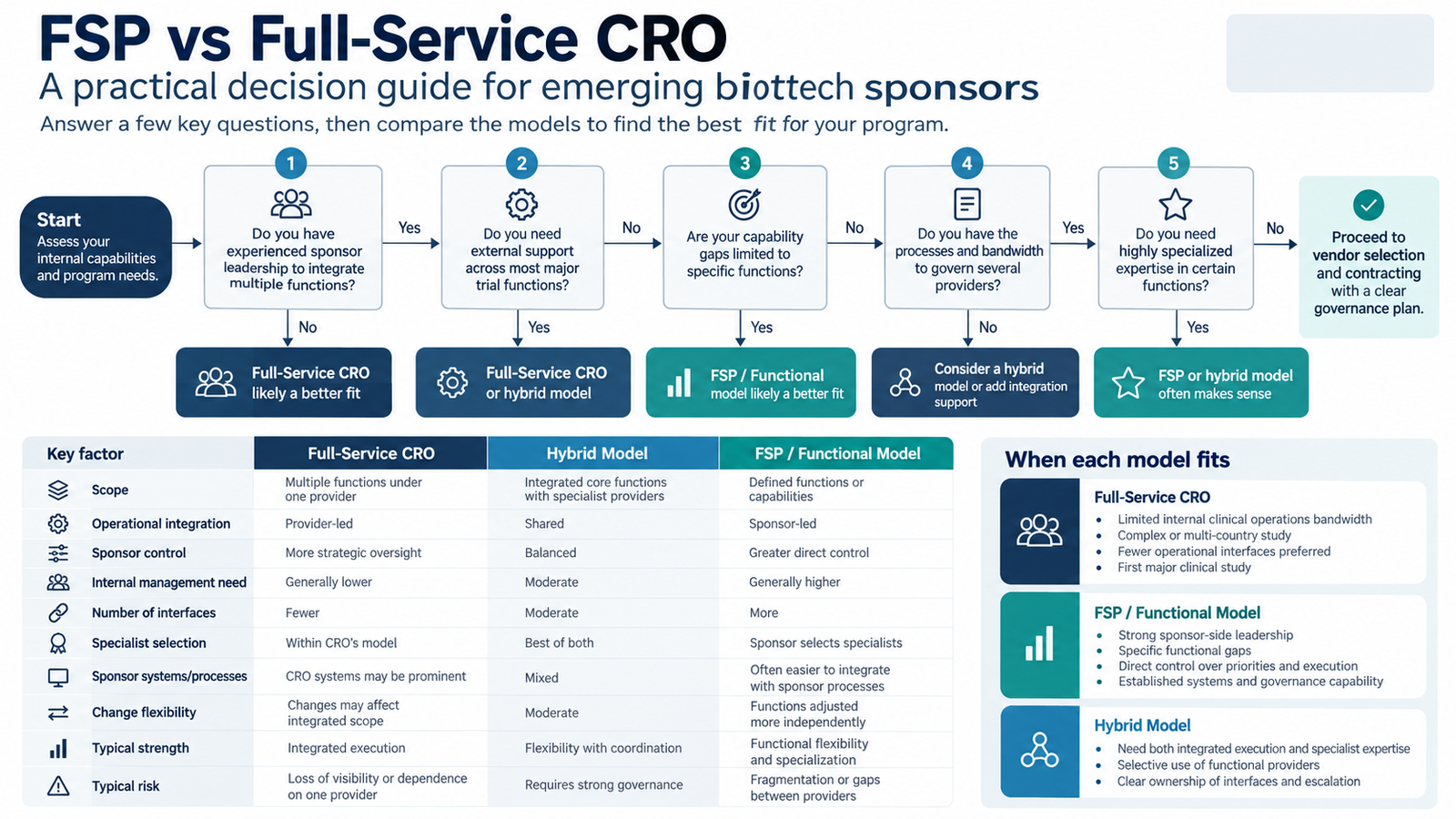
Full-service CRO vs FSP: side-by-side comparison
| Decision factor | Full-service CRO | FSP / functional model |
|---|---|---|
| Scope | Multiple functions coordinated within one delivery model | Defined functions, roles, or capabilities |
| Operational integration | Primarily provider-led | Primarily sponsor-led |
| Sponsor control | More strategic oversight; less direct functional management | Greater direct control over priorities and execution |
| Internal management need | Generally lower | Generally higher |
| Number of interfaces | Fewer major provider interfaces | Potentially more interfaces and dependencies |
| Specialist selection | Usually selected within the CRO’s model | Sponsor can select specialists by function |
| Sponsor systems/processes | CRO systems/processes may be prominent | Often easier to integrate resources into sponsor processes |
| Change flexibility | Changes may affect an integrated scope | Individual functions may be adjusted more independently |
| Cross-functional coordination | CRO carries more coordination responsibility | Sponsor carries more coordination responsibility |
| Governance requirement | Significant | Significant—and often more complex across providers |
| Typical strength | Integrated execution | Functional flexibility and specialization |
| Typical risk | Loss of visibility or dependence on one provider | Fragmentation or gaps between providers |
The comparison should not be interpreted as a regulatory rule or universal description of every CRO contract. Actual responsibilities depend on the agreement and operating model.
The regulatory point emerging sponsors should not overlook
Outsourcing activities does not mean outsourcing the need for sponsor governance.
For U.S. IND studies, 21 CFR 312.52 permits a sponsor to transfer any or all applicable obligations to a CRO, but the transfer must be documented in writing. Obligations that are not identified as transferred remain with the sponsor.
Current ICH E6(R3) Good Clinical Practice also places significant emphasis on clear responsibilities, service-provider selection, access to performance information, appropriate oversight, and escalation.
This means a sponsor should not evaluate outsourcing models only on:
- price;
- headcount;
- geographic reach; or
- the size of the CRO.
The operating model must also allow the sponsor to obtain enough information to understand whether important trial activities are being performed appropriately.
A full-service contract reduces coordination points. It does not eliminate sponsor oversight.
Seven factors that should drive the decision
1. Sponsor-side leadership capacity
This is often the most important factor.
If the sponsor has only a CMO and one clinical lead attempting to manage several providers, a highly fragmented operating model can quickly become difficult to control.
If the sponsor already has experienced Clinical Operations and Project Management leadership, functional outsourcing becomes more feasible.
Ask: Who will integrate the work when two providers disagree or one dependency falls behind?
If the answer is unclear, the outsourcing model is incomplete.
2. Trial complexity
A simple, geographically concentrated study creates different coordination requirements than a multi-country study involving numerous sites, vendors, technologies, laboratories, and data flows.
As dependencies increase, the value of a clearly defined integration layer increases.
That integration can be supplied by a full-service CRO or by the sponsor but someone must own it.
3. Need for specialized expertise
A sponsor may have an excellent clinical operations partner but need unusually specialized expertise in:
- biostatistics;
- rare-disease recruitment;
- data standards;
- medical writing;
- imaging;
- biomarkers;
- pharmacovigilance; or
- another technical area.
Forcing every function into one commercial relationship is not always the optimal solution.
A hybrid approach can allow the sponsor to preserve integrated study execution while selecting specialist providers where additional depth is valuable.
4. Existing sponsor infrastructure
FSP models become more attractive when the sponsor already has mature:
- SOPs;
- systems;
- templates;
- governance processes;
- reporting standards; and
- functional leadership.
An emerging biotech without that infrastructure may inadvertently create multiple different vendor processes rather than one sponsor controlled operating model.
5. Desired level of control
Some sponsors want direct visibility into functional priorities, staffing decisions, metrics and deliverables.
Others intentionally want to remain at a higher governance level while a CRO manages daily execution.
Neither position is inherently better.
The problem occurs when the contract establishes one model while sponsor expectations assume the other.
6. Portfolio versus single-study needs
A sponsor running several trials may benefit from functional teams that work across its portfolio and develop familiarity with its systems, standards and development strategy.
A company approaching its first major clinical study may instead prioritize integrated delivery and reduced coordination burden.
Evaluate the program, not only the immediate staffing gap.
7. Governance capability
The more providers involved, the more important interface management becomes.
A multi-vendor model needs defined:
- responsibilities;
- deliverables;
- dependencies;
- KPIs or performance indicators;
- issue ownership;
- escalation paths;
- meeting structures;
- decision rights; and
- change-control processes.
If those mechanisms do not exist, adding specialized vendors can create fragmentation instead of flexibility.
Sponsor scoring framework
Use the following as a planning tool before issuing an RFP.
It is a BioBoston CRO decision framework—not a regulatory requirement.
Add points toward FSP / functional outsourcing
| Sponsor characteristic | Points |
|---|---|
| Strong internal Clinical Operations/PM leadership | +2 |
| Sponsor wants direct functional control | +2 |
| Established SOPs, systems and processes | +1 |
| Strong vendor-governance capability | +1 |
| Need for best-of-breed functional specialists | +1 |
| Multiple studies need scalable functional capacity | +1 |
| Sponsor can actively manage cross-vendor dependencies | +2 |
Add points toward full-service outsourcing
| Sponsor characteristic | Points |
|---|---|
| Limited internal clinical operations bandwidth | +2 |
| Complex or multi-country study requiring substantial integration | +2 |
| Sponsor wants fewer operational interfaces | +2 |
| Limited internal systems/process infrastructure | +1 |
| First major sponsored clinical study | +1 |
| Compressed execution timeline with many dependencies | +1 |
| Sponsor prefers provider-led day-to-day coordination | +1 |
Interpret the result
One model leads by 3+ points:
That model deserves serious consideration as the primary operating structure.
Scores are within 2 points:
Evaluate a hybrid structure before choosing either extreme.
Both scores are high:
The program probably needs significant external support and substantial specialist expertise. A carefully governed hybrid may be the strongest option.
Do not select from the score alone. Use it to expose where integration responsibilities need to sit.
Practical decision tree
Start: Do you have experienced sponsor-side leadership capable of integrating several clinical functions?
No→ Begin by evaluating an integrated full-service model.
Yes→ Continue.
Do you need external support across most major trial functions?
Yes→ Full-service or a hybrid model is likely more practical.
No→ Continue.
Are the capability gaps limited to specific functions?
Yes→ Evaluate FSP or specialist functional providers.
No→ Reassess the total operating model rather than sourcing functions individually.
Do you have the processes and bandwidth to govern several providers?
No→ Consolidate more responsibility or add a dedicated integration/project-management layer.
Yes→ A functional or hybrid model becomes more viable.
Are some functions highly specialized or strategically important?
Yes→ Consider separating those functions from the primary CRO where doing so improves capability without creating unacceptable interface risk.
Final question: Is every important interface owned?
No→ Do not finalize the operating model yet.
Yes→ Proceed to vendor selection and contracting.
Five red flags before signing the outsourcing model
1. “The CRO will handle everything.”
That statement is too vague.
Define exactly what the provider owns, what the sponsor retains, and which decisions require sponsor approval.
2. Nobody owns cross-vendor integration
A laboratory may meet its deliverable while Data Management cannot use the output.
A monitoring provider may resolve site issues while the central project plan remains outdated.
Each vendor can perform adequately while the overall study still fails at the interfaces.
3. Performance metrics exist but escalation rules do not
Metrics are useful only if poor performance triggers defined action.
Establish: signal → owner → escalation threshold → action → follow-up.
4. Subcontractors are invisible
Understand where important trial activities are subcontracted and how those providers will be governed.
Important responsibilities should not disappear into a vendor chain.
5. The sponsor chose the model before assessing internal capability
Vendor selection should follow operating-model design.
Starting with “Which CRO should we hire?” can be premature.
First determine what the sponsor will manage, what will be transferred, and who will integrate the pieces.
Questions to ask before choosing full-service, FSP or hybrid
Before issuing an RFP, answer:
Sponsor capability
- Who will own the overall trial?
- How much time can sponsor leadership realistically spend managing providers?
- Which functions can the sponsor competently oversee directly?
- Where are internal capability gaps?
Scope
- Which activities need to be outsourced?
- Which functions are tightly interdependent?
- Which require specialist expertise?
- Which could reasonably be changed without destabilizing the rest of the study?
Governance
- Who owns each vendor relationship?
- How will cross-vendor dependencies be tracked?
- What information will the sponsor receive?
- What metrics will be reviewed?
- When must issues be escalated?
- Who has decision authority?
Contracting
- Are transferred responsibilities clearly documented?
- Are subcontracting expectations clear?
- Are deliverables and assumptions measurable?
- Does change control match the operating model?
Quality
- How will the sponsor assess vendor suitability?
- What evidence will support ongoing oversight?
- How will quality issues be escalated and followed through?
- Can the sponsor obtain the information required to evaluate important trial activities?
If several answers remain unclear, the next step is probably not vendor selection.
It is operating-model design.
When a hybrid model makes sense
Emerging biotechs do not need to force every clinical activity into the same outsourcing structure.
A hypothetical sponsor might use:
Full-service clinical operations for startup, site management, monitoring and central project coordination;
Specialist biometrics support for data management, biostatistics and programming;
Independent clinical quality support for sponsor oversight and audit activities; and
Specialist medical/regulatory writing for critical development and submission documents.
That structure can work very well but only if responsibilities, interfaces and escalation are intentionally designed.
Otherwise, “best-of-breed” can become “nobody owns the gap.”
What to do next
Before selecting providers:
- Map all major trial functions.
- Identify what the sponsor can realistically manage internally.
- Define which responsibilities should be outsourced.
- Identify critical interfaces between functions.
- Decide who owns overall integration.
- Create a responsibility matrix.
- Define governance and escalation.
- Establish the performance information required from providers.
- Determine where specialist vendors genuinely improve capability.
- Then evaluate the vendor market.
For sponsors using a CRO alongside laboratories, technology providers and functional specialists, BioBoston CRO Vendor Governance support can help establish the responsibilities, performance controls and escalation structure needed to manage the model effectively.
Final takeaway
The choice between FSP and a full-service CRO is ultimately a choice about where integration will happen.
A full-service model can consolidate more execution and coordination under one provider.
An FSP model can preserve sponsor control and provide targeted expertise, but it requires the sponsor to manage more interfaces.
A hybrid model can provide both but only when governance is strong.
Before asking which vendor is best, determine who will own integration, oversight and decisions when something does not go according to plan.
Need help applying this to your program? Explore BioBoston CRO Vendor Governance support.
FAQ
Does using a full-service CRO eliminate sponsor oversight?
No. Outsourcing can transfer defined trial activities and, where applicable, regulatory obligations, but sponsor governance and appropriate oversight remain important. The exact responsibilities should be documented clearly.
Can an emerging biotech use an FSP model?
Yes. Company size alone does not determine the model. The more important question is whether the sponsor has enough internal leadership, infrastructure and governance capability to integrate the outsourced function with the rest of the program.
Can a sponsor use both a full-service CRO and functional providers?
Yes. Hybrid models can combine integrated delivery for core trial activities with specialist support for selected functions. The critical requirement is clear ownership of interfaces and escalation.