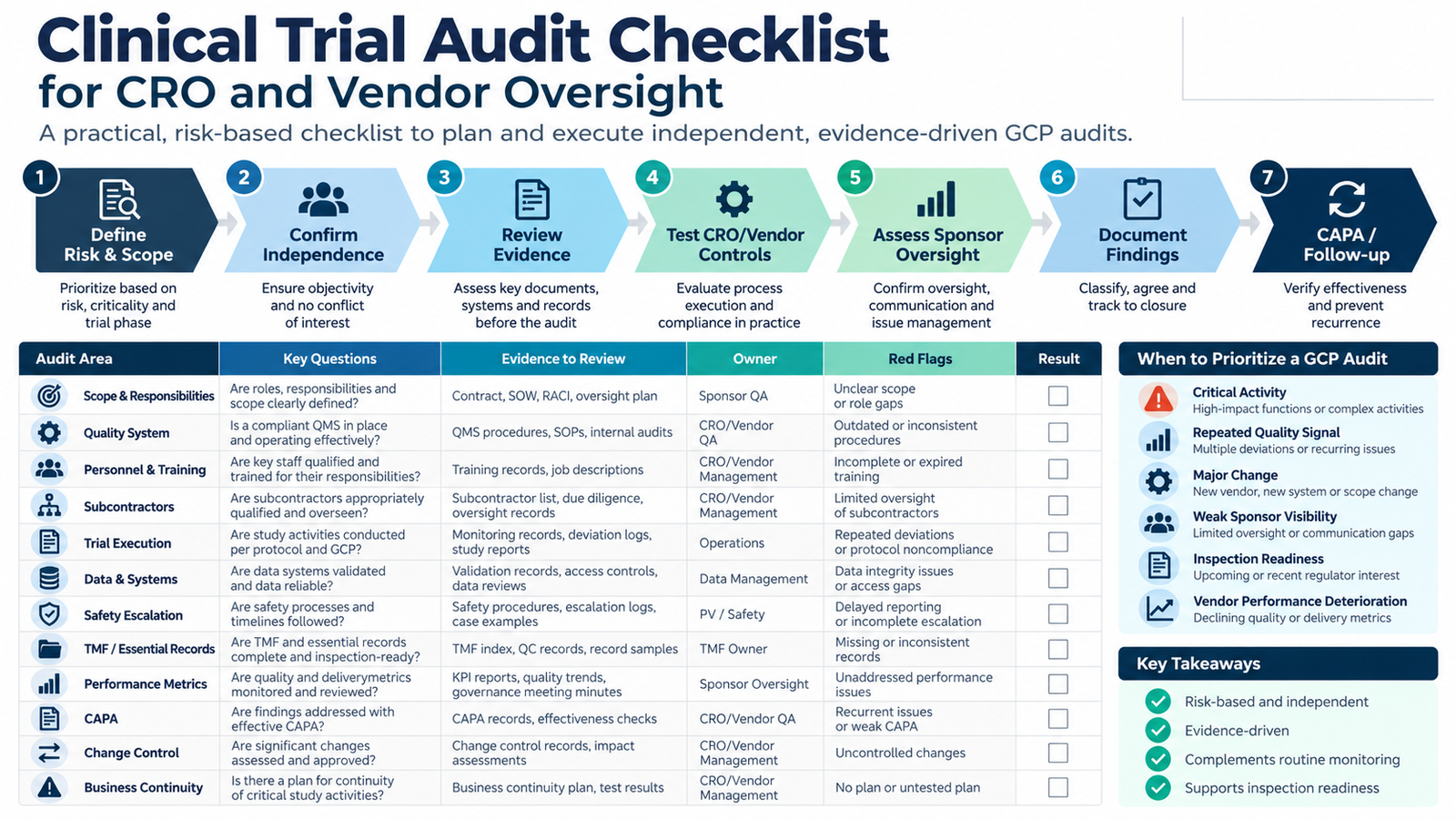
Clinical Trial Audit Checklist for CRO and Vendor Oversight
Clinical trial audit checklist planning should help a sponsor decide what to audit, why it matters, which evidence to test, who owns the response, and what should trigger escalation or CAPA.
For an outsourced early-phase trial, the audit should not be a generic document review. It should be a risk-based, independent examination of the CRO, vendor, site, system, or process most capable of affecting participant protection, data reliability, protocol compliance, or the sponsor’s ability to demonstrate oversight.
This is a BioBoston CRO sponsor-side audit framework. It is not an FDA-prescribed checklist, a substitute for the sponsor’s audit SOP, or a statement that every vendor or site must be audited on the same schedule.
Quick answer: what should a clinical trial audit checklist cover?
A practical sponsor-side checklist should cover seven control areas:
- Audit rationale and risk basis: why this entity or process was selected now.
- Scope and criteria: which trial activities, agreements, procedures, regulations, and GCP expectations apply.
- Independence and auditor competence: who will audit and how conflicts with routine operational work are avoided.
- Objective evidence: records, systems, interviews, samples, metrics, and observations used to test controls.
- CRO or vendor performance: whether delegated activities match agreements, procedures, and actual practice.
- Sponsor oversight: whether the sponsor receives, reviews, challenges, escalates, and follows up on important outsourced activities.
- Findings and follow-up: evidence-based observations, impact, root-cause/CAPA expectations, closure criteria, and effectiveness follow-up.
Who this checklist is for
This resource is designed for Clinical Quality, Clinical Operations, sponsor-oversight, and program leaders planning audits from startup through closeout. It is especially useful when a lean sponsor relies on a primary CRO plus laboratories, technology providers, data vendors, safety vendors, imaging providers, specialty consultants, or investigator sites.
The trigger may be routine risk-based assurance, vendor qualification, repeated performance concerns, a protocol or system change, a recurring deviation trend, a critical milestone, or inspection readiness.
Clinical trial audit checklist: scope and planning
| Checkpoint | Evidence to review | Primary owner / source | Red flag |
|---|---|---|---|
| 1. Audit objective is explicit | Documented reason for audit, decision to support, risk/problem being tested | Sponsor QA / audit program owner | Audit scheduled by habit with no clear risk or decision purpose |
| 2. Scope matches the risk | Activities, trial(s), systems, sites, vendors, period, interfaces, exclusions | Sponsor QA + functional owner | Scope is too broad to test deeply or too narrow to address the trigger |
| 3. Audit criteria are defined | Protocol, agreements, SOPs, GCP, applicable regulations, approved plans and specifications | Auditor | Auditee is judged against undocumented or shifting criteria |
| 4. Auditor is independent | Role description, reporting line, independence from audited activities | Sponsor QA | Auditor routinely performs the work being audited |
| 5. Auditor is qualified | Relevant GCP, process, system, therapeutic-area, and audit experience | Sponsor QA | Checklist is used as a substitute for auditor judgment |
| 6. Timing is risk-based | Milestones, performance trends, findings, data availability, inspection readiness | Sponsor QA + Clinical Ops | Audit occurs too early to test real evidence or too late to change outcome |
| 7. Pre-audit evidence request is targeted | SOPs, org charts, training, agreements, metrics, issue/CAPA history, system records | Auditor | Large unfocused document request with no link to audit questions |
CRO and clinical vendor GCP audit checklist
For CROs and clinical vendors, the audit should test how the contracted operating model works in practice. The exact questions depend on the transferred activities, but the following areas form a strong starting framework.
| Audit area | What to test | Evidence examples | Red flag |
|---|---|---|---|
| Scope and responsibility transfer | Actual work matches contracts, RACI/responsibility documents, and approved plans | MSA/SOW, task transfer, responsibility matrix, change orders | Critical activity occurs outside documented scope or ownership |
| Quality management system | Procedures are fit for the service and consistently applied | SOPs, deviations, CAPAs, quality metrics, management review | Procedures exist but operational teams use undocumented workarounds |
| Organization and competence | Roles are qualified, trained, resourced, and appropriately supervised | Org chart, CVs, training, role profiles, workload/resource data | Key responsibilities depend on unqualified or unstable resources |
| Subcontractors and fourth parties | Downstream providers are selected, controlled, and visible to the sponsor where relevant | Subcontract agreements, qualification, oversight, issue history | Critical work is subcontracted without clear sponsor visibility |
| Trial execution | Delegated activities follow protocol, approved plans, timelines, and escalation requirements | Plans, trackers, monitoring/site records, deliverables, deviations | Persistent deviations are normalized as routine operations |
| Data and computerized systems | Systems and data flows are fit for purpose, controlled, traceable, and protected | Access, validation/assurance evidence, audit trails, change records, reconciliation | Data corrections or access cannot be reconstructed |
| Safety and escalation interfaces | Important safety or quality information reaches the right sponsor owner on time | Safety workflow, escalation log, reconciliations, communications | Vendor and sponsor disagree on who owns an urgent decision |
| TMF / essential records | Records are complete, timely, accurate, attributable, and retrievable | TMF metrics, QC, filing evidence, correspondence, missing-document process | Missing or late records are repeatedly closed without durable correction |
| Performance management | Metrics show whether critical activities are controlled and trends are acted on | KPIs/KRIs, dashboards, minutes, action logs, trend analyses | Metrics are reported but do not drive decisions or escalation |
| Issue and CAPA management | Problems are investigated, contained, corrected, and checked for recurrence | Deviation/issue logs, RCA, CAPA, effectiveness evidence | Repeat findings appear under new IDs with no systemic linkage |
| Change control | Material changes are assessed for quality, timeline, scope, system, and regulatory impact | Change requests, impact assessments, approvals, implementation evidence | Operational changes are implemented before sponsor impact assessment |
| Business continuity and transition | Critical activities can continue or transfer without loss of control or records | BCP, transition plan, staffing contingencies, data/record handover | Single-point dependency with no tested contingency or exit plan |
Risk-based audit selection: what should move to the front of the queue?
ICH E6(R3) supports audit planning that is proportionate to trial risk. A sponsor should use the audit program to concentrate independent assurance where it can materially change a decision or reduce uncertainty.
| Higher-priority trigger | Why it matters | Possible audit focus |
|---|---|---|
| Critical outsourced activity | Failure could affect participant protection or reliability of trial results | Primary CRO, safety, central lab, randomization, data flow |
| Repeated quality signal | Recurrence suggests the control environment may not be working | Deviation trend, CAPA, issue management, training, oversight |
| Major transition or change | New people, systems, scope, or vendors can create control gaps | Handover, change control, data migration, responsibility transfer |
| Weak sponsor visibility | The sponsor cannot explain current performance or open risk | Metrics, governance, issue escalation, subcontractor control |
| Inspection or submission milestone | Evidence must be coherent, traceable, and defensible | Critical records, oversight evidence, TMF, safety, data integrity |
| Vendor performance deterioration | Late deliverables or recurring defects may signal broader process weakness | Resource model, root cause, quality governance, recovery plan |
How to test sponsor oversight during a vendor audit
A vendor audit should not examine only whether the vendor completed tasks. It should also test whether the sponsor retained enough information and control to oversee important transferred activities.
For sponsors with heavily outsourced trials, Sponsor Oversight support can help connect agreements, metrics, governance, escalation, and retained sponsor decisions into a defensible oversight model.
Useful audit questions include:
- Can the sponsor explain which activities are transferred and which responsibilities remain with internal owners?
- Does the sponsor receive performance information that is relevant to important trial risks, rather than only high-level status?
- Are material issues escalated early enough for the sponsor to make a decision?
- Can decisions and follow-up actions be traced through governance records?
- Does the sponsor challenge repeated poor performance, or merely record it?
- Are subcontracted activities visible when they affect critical trial work?
- When a finding is identified, can the sponsor show how remediation and effectiveness were followed through closure?
Audit execution: evidence beats interview answers
Interviews are useful for understanding how people believe the process works. Audit conclusions should be based on objective evidence that tests whether the process actually operated that way.
A practical evidence approach combines:
- procedure and plan review;
- targeted sampling of records or transactions;
- system and audit-trail review where relevant;
- performance and trend data;
- meeting, action, escalation, and decision records;
- cross-checking information across sponsor and vendor sources; and
- follow-up testing when one observation suggests a broader pattern.
The audit checklist should guide coverage, not force every question into a yes/no box. The auditor should be able to follow evidence when a higher-risk condition emerges.
Clinical trial audit checklist red flags
- The audit scope mirrors an old checklist even though the current vendor model has changed.
- The auditor is operationally responsible for the process being audited.
- Documents are reviewed, but actual transactions or records are not sampled.
- Sponsor and CRO responsibility documents disagree with day-to-day practice.
- Critical subcontractors are missing from the oversight model.
- Metrics repeatedly miss targets without escalation, trend analysis, or corrective action.
- Important deviations or quality events are closed locally without sponsor visibility.
- Systems, interfaces, or data transfers cannot be traced end to end.
- The same issue appears across multiple studies or vendors but is treated as isolated.
- Audit findings are closed when a CAPA action is completed, without evidence that the control became effective.
What to do after the audit
The audit report should distinguish factual observations from their quality significance and provide enough evidence for the sponsor to decide what happens next. Not every observation requires the same response.
- Confirm the finding and scope. Make sure the evidence and affected process are clear.
- Assess impact and urgency. Consider participant protection, data reliability, protocol/GCP compliance, timeline, and inspection exposure.
- Assign ownership. Name the sponsor and vendor owners responsible for response and decision.
- Require proportionate remediation. Root-cause analysis and CAPA depth should match the significance and recurrence risk.
- Track due dates and escalation. Late or weak responses should not disappear into routine vendor management.
- Verify effectiveness when warranted. Closure should be supported by evidence that the targeted control actually improved.
For findings that require structured remediation, GCP CAPA Support can help define the problem, test root cause, strengthen corrective actions, and verify effectiveness before closure.
Clearly hypothetical example
Consider a hypothetical Phase I sponsor using a full-service CRO, central laboratory, and EDC vendor. The CRO has missed several startup milestones and the sponsor has also seen repeated late escalation of site issues.
A generic annual CRO audit might sample SOPs, training records, and a few project files. A risk-based audit would focus more directly on the current trigger: responsibility transfer, resource model, startup controls, issue detection, escalation timing, governance decisions, and whether the same weaknesses appear across other sites or workstreams.
| Audit question | Evidence to test | Possible escalation trigger |
|---|---|---|
| Are startup responsibilities working as contracted? | Responsibility matrix, tracker history, handoffs, overdue actions | Repeated missed owner/due-date controls |
| Are site issues escalated on time? | Issue log, monitoring reports, emails, governance minutes | Material issue known before sponsor escalation |
| Is staffing adequate for critical work? | Resource plan, turnover, workload, vacancy coverage | Critical tasks depend on unfilled or unstable roles |
| Does governance drive recovery decisions? | Metrics, meeting minutes, decisions, recovery actions | Same variance reported repeatedly with no decision |
This example is intentionally hypothetical. The exact scope, sampling, severity grading, and follow-up should be defined by the sponsor’s audit procedures and the risks of the actual trial.
ICH E6(R3) and FDA BIMO context
ICH E6(R3) describes sponsor auditing as independent of routine monitoring or quality-control functions. When audits are performed, the approach should be proportionate to trial risk, use qualified independent auditors, follow documented procedures, and consider factors such as trial importance, complexity, participant risk, and identified problems.
For U.S. drug studies, 21 CFR 312.50 places responsibility on sponsors to select qualified investigators, provide needed information, ensure proper monitoring, and ensure investigations follow the investigational plan and protocols. 21 CFR 312.56 requires sponsors to monitor ongoing investigations and secure compliance or take specified action when investigators do not comply.
FDA’s Bioresearch Monitoring program includes inspections of sponsors, contract research organizations, monitors, and clinical investigators. Its objectives include protecting research participants, verifying the reliability of clinical trial data, and assessing compliance with applicable FDA requirements.
These sources support risk-based quality assurance and oversight. They do not prescribe this checklist or require every CRO, vendor, site, or process to be audited on a fixed universal schedule.
When GCP Audits support can help
An independent audit is most valuable when the sponsor needs evidence, not reassurance. The trigger may be vendor qualification, recurring quality signals, weak oversight visibility, a critical transition, inspection readiness, or a concern that routine monitoring is not answering the right question.
BioBoston CRO GCP Audits support can include risk-based audit planning, document review, interviews, remote or onsite assessment, evidence-based findings, reporting, and corrective-action follow-up across sites, vendors, systems, processes, data, and sponsor controls.
If the audit is being used as part of broader FDA readiness, Mock FDA Inspection support can test whether the sponsor’s clinical quality system, oversight evidence, and remediation records are inspection-ready.
Final clinical trial audit checklist
- The audit has a defined risk-based objective.
- Scope and criteria are documented before fieldwork begins.
- The auditor is independent of the audited activities and appropriately qualified.
- Timing is linked to risk, study activity, performance, or a meaningful decision point.
- Pre-audit evidence requests are targeted to the audit questions.
- Transferred activities and retained sponsor responsibilities are both tested.
- Subcontractors and interfaces are visible where they affect critical trial work.
- Objective evidence is sampled rather than relying only on interviews or SOP review.
- Systems, data flows, safety interfaces, TMF, issue management, and change control are included when relevant.
- Findings are evidence-based and tied to impact and scope.
- CAPA depth is proportionate to significance and recurrence risk.
- Effectiveness follow-up is planned for findings where closure requires evidence that the control improved.
Need help designing or performing a risk-based audit of a CRO, vendor, site, process, or sponsor control? Explore BioBoston CRO GCP Audits support.
FAQ
Is a GCP audit the same as routine monitoring?
No. ICH E6(R3) distinguishes sponsor audits from routine monitoring and quality-control functions. An audit is an independent examination used to evaluate whether trial-management and conduct processes are appropriate and compliant with the protocol, GCP, and applicable requirements.
Does every CRO or clinical vendor need to be audited?
Not on a universal fixed schedule. Audit planning should be risk-based and follow the sponsor’s documented procedures. Criticality, complexity, participant risk, prior performance, identified problems, and important milestones can influence whether and when an audit is appropriate.
Can a CRO audit its own work for the sponsor?
A vendor can perform internal quality activities, but a sponsor audit intended to provide independent assurance should use auditors who are independent of the clinical trial or process being audited. The sponsor should preserve the independence and objectivity of the audit function.
Can a clinical vendor audit be remote?
Yes, when appropriate to the audit objective and sponsor procedure. ICH E6(R3) allows documented audit procedures to address on-site and/or remote methods. The method should still allow the auditor to obtain sufficient objective evidence for the questions being tested.