FDA Inspection Readiness Checklist for BIMO Sponsors and CROs
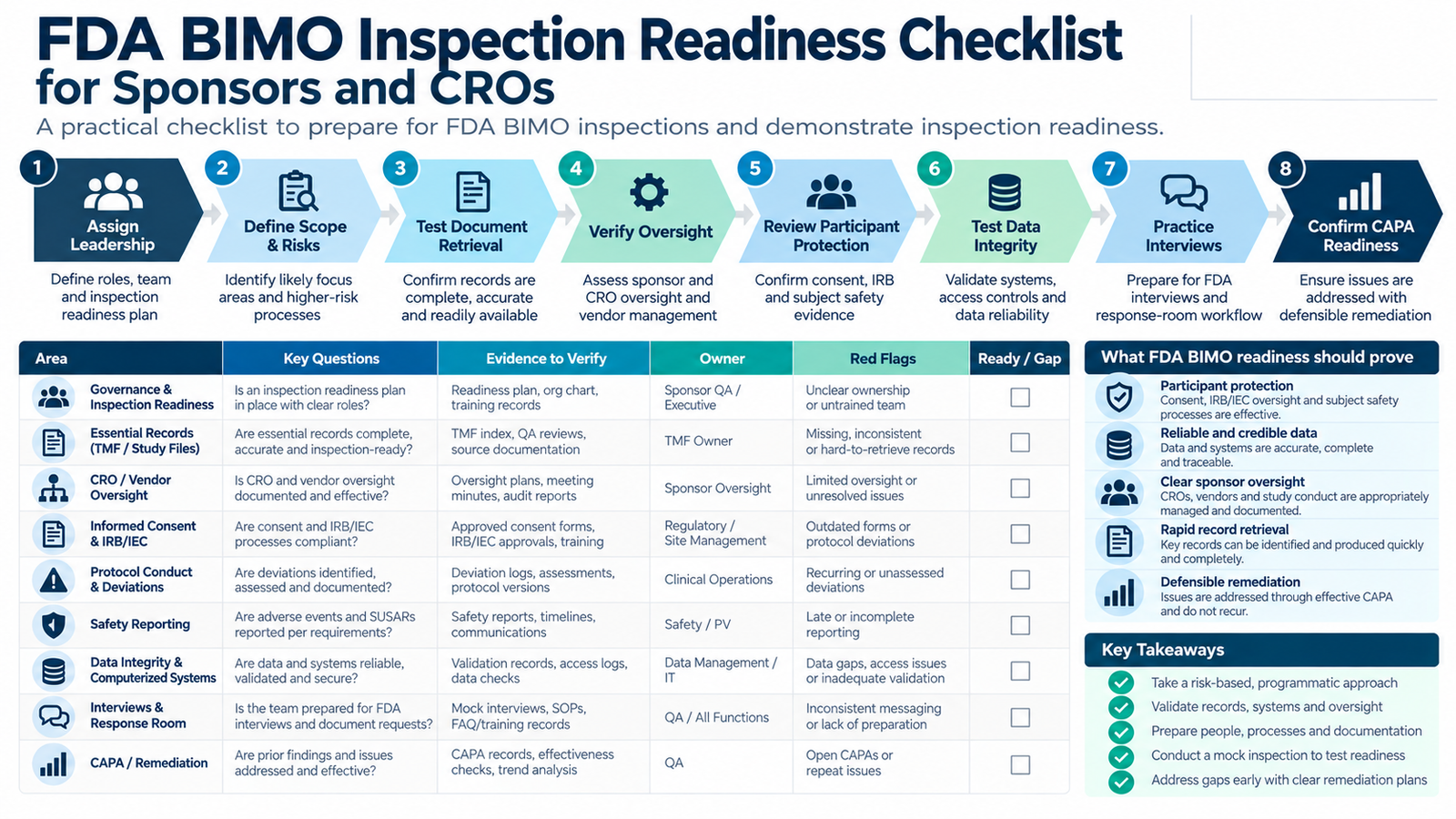
FDA inspection readiness checklist planning should confirm that a sponsor can explain how the trial was governed, show objective evidence for critical decisions, retrieve the right records quickly, and demonstrate that quality issues were detected, escalated, corrected, and followed through.
For a Bioresearch Monitoring (BIMO) inspection, readiness is broader than having a clean trial master file. FDA may examine the conduct and reporting of FDA-regulated research and, depending on the inspection assignment, may focus on sponsors, CROs, monitors, clinical investigators, IRBs, laboratories, systems, data flows, or other regulated research activities.
This is a sponsor-side readiness framework. It is not an FDA-prescribed checklist and does not replace study-specific regulations, FDA requests, your inspection SOP, or qualified regulatory and quality judgment.
Quick answer: what should an FDA inspection readiness checklist cover?
A strong readiness review should test six things before an inspection or major readiness decision:
- People: the right owners can explain responsibilities, decisions, and escalation paths.
- Records: essential evidence is complete, consistent, current, and quickly retrievable.
- Oversight: the sponsor can demonstrate control of CROs and other delegated activities.
- Participant protection: consent, IRB, eligibility, safety, and protocol controls are supported by evidence.
- Data integrity: source-to-submission data flows, systems, corrections, reconciliations, and audit trails can be explained.
- Remediation: deviations, audit findings, quality events, and CAPAs show appropriate investigation, ownership, closure, and effectiveness follow-up.
Who this checklist is for
This checklist is designed for Clinical Quality, Regulatory Affairs, Clinical Operations, sponsor-oversight, and executive leaders preparing for an announced or reasonably anticipated FDA clinical inspection, a BIMO-related inspection window, a major submission milestone, or a board-level readiness review.
It is especially useful for emerging biotech and small-pharma sponsors operating through a primary CRO and multiple specialist vendors, where the central inspection-readiness question is not simply whether records exist, but whether the sponsor can demonstrate retained oversight across the outsourced operating model.
FDA inspection readiness checklist: governance and inspection control
| Checkpoint | Evidence to expect | Typical owner | Red flag |
|---|---|---|---|
| 1. Inspection leadership is assigned | Named inspection lead, executive sponsor, quality lead, regulatory contact, backups | Clinical Quality / Regulatory | Roles are being decided after notice arrives |
| 2. Inspection scope is understood | Known study, function, site, vendor, product, period, and likely records in scope | Inspection lead | Teams prepare everything equally with no risk prioritization |
| 3. Response governance is documented | Escalation tree, response approval path, document-request workflow, decision log | Quality + Legal/Regulatory as applicable | Multiple teams can send inconsistent responses independently |
| 4. Inspection room process is tested | Front room/back room roles, request log, document QC, response tracking | Inspection coordinator | No single source of truth for requests and commitments |
| 5. Key personnel are available | Interview schedule, role coverage, contact information, contingency plan | Functional leaders | Critical decisions depend on former staff or unavailable vendors |
Records and document retrieval readiness
FDA inspection readiness depends on more than record completeness. Teams should be able to retrieve the correct version quickly, explain why it is authoritative, and reconcile it with related records across the sponsor, CRO, sites, and systems.
| Checkpoint | Evidence to expect | Typical owner | Red flag |
|---|---|---|---|
| 6. Essential records are inspection-ready | Current, final, attributable records with clear filing location | TMF / functional owner | Important records exist only in email or local folders |
| 7. Document versions reconcile | Approved protocols, amendments, plans, manuals, agreements, training | Document owners | Teams use different versions of the same governing document |
| 8. Missing-document issues are visible | Gap log, remediation owner, due date, impact assessment | TMF / Quality | Missing evidence is discovered only during inspection simulation |
| 9. Retrieval speed is tested | Timed mock requests across sponsor/CRO/site systems | Inspection coordinator | Records can be found only by one person who knows where they are |
If essential-record completeness is a major concern, a focused TMF Audit can help identify missing, late, inconsistent, or weakly supported evidence before inspection pressure increases.
Sponsor and CRO oversight readiness
Under U.S. IND regulations, sponsors retain defined responsibilities even when activities are delegated. Inspection readiness should therefore show not only what the CRO did, but how the sponsor knew whether critical activities were controlled.
| Checkpoint | Evidence to expect | Typical owner | Red flag |
|---|---|---|---|
| 10. Responsibilities are traceable | Contracts, transfer-of-obligations records, responsibility matrices, plans | Clinical Ops / Regulatory | Contract language, RACI, and actual practice conflict |
| 11. Vendor performance is actively reviewed | KPIs/KRIs, governance minutes, trend reviews, action logs | Clinical Ops / QA | Metrics are reported but do not trigger decisions |
| 12. Escalations are documented | Issue records, decisions, communications, follow-up | Functional sponsor owner | Material issues are handled verbally with no decision trail |
| 13. Subcontractors are visible | Approved vendor chain, qualification, oversight evidence | Vendor owner / QA | Critical fourth-party work is unknown to sponsor owners |
Where oversight evidence is weak, a risk-based GCP Audit can test whether the outsourced operating model works as documented.
Participant protection and protocol compliance
For FDA-regulated clinical research, inspection readiness should connect participant protection requirements to the records that demonstrate how those requirements were implemented in the actual study.
| Area | Evidence to test | Red flag |
|---|---|---|
| Informed consent | Approved forms, consent dates, re-consent, version control, documentation of process | Consent records conflict with enrollment or procedure dates |
| IRB oversight | Approvals, continuing review where applicable, amendments, reportable events, correspondence | Protocol activity predates required approval |
| Eligibility | Source evidence, inclusion/exclusion assessment, medical review where required | Eligibility decisions cannot be reconstructed |
| Protocol deviations | Deviation log, significance assessment, trends, sponsor awareness, corrective action | Repeat deviations are classified as isolated events |
| Safety reporting | AE/SAE workflow, reconciliation, timelines, medical assessment, sponsor reporting records | Safety information differs across systems with unresolved reconciliation |
Data integrity and computerized-system readiness
An inspection-ready sponsor should be able to explain how critical trial data move from source and vendor systems into analyses and submissions, including who can change data, how changes are recorded, and how discrepancies are reconciled.
- Map critical data flows across sites, CROs, laboratories, EDC, safety, imaging, randomization, and other relevant systems.
- Confirm user access, role assignment, change control, validation/assurance evidence, and audit-trail availability where applicable.
- Test how data corrections, queries, reconciliations, and late changes are documented and approved.
- Verify that significant data-quality issues are linked to documented decisions, deviations, investigations, or CAPAs when appropriate.
- Make sure sponsor and vendor teams can explain the same data flow consistently.
Interview readiness: can your team explain the evidence?
Inspection readiness is not a memorization exercise. Interview preparation should help personnel give accurate, concise, role-appropriate answers grounded in records and actual practice.
Useful mock-interview questions include:
- What are your responsibilities for this study, and which responsibilities are delegated?
- How do you know the CRO or vendor is performing critical activities as expected?
- Describe the most significant quality issue in your area and how it was escalated.
- How are protocol deviations or safety issues reviewed and trended?
- Where is the authoritative record for this process, and how would you retrieve it?
- What happens when a vendor misses a critical requirement?
A good answer should be truthful and bounded by the interviewee’s role. Teams should avoid speculation, over-answering, rehearsed scripts that conflict with records, or trying to explain another function’s work.
CAPA and remediation readiness
Open or recently closed quality issues often receive more attention when they indicate a systemic weakness. Readiness should show that important findings were investigated proportionately and that closure was based on evidence rather than task completion alone.
- Define the problem and affected scope clearly.
- Document containment when immediate control is necessary.
- Support root-cause conclusions with evidence.
- Assign corrective and preventive actions to accountable owners.
- Track due dates, extensions, and escalation.
- Verify effectiveness when recurrence risk or significance warrants it.
For inspection-related remediation, GCP CAPA Support can help connect the finding, root cause, evidence, action plan, and effectiveness check into a defensible closure package.
What changed for BIMO inspection readiness in 2026?
One important readiness update is FDA’s December 2025 final guidance, Processes and Practices Applicable to Bioresearch Monitoring Inspections. The guidance describes FDA’s current thinking on records and information to be provided, communication before and during inspections or record requests, and other inspection-related conduct.
The guidance is nonbinding. The applicable statutory and regulatory requirements still depend on the product, study, inspection assignment, and regulated activity. For IND drug studies, 21 CFR 312.50 and 312.56 define key sponsor responsibilities for investigator selection, monitoring, protocol compliance, and response to investigator noncompliance. Parts 50 and 56 address human-subject protection and IRB requirements. ICH E6(R3) provides a modern risk-based GCP framework but should not be presented as a U.S. regulation.
Final FDA inspection readiness checklist
- Inspection leadership, backups, and response governance are assigned.
- The likely inspection scope and highest-risk evidence are understood.
- Front-room/back-room and document-request workflows are tested.
- Essential records are complete, version-controlled, and rapidly retrievable.
- Delegated CRO/vendor responsibilities and retained sponsor oversight are traceable.
- Participant protection, IRB, consent, eligibility, protocol, and safety evidence reconciles.
- Critical data flows, system controls, changes, and reconciliations can be explained.
- Key personnel can answer role-specific questions accurately and consistently.
- Open deviations, audit findings, and CAPAs have clear status, ownership, and evidence.
- Known gaps have documented remediation plans and escalation where needed.
- A mock inspection has tested people, records, systems, document retrieval, and response coordination.
When a mock FDA inspection is worth doing
A mock inspection is most useful when the organization needs to test the whole readiness system under realistic pressure, not simply review documents. BioBoston CRO Mock FDA Inspection and Clinical Inspection Readiness support can include readiness assessment, interview preparation, document-room simulation, mock interviews, response coaching, observation reporting, and remediation planning.
Need help applying this to your program? Explore BioBoston CRO Mock FDA Inspection support.
FAQ
Is there an official FDA BIMO inspection checklist for sponsors?
FDA publishes BIMO program information, compliance programs, inspection guidance, and other resources, but this BioBoston CRO checklist is not an FDA-issued checklist. Sponsors should prepare against the actual regulations, FDA requests, relevant compliance programs, current guidance, and the facts of their study.
What is the difference between a BIMO inspection and a mock FDA inspection?
A BIMO inspection is an FDA regulatory activity. A mock FDA inspection is a readiness exercise designed to test people, records, systems, response processes, and known risks before an actual inspection.
Should the CRO own inspection readiness?
A CRO may support preparation and provide important records and subject-matter experts, but the sponsor should maintain clear oversight of delegated activities and retained responsibilities. Readiness should therefore test both CRO execution and sponsor oversight.