The 505(b)(1) vs 505(b)(2) pathway decision turns on the proposed drug, the applicant's evidence, and any reliance on studies or FDA findings that the applicant did not generate. This guide provides an evidence-ownership map and questions for evaluating the proposed reliance strategy.
Quick answer: what is the core difference?
| Dimension | 505(b)(1) | 505(b)(2) |
|---|---|---|
| Core evidence model | Full reports of investigations conducted by/for the applicant or available through right of reference/use | At least some information relied on for approval was not conducted by/for the applicant and no right of reference/use is available |
| Typical strategic question | What development program will independently support approval? | What prior finding or literature can be relied on, and what new studies bridge the proposed product to that evidence? |
| Development implication | Applicant generates/controls the core approval package | Program must justify the relevance of relied-upon evidence and fill product-specific gaps |
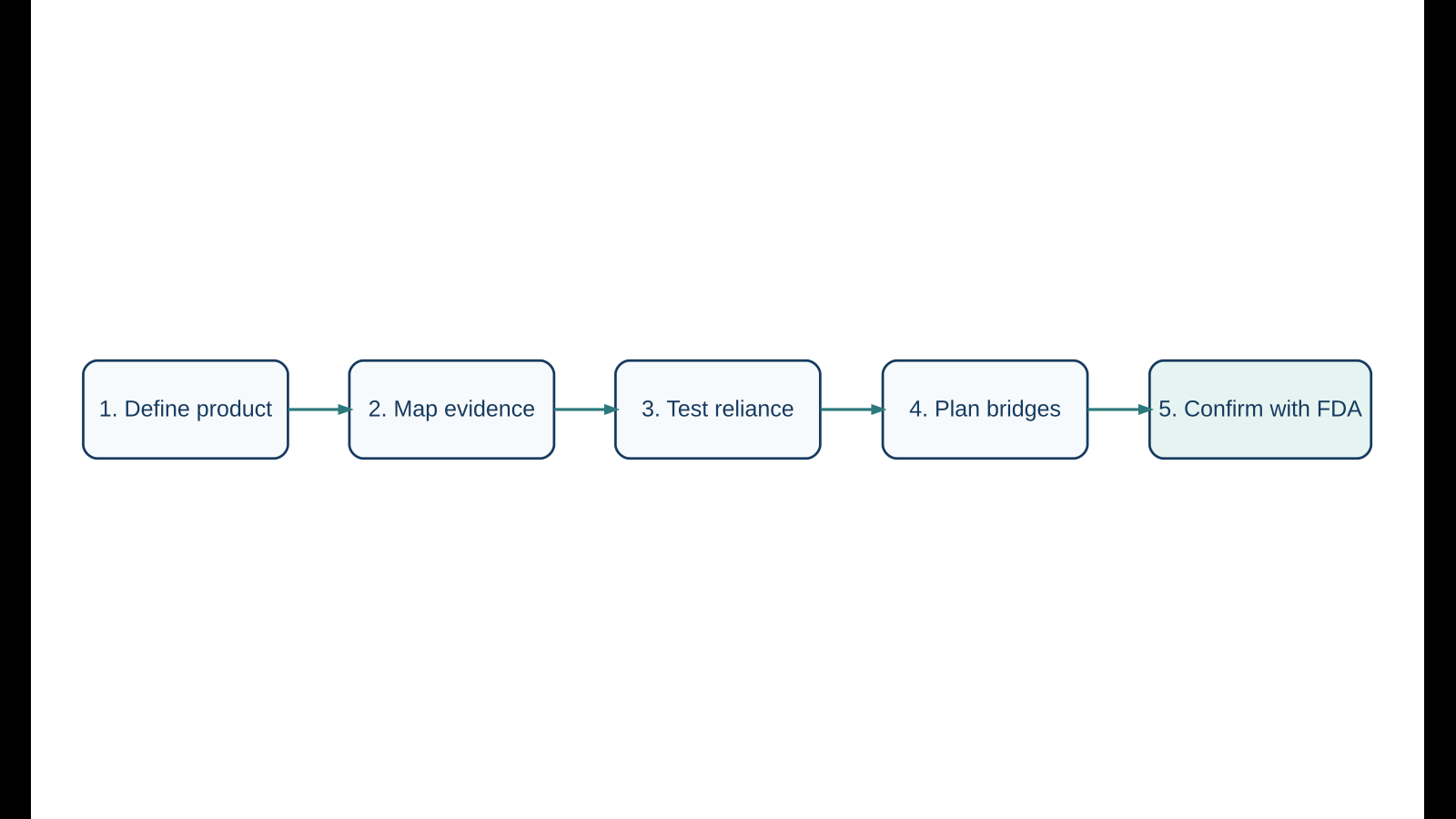
1. Start with the proposed product and change from precedent
- Active ingredient and formulation.
- Route, dosage form, strength, and regimen.
- Indication, population, and claims.
- Manufacturing or delivery differences.
- What prior FDA finding, approved product, or literature is scientifically relevant.
2. Build an evidence ownership map
| Evidence | Owned / right of reference? | Potential reliance role | Gap / bridge needed |
|---|---|---|---|
| Nonclinical finding | Yes / No | Direct evidence or relied-upon support | Define relevance |
| Clinical efficacy | Yes / No | Applicant study, literature, or FDA finding | Population/dose/endpoint bridge |
| Safety | Yes / No | Integrated own and relied-upon evidence | Product-specific risks |
| CMC / product quality | Usually applicant-specific | Supports proposed commercial product | Full product-specific control strategy |
3. Do not confuse 505(b)(2) with “less evidence”
A 505(b)(2) application can reduce unnecessary duplication when reliance is scientifically and legally appropriate, but it still needs enough product-specific evidence to support the proposed conditions of use. The bridging strategy is often the central development question.
For sponsors that need hands-on support applying this framework, BioBoston CRO Regulatory Pathway can support the underlying regulatory and cross-functional work.
4. Plan patent, exclusivity, and listed-drug questions with specialists
The pathway can involve legal and Orange Book considerations that are outside a scientific evidence matrix. Regulatory strategy should identify these dependencies early and route them to appropriate legal/patent counsel rather than treating them as a writing issue.
5. Use FDA interaction to test the reliance strategy
- Is the identified prior finding or information appropriate for reliance?
- What pharmacokinetic, clinical, or nonclinical bridge is needed?
- Does the proposed indication or formulation create additional data needs?
- Which product-specific safety or CMC questions remain independent of the relied-upon evidence?
Decision red flags
- The pathway is chosen before the evidence map is built.
- The sponsor assumes an approved reference product eliminates the need for bridging.
- The proposed indication is broader than the evidence that can be relied on.
- Product-specific CMC or safety differences are treated as administrative.
Need help evaluating the pathway?
BioBoston CRO Regulatory Pathway support can help compare evidence routes and define the questions that should be resolved with FDA.