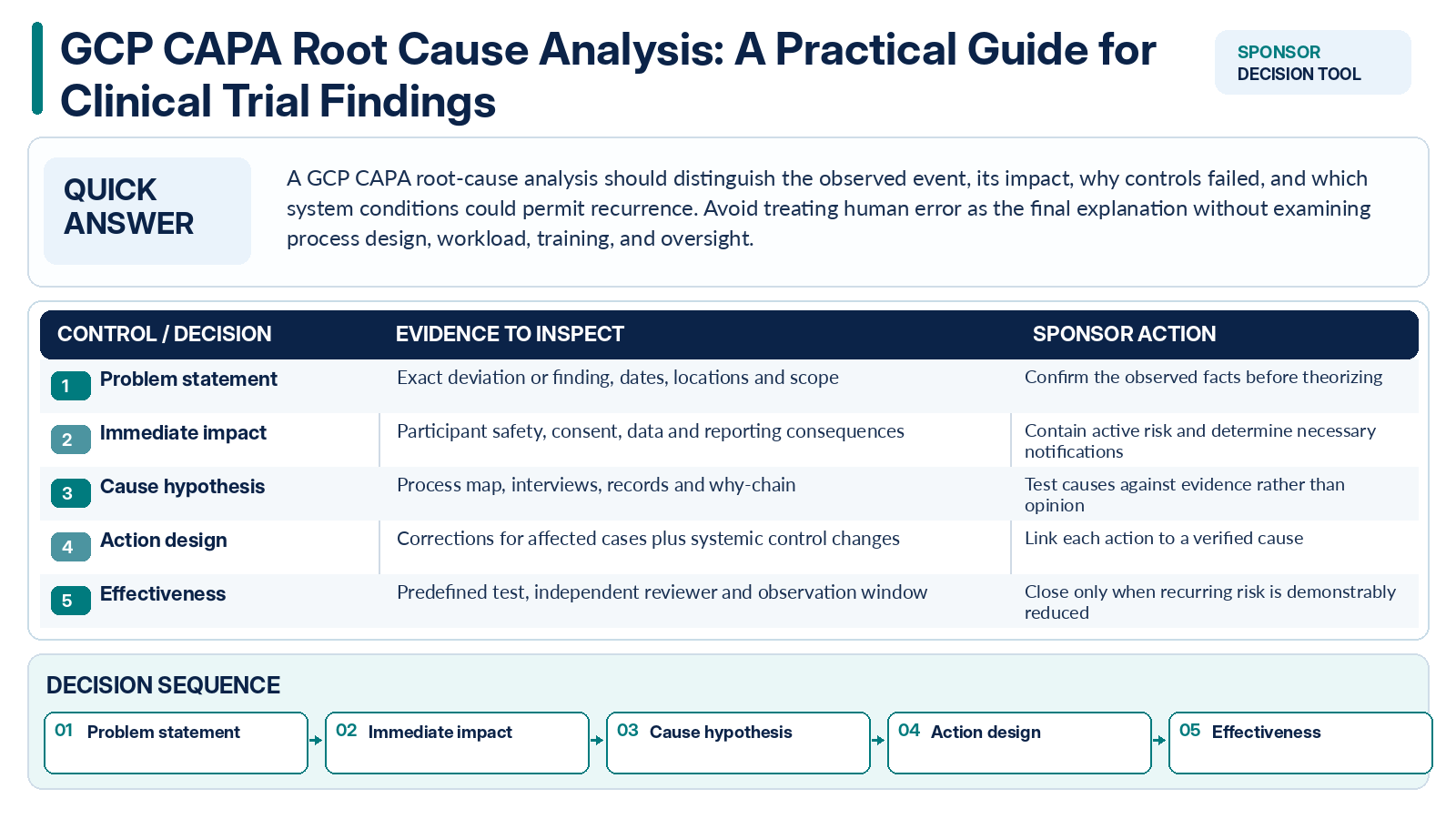
A GCP CAPA root-cause analysis should distinguish the observed event, its impact, why controls failed, and which system conditions could permit recurrence. Avoid treating human error as the final explanation without examining process design, workload, training, and oversight.
How to apply this workflow in practice
Begin with the most consequential control and the evidence needed to resolve it. The following matrix connects each decision to records and an accountable action, rather than treating the list as a generic compliance checkbox.
| Control / question | Evidence to examine | Sponsor action |
|---|---|---|
| Problem statement | Exact deviation or finding, dates, locations and scope | Confirm the observed facts before theorizing |
| Immediate impact | Participant safety, consent, data and reporting consequences | Contain active risk and determine necessary notifications |
| Cause hypothesis | Process map, interviews, records and why-chain | Test causes against evidence rather than opinion |
| Action design | Corrections for affected cases plus systemic control changes | Link each action to a verified cause |
| Effectiveness | Predefined test, independent reviewer and observation window | Close only when recurring risk is demonstrably reduced |
For teams that need support implementing this across functions, BioBoston CRO GCP CAPA Support can help adapt the controls to the study, vendors, and decision calendar.
Working through the controls
1. Problem statement
Evidence: Exact deviation or finding, dates, locations and scope. Decision: Confirm the observed facts before theorizing. Record the responsible function and the approved source version, and keep any remaining exceptions visible to the sponsor before this item is closed.
2. Immediate impact
Evidence: Participant safety, consent, data and reporting consequences. Decision: Contain active risk and determine necessary notifications. Record the responsible function and the approved source version, and keep any remaining exceptions visible to the sponsor before this item is closed.
3. Cause hypothesis
Evidence: Process map, interviews, records and why-chain. Decision: Test causes against evidence rather than opinion. Record the responsible function and the approved source version, and keep any remaining exceptions visible to the sponsor before this item is closed.
4. Action design
Evidence: Corrections for affected cases plus systemic control changes. Decision: Link each action to a verified cause. Record the responsible function and the approved source version, and keep any remaining exceptions visible to the sponsor before this item is closed.
5. Effectiveness
Evidence: Predefined test, independent reviewer and observation window. Decision: Close only when recurring risk is demonstrably reduced. Record the responsible function and the approved source version, and keep any remaining exceptions visible to the sponsor before this item is closed.
Red flags that should change the plan
- Calling retraining the root cause.
- Failing to assess other sites or data.
- Using the CAPA due date as proof of effectiveness.
Decision gate and governance
Use a cause–evidence–action table: if an action cannot be traced to a credible cause, revise the CAPA before approval. The control owner should record the decision, evidence version, date, residual uncertainty and next re-review trigger. Where delegated providers perform the work, the sponsor should retain the relevant oversight and acceptance evidence.
Regulatory note: Applicable regulations, trial commitments and agreements must be distinguished from nonbinding FDA and ICH guidance. Apply this framework to the actual product, jurisdiction and study.
Need practical support?
Use BioBoston CRO GCP CAPA Support to review the evidence, define decision rights, and build a study-specific action plan for the next milestone.