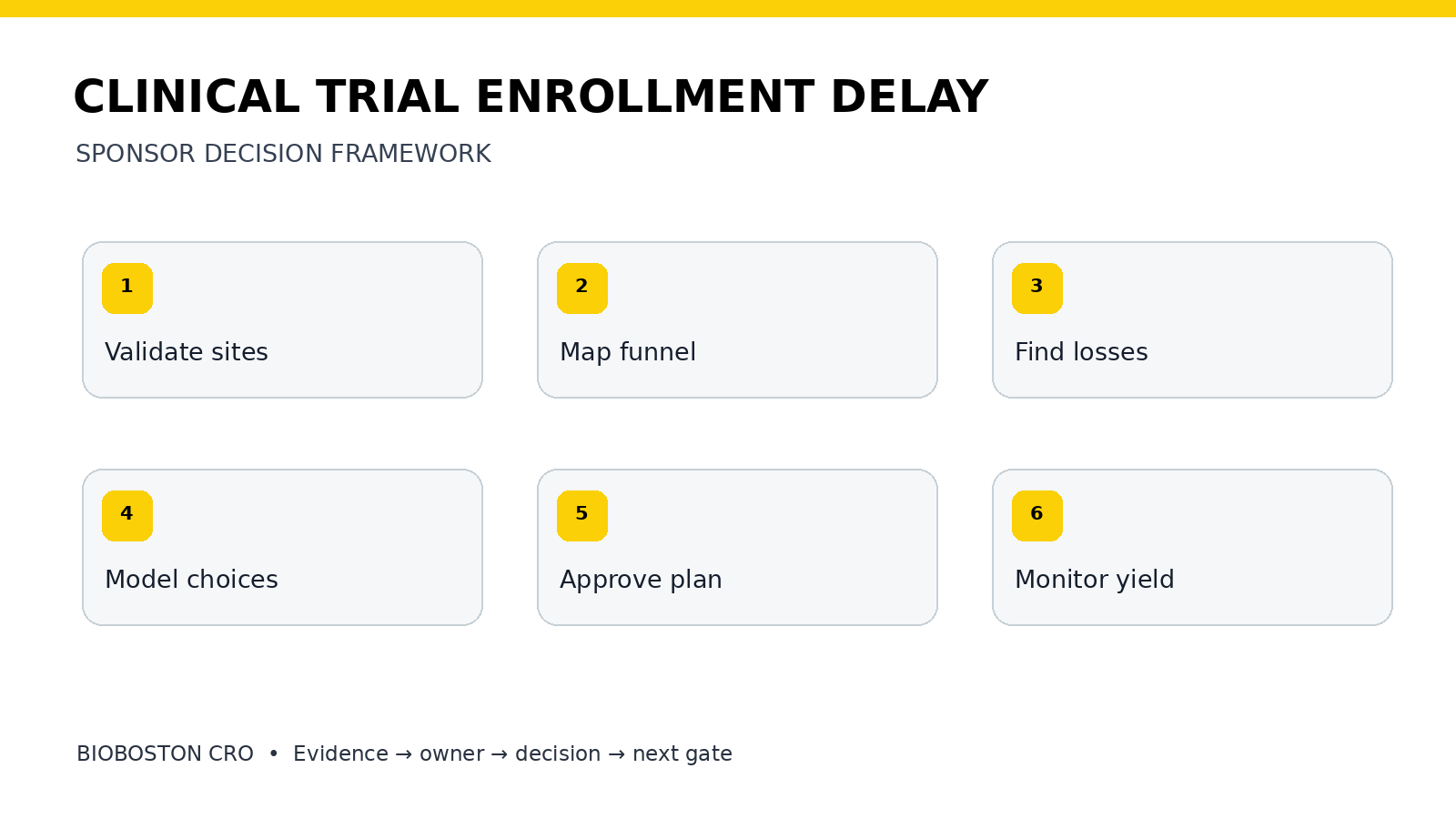
A clinical trial enrollment delay needs a sponsor-owned recovery plan grounded in the site funnel, eligibility criteria, activation readiness, screened-to-enrolled conversion and local operational constraints. Recruitment activity alone does not prove that enrollment forecasts are achievable.
Why this matters to the sponsor
Sponsors should determine where candidates are lost before authorizing spending on more sites or advertising. Activation, referral conversion, screen-failure rates, consent timing, visit burden and capacity may each require a different solution. Partner-supported patient/site-facing work must be coordinated with appropriate oversight.
Enrollment funnel and intervention matrix
| Signal / timing | What to verify | Accountable owner | Evidence / escalation |
|---|---|---|---|
| Sites activated vs planned | Regulatory/ethics permissions, contracts, site training | Clinical Operations | Fix delayed activation dependencies before increasing projected output |
| Referrals received | Verified referral channel and potential eligibility | Site/Recruitment Partner | Assess channel yield and consent approach |
| Prescreen to screen | Eligibility precheck process and documented reasons not progressing | Clinical Ops/Sites | Improve information exchange while protecting privacy |
| Screen failure rate | Protocol criteria, screen-failure reason coding and site variation | Medical/Statistics | Assess design feasibility; amendments require appropriate approval |
| Screen to enrollment | Consent flow, visit scheduling, lab/IMP readiness | Site/Clinical Ops | Resolve specific visit or supply bottlenecks |
| Retention to key endpoint | Withdrawals, burden and protocol deviations | Clinical Ops/Medical | Protect participant experience and data reliability |
| Forecast confidence | Site-by-site evidence and assumptions for next period | Clinical PM | Rebase only with transparent assumptions and decision approval |
How to put the framework into practice
Reconstruct the actual funnel
Use consistent denominators and reporting cut-off dates; distinguish potential referrals from consented, screened and enrolled participants.
Investigate site-level constraints
Review which sites are truly activated, their training and supplies, staff capacity, and time to first eligible participant.
Separate medical feasibility from recruitment operations
If eligibility criteria appear to constrain enrollment, involve clinical and statistical decision-makers; do not encourage sites to circumvent the approved protocol.
Build site-specific recovery choices
For each site or region compare realistic yield, time to activate, added cost, vendor dependencies, country rules and impact on data consistency.
Approve and monitor controlled changes
Assign sponsor approval rights, updated enrollment milestones, trigger thresholds and next-week source evidence. For protocol changes obtain applicable approvals before implementation.
Illustrative scenario (hypothetical)
Hypothetical: the study has six activated sites but only two screening participants each month. A funnel review finds that consented patients frequently fail a narrow laboratory criterion. Adding more advertising may not address the root cause; medical feasibility analysis and careful protocol planning may be more relevant.
Sponsor action log fields
Issue/risk ID; source evidence; affected milestone; critical-to-quality impact; owner; action due; decision authority; approved recovery option; next verification; status.
Regulatory context and limitations
Clinical program decision-support materials. These matrices are operational examples that require protocol-, jurisdiction-, and study-specific adaptation. ICH E6(R3) is FDA guidance containing nonbinding recommendations; applicable requirements under 21 CFR Part 312 remain binding for covered IND studies. Escalate participant safety, protocol deviations, and data integrity matters through the appropriate established processes rather than waiting for a weekly meeting.
Apply to your program
Make these controls work across teams with BioBoston CRO Trial Rescue Management.
Discuss sponsor-side Clinical trial enrollment delay support