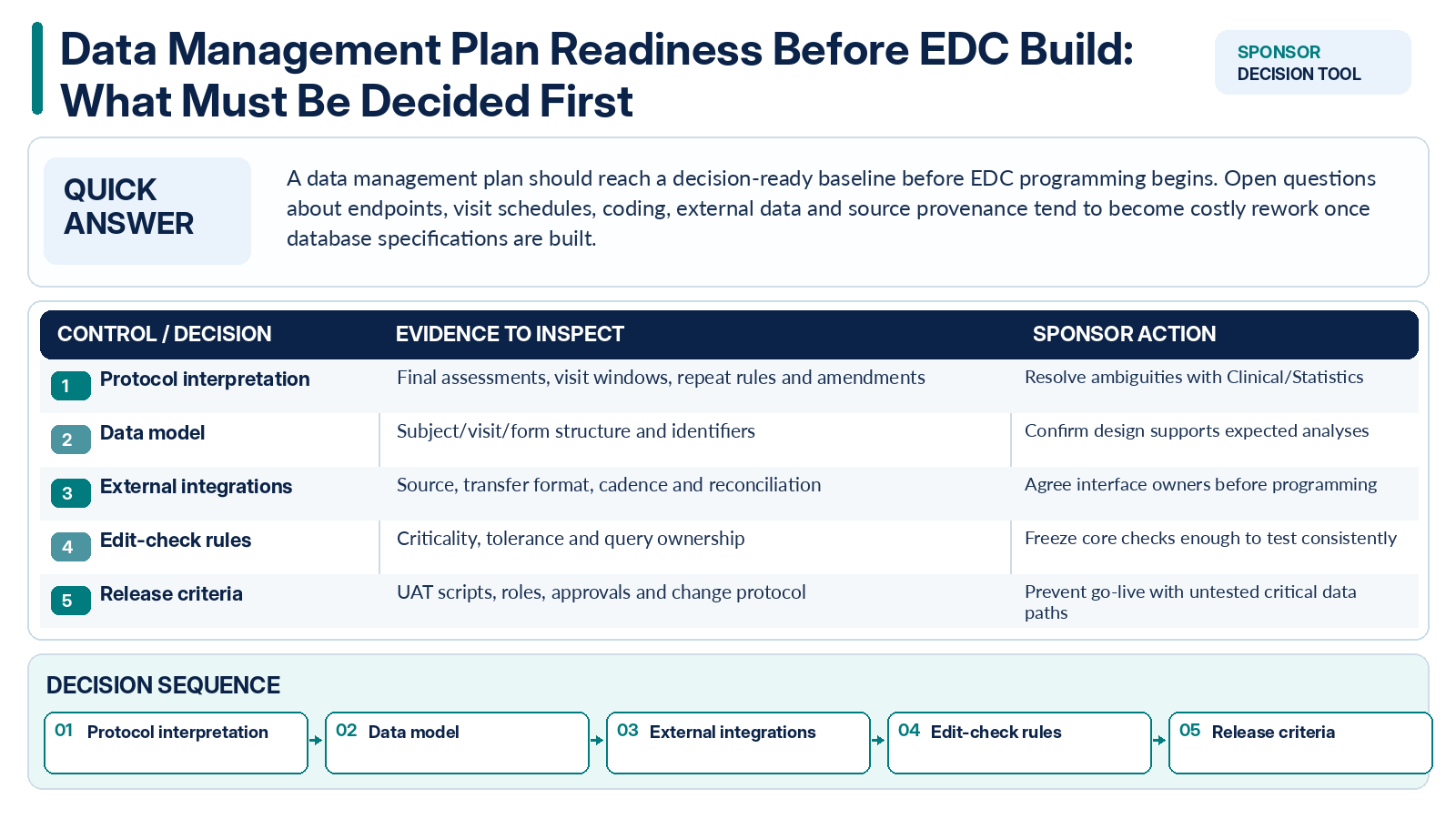
A data management plan should reach a decision-ready baseline before EDC programming begins. Open questions about endpoints, visit schedules, coding, external data and source provenance tend to become costly rework once database specifications are built.
How to apply this workflow in practice
Begin with the most consequential control and the evidence needed to resolve it. The following matrix connects each decision to records and an accountable action, rather than treating the list as a generic compliance checkbox.
| Control / question | Evidence to examine | Sponsor action |
|---|---|---|
| Protocol interpretation | Final assessments, visit windows, repeat rules and amendments | Resolve ambiguities with Clinical/Statistics |
| Data model | Subject/visit/form structure and identifiers | Confirm design supports expected analyses |
| External integrations | Source, transfer format, cadence and reconciliation | Agree interface owners before programming |
| Edit-check rules | Criticality, tolerance and query ownership | Freeze core checks enough to test consistently |
| Release criteria | UAT scripts, roles, approvals and change protocol | Prevent go-live with untested critical data paths |
For teams that need support implementing this across functions, BioBoston CRO Data Management Plan Review can help adapt the controls to the study, vendors, and decision calendar.
Working through the controls
1. Protocol interpretation
Evidence: Final assessments, visit windows, repeat rules and amendments. Decision: Resolve ambiguities with Clinical/Statistics. Record the responsible function and the approved source version, and keep any remaining exceptions visible to the sponsor before this item is closed.
2. Data model
Evidence: Subject/visit/form structure and identifiers. Decision: Confirm design supports expected analyses. Record the responsible function and the approved source version, and keep any remaining exceptions visible to the sponsor before this item is closed.
3. External integrations
Evidence: Source, transfer format, cadence and reconciliation. Decision: Agree interface owners before programming. Record the responsible function and the approved source version, and keep any remaining exceptions visible to the sponsor before this item is closed.
4. Edit-check rules
Evidence: Criticality, tolerance and query ownership. Decision: Freeze core checks enough to test consistently. Record the responsible function and the approved source version, and keep any remaining exceptions visible to the sponsor before this item is closed.
5. Release criteria
Evidence: UAT scripts, roles, approvals and change protocol. Decision: Prevent go-live with untested critical data paths. Record the responsible function and the approved source version, and keep any remaining exceptions visible to the sponsor before this item is closed.
Red flags that should change the plan
- Starting build from a draft schedule of activities.
- Undefined lab reconciliation.
- Changing endpoint derivation after UAT.
Decision gate and governance
Hold a documented pre-build gate; classify open items into design blockers versus controlled post-build refinements. The control owner should record the decision, evidence version, date, residual uncertainty and next re-review trigger. Where delegated providers perform the work, the sponsor should retain the relevant oversight and acceptance evidence.
Regulatory note: Determine which electronic records and signatures are regulated before applying 21 CFR Part 11 controls; FDA guidance supports risk- and intended-use-based implementation.
Need practical support?
Use BioBoston CRO Data Management Plan Review to review the evidence, define decision rights, and build a study-specific action plan for the next milestone.