A database lock readiness checklist is a documented go/no-go review of whether the clinical data needed for the planned analysis are complete, reconciled, interpreted, and under appropriate change control. The sponsor should be able to identify each unresolved exception, its likely impact on participant safety or endpoint reliability, who may accept the residual risk, and the evidence supporting the decision. A calendar date or a vendor’s statement that queries are “essentially closed” is not enough.
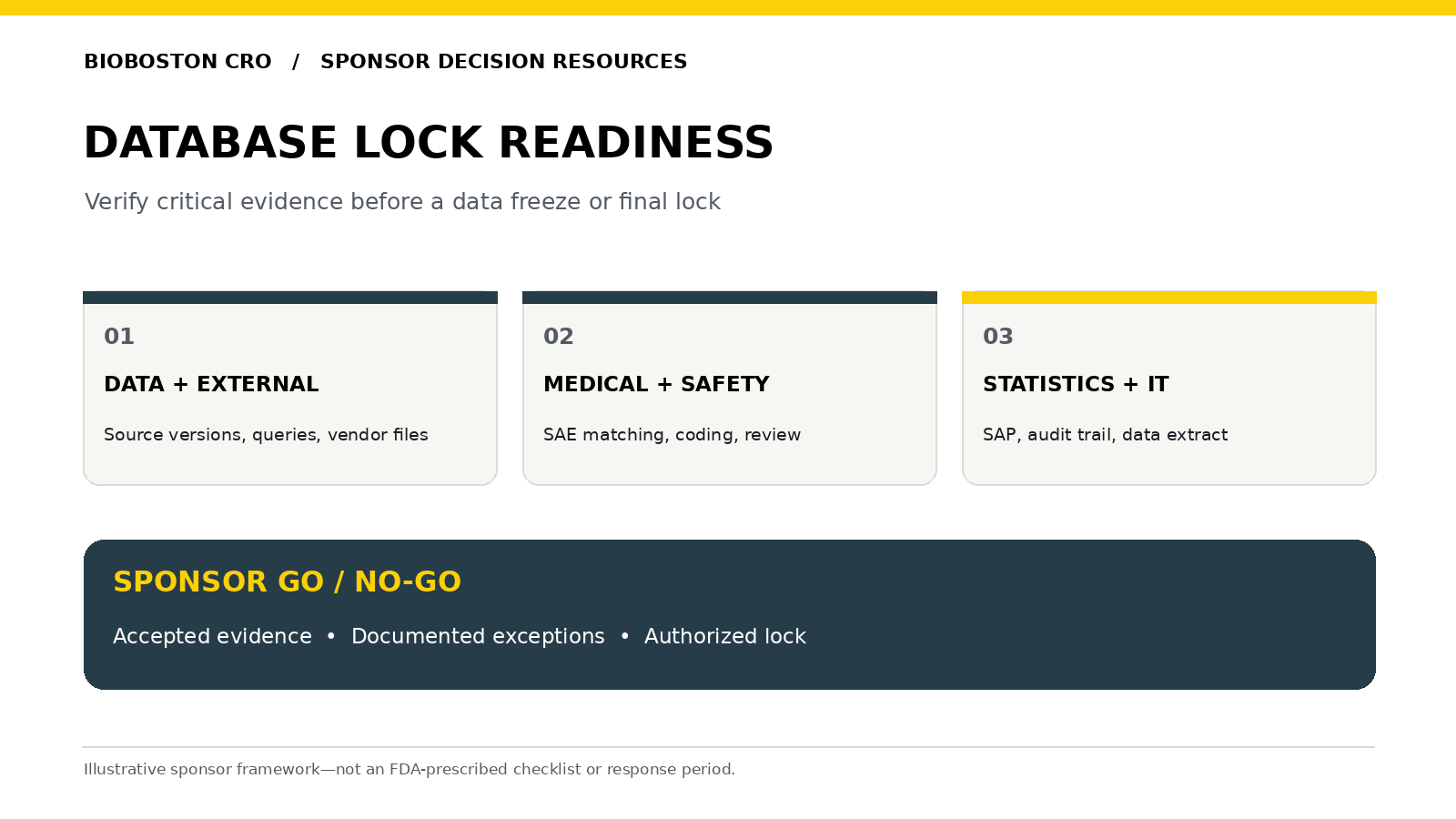
This resource is for a sponsor Head of Data Management, Clinical Operations, Biostatistics, Medical/Safety, or Clinical Quality representative preparing for an interim freeze or final database lock. It is especially useful when the EDC is managed by a CRO and safety, central laboratory, imaging, ePRO or randomization data come from separate service providers. A database lock is a controlled operational event, not a universal FDA-mandated checklist or a guarantee that every conceivable issue has been eliminated. The protocol, statistical analysis plan (SAP), data management plan (DMP), applicable regulations, and validated operating procedures determine the actual acceptance criteria.
Start with the decision the lock is supposed to enable
Before evaluating individual fields, clarify whether the team proposes a final lock, a data cut or an interim frozen dataset. Document the analysis population, endpoint timepoint, database version, data-cut date, external data snapshots, and intended transfer to Statistics. If the analysis requires treatment unblinding, establish an access and segregation plan separately from ordinary cleaning and lock authorization. An interim data cut and final study closeout have different expectations; describe the scope precisely rather than treating either as a single green badge.
Agree the intended acceptance criteria while there is still time to resolve issues. List critical-to-quality data for primary endpoints, key safety information, eligibility, exposure, important protocol deviations, and major analysis covariates. Identify whether each critical data source is in EDC, a separate validated platform, or a vendor file, and what constitutes the authoritative accepted version. The sponsor should not change acceptance thresholds to fit a deadline without documented impact assessment and the correct approval path.
FDA’s September 2025 ICH E6(R3) GCP guidance recommends risk-proportionate controls directed at participant protection and reliable trial results; it contains nonbinding recommendations. FDA’s October 2024 final guidance on electronic systems, records and signatures discusses trustworthy, reliable clinical records. Applicable predicate regulations and 21 CFR Part 11 requirements, where relevant, must be evaluated separately. Neither guidance prescribes the sample scorecard or meeting timing below.
The sponsor-side readiness register
Use this as a working agenda. For each row capture: study ID and lock scope; system/source and version; current status (verified, conditional, blocked); objective evidence link; named functional owner; reviewer; next decision date; and approval or escalation record. The acceptance rule must be tailored to the protocol and SAP. “Green” is valid only when evidence, not merely an assertion, supports it.
| Readiness gate | Evidence that should be inspected | Accountable reviewer | Block or escalate when |
|---|---|---|---|
| Endpoint and visit data | Final planned forms, visit reconciliation, primary endpoint completeness, protocol/SAP crosswalk | Data Management and Statistics | Critical endpoint missingness or unresolved interpretation may affect estimand or analysis |
| Query disposition | Open-query list by severity and subject; resolved-query history; documented exceptions | Data Management with Clinical Operations | Critical query is open, or closure does not show a reliable data correction or justified disposition |
| Medical coding and review | Coding dictionary/version, unresolved medical terms, medical review sign-off | Medical/Safety and Data Management | Ambiguous serious safety term or inconsistent coding affects interpretation |
| Safety reconciliation | EDC-to-safety database/SAE comparison, differences and approved resolutions | Safety/Pharmacovigilance and Medical | Serious event, causality or key date mismatch remains without disposition |
| External data feeds | Lab/ECG/imaging/ePRO/IRT receipts, mapping tests, sample/visit matching, file version | Vendor owner and Data Management | Unmapped records, repeat transfers, wrong units or data lineage failures affect critical data |
| Protocol deviations and eligibility | Deviation classifications, important eligibility and treatment exposure checks | Clinical Operations, Medical, Statistics | A potentially analysis-relevant deviation or population status is unresolved |
| Statistical readiness | SAP version and approvals, derivation decisions, blind-review record, planned data transfer | Biostatistics | Definition or derived-variable issue changes planned analyses or threatens blinding |
| Technical and access control | Database validation/release record, audit trail accessibility, user privileges, snapshot and recovery evidence | EDC/system owner and QA/IT as needed | Uncontrolled editing, uncertain export provenance or failed backup prevents trustworthy release |
| Final authorization | Lock checklist, residual-exception list, named approvers, effective time, archive/reopen instructions | Sponsor Data Lead plus defined decision authority | Required reviewer or acceptance evidence is missing |
The table is a sponsor planning aid, not an assertion that all functions must personally sign every lock. Signatures and authorizations should follow the approved DMP, quality procedures, contract responsibilities, and the nature of the analysis.
Four tests that expose a false green status
Test the population, not just form completion. Compare subject enrollment, randomization, discontinuation, treatment exposure and the analysis population across EDC, IRT and the current approved subject disposition. Check screen failures and unscheduled visits where relevant. A study can have a high form-completion percentage and still be missing the visit that establishes the primary endpoint.
Reconcile across systems using stable identifiers. Ensure the laboratory specimen ID, visit label, collection time, subject ID and unit mappings agree with the receiving dataset. A successful file transfer says nothing about correct subject/visit attribution. Inspect exception samples and the mapping version, including any post-protocol-amendment change.
Review exceptions by decision impact. An unresolved harmless administrative query and an unresolved SAE reconciliation are not equivalent. Define which residual discrepancies require medical, statistics, QA, or sponsor risk acceptance. Record whether they change the data, the analysis set, the interpretation, or the analysis timing.
Demonstrate controlled release. Confirm which user roles can change records after the declared cut-off, how the approved snapshot is identified, whether the data transfer is reproducible, and who may authorize a reopen. An edit made after lock is not necessarily prohibited in every context, but it must follow a controlled, reconstructable process and the applicable system and recordkeeping requirements.
A practical 10-business-day preparation rhythm
Ten to seven business days before the proposed lock: Data Management publishes the lock scope, critical data inventory and unresolved exception baseline. Vendor leads verify file receipt calendars. Statistics identifies endpoints or derived variables requiring adjudication. Medical/Safety confirms outstanding review priorities. This is an illustrative planning cadence, not a prescribed regulatory deadline.
Six to four business days before: Resolve severe issues; inspect the external reconciliation report and query aging; test the intended data extracts and version identifiers. Record any proposed exceptions with clinical/statistical impact. If an underlying data source is changing, identify whether the cut-off must move.
Three to one business days before: Hold a focused lock-readiness meeting. Review each exception that could affect participant protection, the primary analysis or data traceability; record the owner, recommendation and authorized decision. Finalize access roles, backup procedures, export checksums or comparable version controls where appropriate, and data transfer handoffs.
On the lock date and immediately after: Document the release instruction, approved status and effective timestamp. Verify the delivered dataset matches the approved frozen/locked version and the recipient accepted it. Retain records sufficient to reconstruct the decision, and trigger the documented reopen/change process if a significant issue is discovered later.
Example: an external laboratory file arrives as “complete”
Hypothetical illustration only. A Phase II trial has reached its proposed final lock week. The central laboratory confirms all scheduled files were transmitted, and EDC query count is near zero. During reconciliation, the sponsor Data Lead finds 18 lab values whose visit identifiers do not match the current protocol visit map. Four belong to the endpoint assessment window. The vendor transfer dashboard is green because files arrived on time; the receiving data are not yet accepted.
The team classifies the four endpoint-window records as a potential analysis-impacting exception. Data Management owns the mapping investigation; the vendor supplies raw-to-transformed provenance; Statistics evaluates effect on the analysis dataset; Medical assesses any critical safety use of the values. The sponsor records the decision whether to correct, exclude with justification, or defer the intended lock. A revised delivery promise is not the acceptance evidence; the accepted corrected file, reconciliation output and analysis-impact decision are.
Make the go/no-go decision auditable
A useful disposition format is Ready / Ready with controlled exceptions / Not ready. The middle state does not create a permission to ignore critical issues. It requires a clearly bounded list of residual exceptions, impact assessment, compensating controls where appropriate, a named decision authority and a defined follow-up. For an analysis whose validity depends on the unresolved information, “Not ready” may be the only defensible outcome.
Record at least the approved data cut; evidence-pack version; unresolved critical issues; signatures or equivalent authorization; the specific system action; time and time zone; delivery recipient; and post-lock change process. Keep a clear distinction between a sponsor governance decision and the system administrator’s technical execution. Maintain an archive/index consistent with record-retention obligations and contracts instead of proliferating uncontrolled spreadsheets.
Common failure modes and the sponsor’s corrective question
A zero-query KPI may conceal outstanding external files: “Which critical datasets were reconciled against the locked population?” A database export with no provenance invites version confusion: “Which source version and transformation were accepted?” A broad ‘Medical approved’ statement may omit coding and SAE reconciliation: “What specific discrepancy report and date did Medical review?” An unblinding step combined with routine cleaning may create avoidable risk: “Who can see treatment assignments, and how is that access controlled?” A forced milestone can turn a sponsor decision into an undocumented exception: “Who authorized the residual risk, on what evidence and with which downstream consequences?”
Review whether the DMP already defines the lock review, query exception process, external-data reconciliation, access controls and reproducible transfer. If not, address those gaps before the next major data cut. This is a natural point to seek an independent review of the DMP and evidence pack rather than rewriting all data-management procedures on the eve of lock.
For practical review of data-flow responsibilities, lock gates and vendor acceptance criteria, see BioBoston CRO’s Data Management Plan Review services. The related eCRF Design and Review services can help address recurring protocol-to-field traceability issues upstream. Explore Data Management Plan Review support to discuss an evidence-based lock-readiness assessment.
Regulatory distinction and review: This readiness framework is BioBoston CRO sponsor-side guidance, not an FDA requirement or an automatically sufficient lock SOP. FDA’s September 2025 ICH E6(R3) and October 2024 electronic-systems guidance are nonbinding; applicable 21 CFR Part 11 and predicate requirements remain binding where relevant. Recommended reviewers: senior Clinical Data Management lead with Biostatistics, Medical/Safety, Clinical Operations and validation/QA input. Refresh at protocol/SAP/DMP amendments, data-vendor or system changes, and relevant FDA/ICH updates.