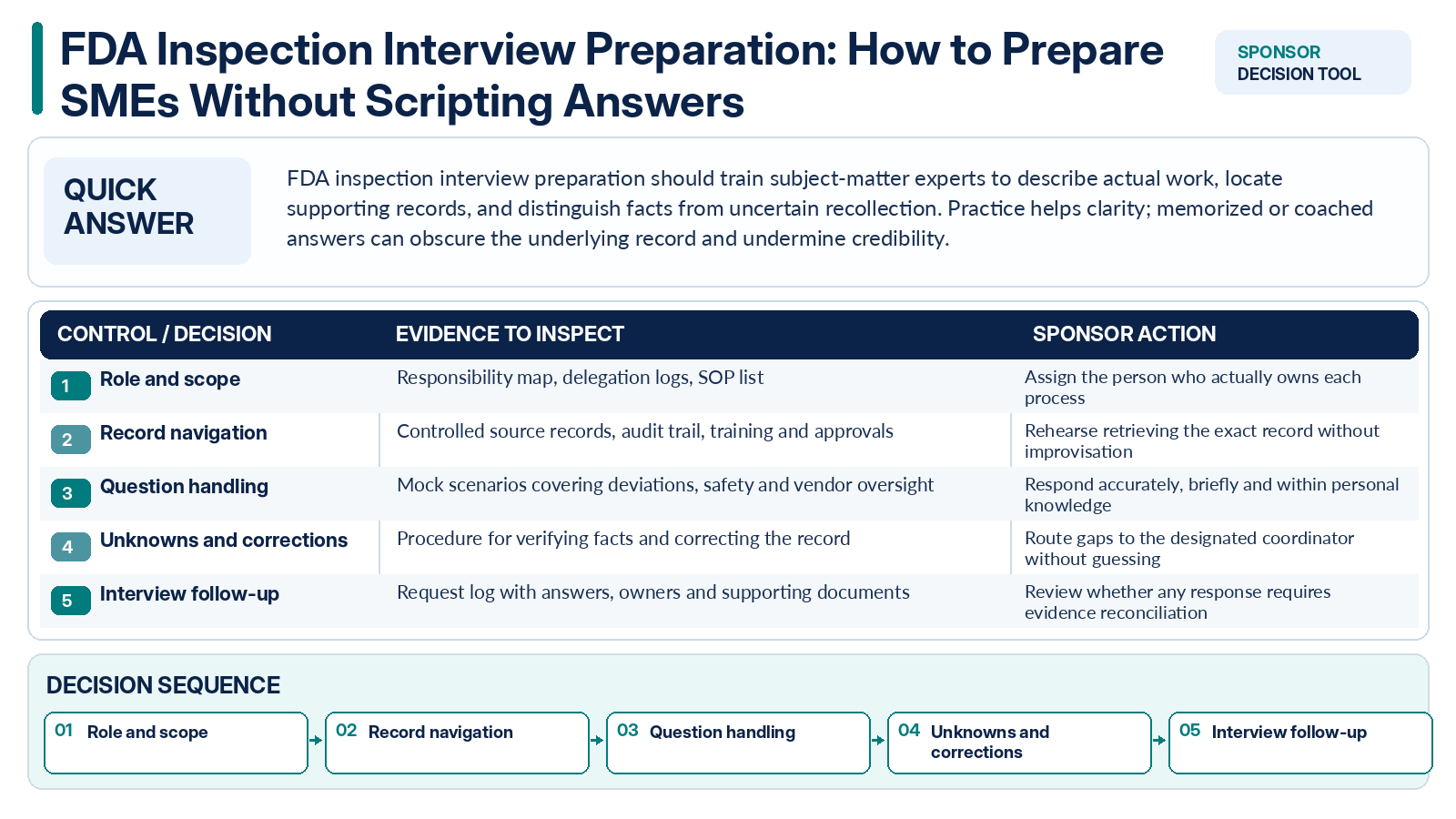
FDA inspection interview preparation should train subject-matter experts to describe actual work, locate supporting records, and distinguish facts from uncertain recollection. Practice helps clarity; memorized or coached answers can obscure the underlying record and undermine credibility.
How to apply this workflow in practice
Begin with the most consequential control and the evidence needed to resolve it. The following matrix connects each decision to records and an accountable action, rather than treating the list as a generic compliance checkbox.
| Control / question | Evidence to examine | Sponsor action |
|---|---|---|
| Role and scope | Responsibility map, delegation logs, SOP list | Assign the person who actually owns each process |
| Record navigation | Controlled source records, audit trail, training and approvals | Rehearse retrieving the exact record without improvisation |
| Question handling | Mock scenarios covering deviations, safety and vendor oversight | Respond accurately, briefly and within personal knowledge |
| Unknowns and corrections | Procedure for verifying facts and correcting the record | Route gaps to the designated coordinator without guessing |
| Interview follow-up | Request log with answers, owners and supporting documents | Review whether any response requires evidence reconciliation |
For teams that need support implementing this across functions, BioBoston CRO Mock FDA Inspection can help adapt the controls to the study, vendors, and decision calendar.
Working through the controls
1. Role and scope
Evidence: Responsibility map, delegation logs, SOP list. Decision: Assign the person who actually owns each process. Record the responsible function and the approved source version, and keep any remaining exceptions visible to the sponsor before this item is closed.
2. Record navigation
Evidence: Controlled source records, audit trail, training and approvals. Decision: Rehearse retrieving the exact record without improvisation. Record the responsible function and the approved source version, and keep any remaining exceptions visible to the sponsor before this item is closed.
3. Question handling
Evidence: Mock scenarios covering deviations, safety and vendor oversight. Decision: Respond accurately, briefly and within personal knowledge. Record the responsible function and the approved source version, and keep any remaining exceptions visible to the sponsor before this item is closed.
4. Unknowns and corrections
Evidence: Procedure for verifying facts and correcting the record. Decision: Route gaps to the designated coordinator without guessing. Record the responsible function and the approved source version, and keep any remaining exceptions visible to the sponsor before this item is closed.
5. Interview follow-up
Evidence: Request log with answers, owners and supporting documents. Decision: Review whether any response requires evidence reconciliation. Record the responsible function and the approved source version, and keep any remaining exceptions visible to the sponsor before this item is closed.
Red flags that should change the plan
- Scripting identical talking points across unrelated roles.
- Offering explanations without records.
- Trying to fill silence with speculation.
Decision gate and governance
Ask each SME to demonstrate the real process and retrieve one representative record; use deviations discovered in practice to improve readiness. The control owner should record the decision, evidence version, date, residual uncertainty and next re-review trigger. Where delegated providers perform the work, the sponsor should retain the relevant oversight and acceptance evidence.
Regulatory note: Applicable regulations, trial commitments and agreements must be distinguished from nonbinding FDA and ICH guidance. Apply this framework to the actual product, jurisdiction and study.
Need practical support?
Use BioBoston CRO Mock FDA Inspection to review the evidence, define decision rights, and build a study-specific action plan for the next milestone.