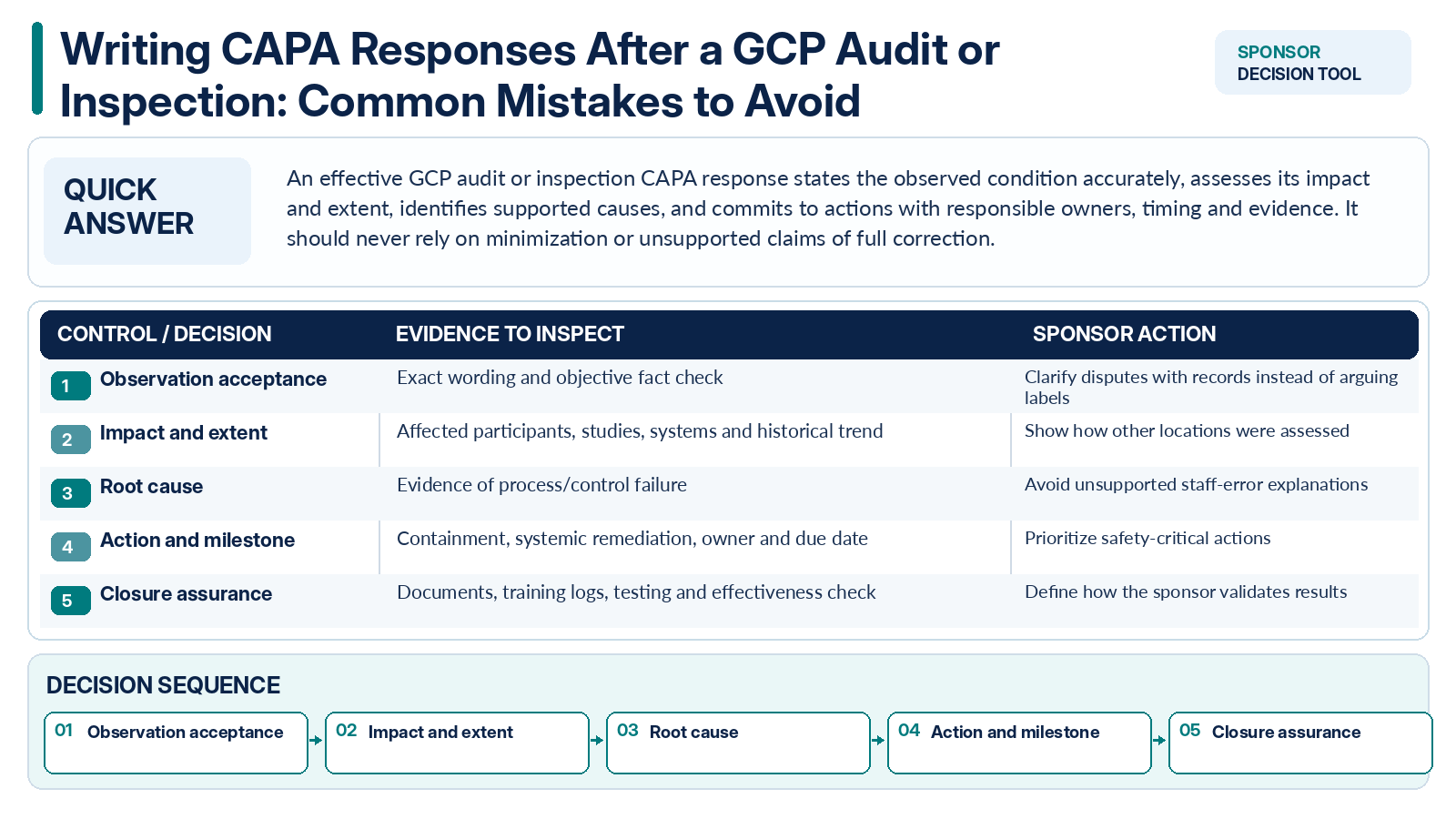
An effective GCP audit or inspection CAPA response states the observed condition accurately, assesses its impact and extent, identifies supported causes, and commits to actions with responsible owners, timing and evidence. It should never rely on minimization or unsupported claims of full correction.
How to apply this workflow in practice
Begin with the most consequential control and the evidence needed to resolve it. The following matrix connects each decision to records and an accountable action, rather than treating the list as a generic compliance checkbox.
| Control / question | Evidence to examine | Sponsor action |
|---|---|---|
| Observation acceptance | Exact wording and objective fact check | Clarify disputes with records instead of arguing labels |
| Impact and extent | Affected participants, studies, systems and historical trend | Show how other locations were assessed |
| Root cause | Evidence of process/control failure | Avoid unsupported staff-error explanations |
| Action and milestone | Containment, systemic remediation, owner and due date | Prioritize safety-critical actions |
| Closure assurance | Documents, training logs, testing and effectiveness check | Define how the sponsor validates results |
For teams that need support implementing this across functions, BioBoston CRO GCP CAPA Support can help adapt the controls to the study, vendors, and decision calendar.
Working through the controls
1. Observation acceptance
Evidence: Exact wording and objective fact check. Decision: Clarify disputes with records instead of arguing labels. Record the responsible function and the approved source version, and keep any remaining exceptions visible to the sponsor before this item is closed.
2. Impact and extent
Evidence: Affected participants, studies, systems and historical trend. Decision: Show how other locations were assessed. Record the responsible function and the approved source version, and keep any remaining exceptions visible to the sponsor before this item is closed.
3. Root cause
Evidence: Evidence of process/control failure. Decision: Avoid unsupported staff-error explanations. Record the responsible function and the approved source version, and keep any remaining exceptions visible to the sponsor before this item is closed.
4. Action and milestone
Evidence: Containment, systemic remediation, owner and due date. Decision: Prioritize safety-critical actions. Record the responsible function and the approved source version, and keep any remaining exceptions visible to the sponsor before this item is closed.
5. Closure assurance
Evidence: Documents, training logs, testing and effectiveness check. Decision: Define how the sponsor validates results. Record the responsible function and the approved source version, and keep any remaining exceptions visible to the sponsor before this item is closed.
Red flags that should change the plan
- Using future tense for actions already due.
- Promising SOP revision without implementation proof.
- Claiming zero participant impact without an assessment.
Decision gate and governance
Have an independent reviewer test each response for evidence, logical cause-action linkage and realistic dates before sending. The control owner should record the decision, evidence version, date, residual uncertainty and next re-review trigger. Where delegated providers perform the work, the sponsor should retain the relevant oversight and acceptance evidence.
Regulatory note: Applicable regulations, trial commitments and agreements must be distinguished from nonbinding FDA and ICH guidance. Apply this framework to the actual product, jurisdiction and study.
Need practical support?
Use BioBoston CRO GCP CAPA Support to review the evidence, define decision rights, and build a study-specific action plan for the next milestone.