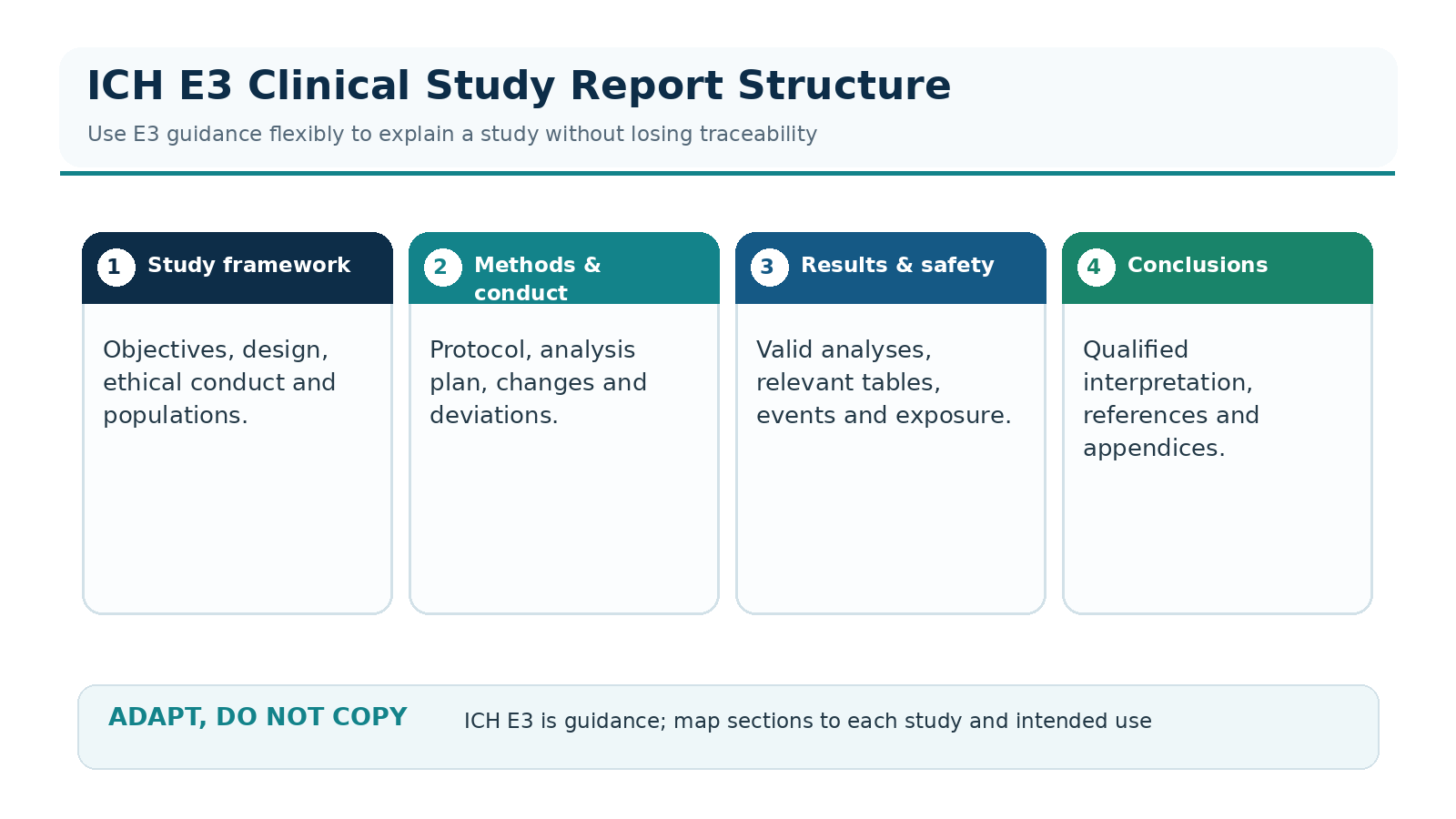
ICH E3 clinical study report structure gives sponsors a common way to explain what a trial set out to test, what happened, how the data were analyzed, what was observed, and how the sponsor interprets the results. It is a guideline, not a compulsory section-by-section template. The best structure is one that makes an integrated clinical and statistical report complete, traceable, unambiguous, and practical for the intended regulatory review.
This guide is for medical writing and clinical development leaders planning the clinical study report (CSR) after database lock or preparing an outline earlier in the reporting cycle. It translates ICH E3 into source-owner decisions, without presenting guidance recommendations as binding regulations.
What is guidance, and what must be established separately?
The FDA’s ICH E3 guidance describes a core clinical study report and its recommended content. The ICH E3 Questions and Answers (R1) explicitly explain that flexibility is inherent: sections can be reorganized when that better communicates a study’s design, methods, and results. Regulatory requirements for a particular application, jurisdiction, product, and supporting dataset are a separate matter. In the United States, for example, NDA clinical-data expectations under 21 CFR 314.50 are regulatory requirements, but they should not be misread as instructions that every exploratory Phase I CSR must duplicate a late-stage registration report.
A good sponsor establishes the intended use first: internal decision, development milestone, submission-supporting study, publication, or an integrated development program. Then it documents how the report will satisfy relevant requirements while using ICH E3 as the organizing reference.
The core ICH E3 structure, translated into owner decisions
| Report component | Sponsor question | Primary input / owner |
|---|---|---|
| Title page, synopsis and contents | Is the study unambiguously identified and accurately summarized? | Study identifiers, protocol, sponsor and medical writer |
| Ethics, investigators and administration | Can reviewers understand study conduct and key parties? | Clinical Operations / essential records |
| Introduction and objectives | Why was the study designed, and what questions did it test? | Protocol, development rationale / Clinical |
| Investigational plan | What was prespecified, amended, and actually conducted? | Protocol, amendments, SAP and deviation log |
| Study patients | Who entered, received treatment, completed, or discontinued? | Disposition outputs / Data Management and Statistics |
| Efficacy or other key results | Are estimands, endpoints, populations and results accurately described? | SAP and validated TLFs / Statistics and Clinical |
| Safety | Do exposure, events, deaths, important findings and caveats agree? | Safety dataset, medical review, PV and TLFs |
| Discussion and conclusions | What follows from the observed evidence, and what remains uncertain? | Cross-functional interpretation / Clinical and Medical |
| References and appendices | Can every material statement and output be traced? | Controlled source and appendix inventory |
The headings above are a practical grouping of E3 content, not a verbatim mandated template. A particular study may require a clearer standalone section for PK/PD, biomarkers, device performance, dose escalation, or another central endpoint. Explain structural adaptations in the report plan so reviewers are not left searching for expected information.
A six-decision outline workshop
1. Choose the report’s regulatory job. Write one sentence stating how the report will be used, the study’s phase, and relevant authorities. This sets the expected evidence depth.
2. Map questions to evidence. For each primary objective and safety question, identify its planned analysis, source output, clinical owner, and location in the report.
3. Design for the study type. A first-in-human dose-escalation trial may require particular clarity on cohorts, escalation decisions, safety review windows, exposure, and emerging PK. An endpoint-heavy randomized trial needs comparably clear efficacy estimands, analysis populations, handling of intercurrent events, and sensitivity analyses where relevant. Do not copy a late-stage template indiscriminately.
4. Decide how to handle changes. Protocol amendments, deviations, analysis-plan revisions, unblinding decisions, data corrections, and cutoff changes need a traceable treatment. Different versions of a fact should never sit unexplained in separate sections.
5. Agree interpretation ownership. Biostatistics owns method and numerical correctness, clinical/safety experts assess clinical meaning, Medical Writing integrates approved language, and sponsor leadership authorizes the conclusion and final report.
6. Set a document-control route. Map authoring, medical review, statistical QC, regulatory review, final sign-off, and archive. Each stage needs evidence of what was approved and what changed.
An adaptable CSR section-decision matrix
| Decision | Choose A when… | Choose B when… | Evidence of the choice |
|---|---|---|---|
| Dedicated PK/PD results | PK is central to objectives or dose decisions | PK is ancillary and well integrated elsewhere | Protocol objectives and analysis plan |
| Integrated versus separated populations | Populations overlap and one summary stays clear | Safety and efficacy sets differ materially | SAP population definitions |
| Study conduct discussion | Few deviations affect interpretation | Amendments, deviations or interruptions warrant expanded context | Amendment and deviation records |
| Appendices strategy | A concise set of final supporting files is sufficient | Extensive listings or regional requirements call for additional packages | Submission plan and source inventory |
This matrix is a BioBoston CRO planning aid, not an ICH requirement. Preserve all material results and underlying evidence whichever arrangement is selected.
Common CSR structural mistakes
A polished synopsis describes a different data cutoff from the body. An efficacy table reports a treatment group omitted from the methods narrative. A safety section gives totals without an exposure denominator. The report discusses a protocol amendment without its effect on analysis or conduct. Sections use inconsistent definitions for enrolled, randomized, treated, and analyzed participants. A rigid legacy template creates blank or redundant sections instead of explaining where information is actually presented.
Each problem is solved by source-to-report traceability, not by stylistic editing alone. Maintain an index tying the protocol, SAP, controlled outputs, safety review records, and appendices to report sections and decision owners.
Pre-approval sponsor checklist
Before release, confirm that the chosen structure communicates all material objectives and outcomes; the protocol and SAP are correctly represented; analyses and safety findings reconcile with validated sources; deviations and key changes are explained; limitations are not buried; and each source, review decision, and approval is traceable. Where a section was adapted from the E3 organization, ensure a reviewer can still find the information.
For dependencies outside writing, see Clinical Project Management and Data Management Plan Review.
Need a defensible study-report structure?
BioBoston CRO Clinical Study Report Writing support can align the outline, source package, clinical/statistical narrative, reviewer workflow, and final reporting decisions for your specific study.