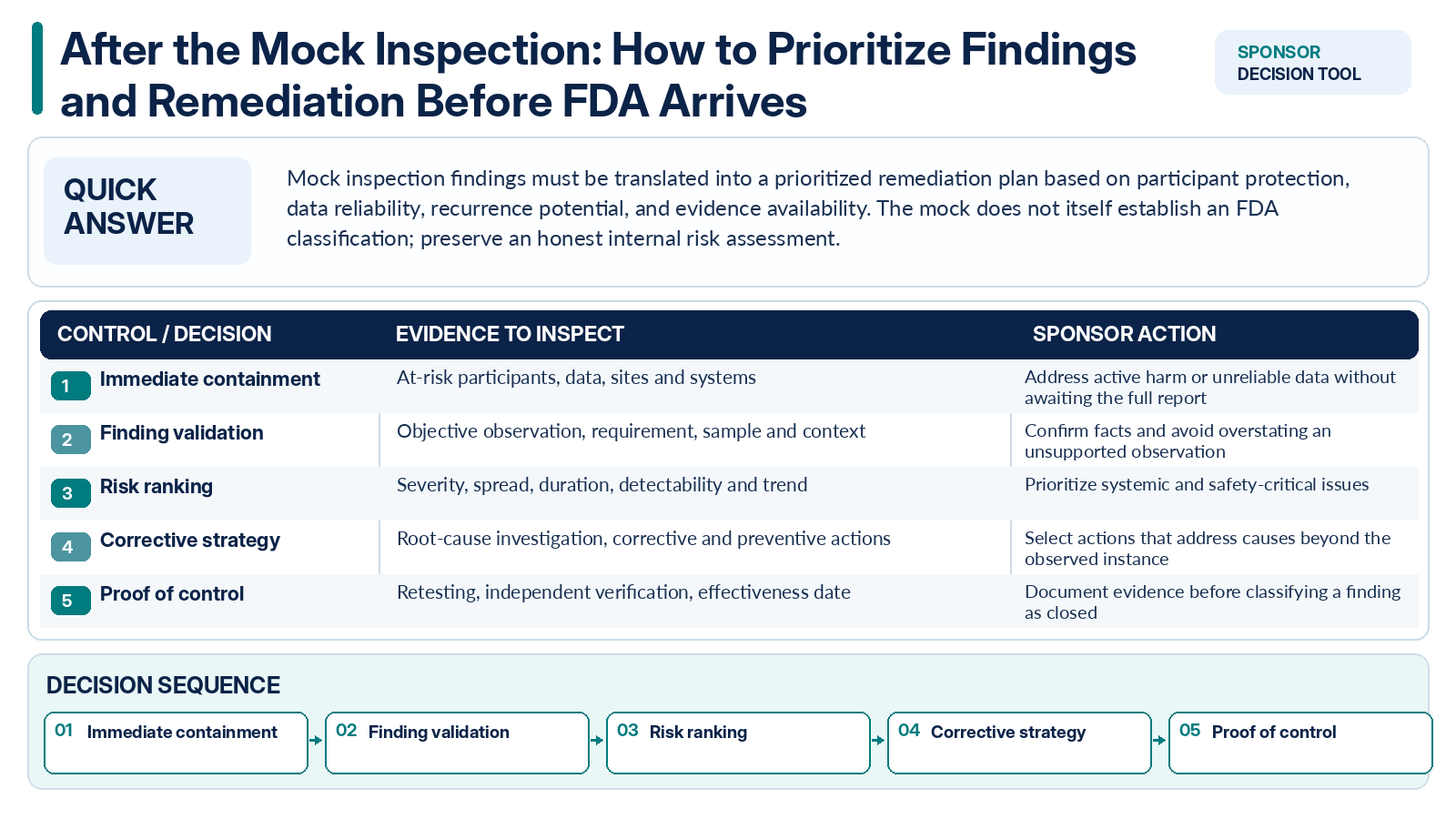
Mock inspection findings must be translated into a prioritized remediation plan based on participant protection, data reliability, recurrence potential, and evidence availability. The mock does not itself establish an FDA classification; preserve an honest internal risk assessment.
How to apply this workflow in practice
Begin with the most consequential control and the evidence needed to resolve it. The following matrix connects each decision to records and an accountable action, rather than treating the list as a generic compliance checkbox.
| Control / question | Evidence to examine | Sponsor action |
|---|---|---|
| Immediate containment | At-risk participants, data, sites and systems | Address active harm or unreliable data without awaiting the full report |
| Finding validation | Objective observation, requirement, sample and context | Confirm facts and avoid overstating an unsupported observation |
| Risk ranking | Severity, spread, duration, detectability and trend | Prioritize systemic and safety-critical issues |
| Corrective strategy | Root-cause investigation, corrective and preventive actions | Select actions that address causes beyond the observed instance |
| Proof of control | Retesting, independent verification, effectiveness date | Document evidence before classifying a finding as closed |
For teams that need support implementing this across functions, BioBoston CRO Mock FDA Inspection can help adapt the controls to the study, vendors, and decision calendar.
Working through the controls
1. Immediate containment
Evidence: At-risk participants, data, sites and systems. Decision: Address active harm or unreliable data without awaiting the full report. Record the responsible function and the approved source version, and keep any remaining exceptions visible to the sponsor before this item is closed.
2. Finding validation
Evidence: Objective observation, requirement, sample and context. Decision: Confirm facts and avoid overstating an unsupported observation. Record the responsible function and the approved source version, and keep any remaining exceptions visible to the sponsor before this item is closed.
3. Risk ranking
Evidence: Severity, spread, duration, detectability and trend. Decision: Prioritize systemic and safety-critical issues. Record the responsible function and the approved source version, and keep any remaining exceptions visible to the sponsor before this item is closed.
4. Corrective strategy
Evidence: Root-cause investigation, corrective and preventive actions. Decision: Select actions that address causes beyond the observed instance. Record the responsible function and the approved source version, and keep any remaining exceptions visible to the sponsor before this item is closed.
5. Proof of control
Evidence: Retesting, independent verification, effectiveness date. Decision: Document evidence before classifying a finding as closed. Record the responsible function and the approved source version, and keep any remaining exceptions visible to the sponsor before this item is closed.
Red flags that should change the plan
- Treating every observation as equal.
- Installing a SOP without changing behavior.
- Declaring CAPA effective immediately.
Decision gate and governance
Tie each high-risk finding to a named owner, dated evidence artifact and escalation criterion for the sponsor steering group. The control owner should record the decision, evidence version, date, residual uncertainty and next re-review trigger. Where delegated providers perform the work, the sponsor should retain the relevant oversight and acceptance evidence.
Regulatory note: Applicable regulations, trial commitments and agreements must be distinguished from nonbinding FDA and ICH guidance. Apply this framework to the actual product, jurisdiction and study.
Need practical support?
Use BioBoston CRO Mock FDA Inspection to review the evidence, define decision rights, and build a study-specific action plan for the next milestone.