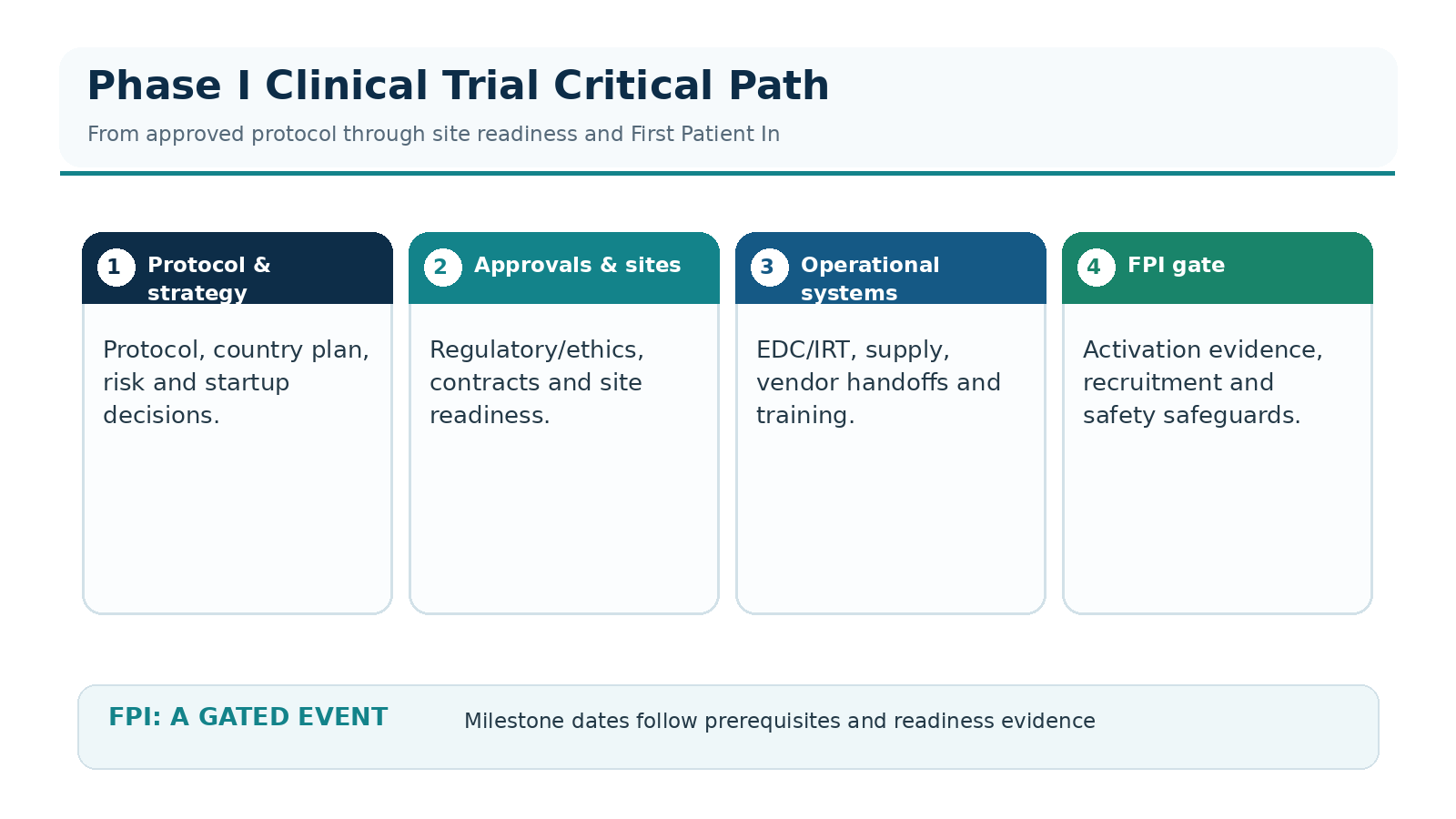
A phase 1 clinical trial timeline should connect the sponsor’s final protocol to the regulatory, site, vendor, systems and supply evidence needed before the first participant receives an investigational product. First-patient-in (FPI) is not reached simply because every workstream reports that it is "on schedule." The integrated critical path must show which prerequisite is truly complete, who accepts the evidence, and which downstream activity is blocked if it is not.
This guide is for emerging biotech Clinical Operations and Project Management leaders, CMOs, COOs and CEOs managing an early-phase program with a lean sponsor team and outsourced execution partners. The goal is a practical milestone-to-evidence map, not a promise of a universal number of weeks to FPI. Actual durations depend on protocol complexity, jurisdiction, product, trial model, sites, vendors and readiness of the supporting data.
Start with the appropriate regulatory gate
For a U.S. clinical drug investigation requiring an IND, 21 CFR 312.40 describes when an IND takes effect: generally 30 days after FDA receives it unless a clinical hold applies, or earlier if FDA notifies the sponsor that the investigation may begin. An investigator must not administer the investigational drug before the IND is in effect. IRB approval and applicable informed-consent safeguards must also be in place. These are requirements or conditions, not interchangeable project-plan dates. For other regions and trial types, check the applicable requirements independently.
FDA’s ICH E6(R3) Good Clinical Practice guidance encourages fit-for-purpose, risk-proportionate trial design and quality management. Use that principle to identify critical-to-quality activities and decision gates, while recognizing that the guidance does not set a single FPI timetable for every trial.
Build the Phase I timeline around evidence-based gates
The following table can be copied into the integrated project plan. Each milestone needs a named sponsor or provider owner, acceptance criteria and an evidence link. Several activities may run in parallel, but downstream milestones should not be marked complete until their actual predecessors are accepted.
| Workstream and gate | Evidence needed before the next step | Typical decision owner | Early warning signal |
|---|---|---|---|
| Protocol and design freeze | Approved protocol, schedule, risk priorities and planned changes | Sponsor Clinical Development / Operations | Open critical endpoint or visit decisions |
| Regulatory readiness | Applicable application status and evidence that study may proceed | Sponsor Regulatory Affairs | Submission response or clinical-hold dependency unresolved |
| Ethics and site readiness | Required IRB/ethics approvals, informed-consent documents, training and site essential records | Site and sponsor site-activation authority | Site forecasts FPI before approval or staff readiness |
| Vendor mobilization | Signed scopes, kickoff decisions, qualified providers and operational handoffs | Sponsor PM / vendor leads | Contract, staffing or interface owner unsettled |
| EDC, IRT and data flows | Approved specifications, testing/UAT and production readiness | Sponsor Data / system owners | Critical test deviations or missing user access |
| Safety processes | Approved safety escalation, contacts, reporting workflow and emergency availability | Sponsor Medical/Safety | Safety responsibilities or backup coverage ambiguous |
| Investigational product and laboratory | Applicable release, labeling, logistics, chain of custody and sample processing readiness | Qualified supply and lab teams | Product or collection workflow untested |
| FPI authorization / first dose | Joint readiness decision with all critical gates accepted | Sponsor-authorized trial readiness group | Go/no-go rests on an oral status update |
This is a sponsor planning framework, not a substitute for protocol-specific and jurisdiction-specific regulatory requirements.
Step 1: Identify the date that actually drives the program
Separate a public financing or board milestone, a contractual target, a regulatory milestone, a site activation forecast, and an FPI target. They may have different owners and levels of confidence. Define precisely what FPI means for the sponsor’s reporting: consent, screening, randomization, first dose or first study intervention are not synonyms. Record the definition in the master plan so that vendors and executives do not report inconsistent achievement.
Assign a baseline version and a current forecast. Each date should contain assumptions, source, dependencies and decision owner. Avoid calling a working forecast a commitment when key upstream gates are unresolved.
Step 2: Convert workstreams into a real critical path
A phase 1 clinical trial timeline becomes actionable when every major task has a predecessor, successor, owner, due trigger and acceptance evidence. Start from the planned first dose and work backward. Identify which regulatory, vendor or site condition would delay it if late; mark those as critical or near-critical. Test whether assumed parallel tasks can actually happen in parallel. For example, some site training can be prepared early, but final system training may depend on a controlled release of updated forms or randomization specifications.
Use three planning lanes: regulatory and ethical permission; technical/clinical execution readiness; and sponsor decision readiness. The true FPI gate is the intersection of the lanes, not the date printed on a vendor’s individual project plan.
Step 3: Establish owners for handoffs, not just tasks
For every critical interface, specify who produces the output, who accepts it, where its controlled evidence is stored and who receives it next. Common interfaces include protocol to EDC/IRT, sponsor to site startup partner, supply to site pharmacy, laboratory to data management, and medical safety to investigators. The sponsor should maintain a single issue and decision log that cross-references its Clinical Project Management operating plan.
Provider execution may be partner-supported. The master schedule should make the actual accountable parties clear and distinguish sponsor oversight decisions from work performed by a provider or investigator.
Step 4: Use signals that reveal risk before the milestone moves
Lagging indicators are useful but late. "Site activated: no" tells you an outcome; the leading reasons may be a missing contract signature, a site-specific training issue, a delayed laboratory manual, an untested IRT interaction or unavailable investigational product. Keep a concise signal list: each critical dependency’s status, evidence expected, due trigger, responsible owner, current blocker, decision date and realistic recovery option.
Assign status from the evidence, not from a color chosen by the workstream lead. A task is green only when its next acceptance gate is credible. Use amber for a risk with a dated mitigation owned by someone authorized to act. Use red for a critical dependency without a viable mitigation or with a required approval or safety condition unresolved. Escalation should focus on getting a decision, not producing a longer status report.
Step 5: Conduct a cross-functional go/no-go readiness review
Before first dosing, the sponsor should use a documented meeting or workflow with the right medical, regulatory, clinical operations, quality, data, safety and provider participants. Ask whether every applicable prerequisite is accepted; whether site teams have the current approved documents; whether systems and supply are ready; and whether any critical unresolved issue would affect participant protection or data reliability. Do not use project schedule pressure to waive a regulatory prerequisite.
Record the decision, remaining conditions, owners, evidence links and any repeat review date. An internal go decision does not substitute for FDA IND effectiveness, IRB approval or the investigator’s own responsibilities.
A hypothetical delay scenario: a late system revision
Illustrative, not a claim about a BioBoston CRO client. A sponsor targets first dose after site activation. Two weeks before its forecast, a protocol clarification changes an eligibility criterion. The change affects the screening form, IRT logic and site instructions. The clinical operations leader must not simply ask the EDC and IRT teams to "expedite" the work independently.
Instead, the integrated owner creates a dependency chain: approved protocol interpretation; change impact assessment; EDC/IRT configuration; risk-appropriate testing and approvals; site training; and confirmation of readiness before using the revised process. The sponsor assesses whether the issue changes participant safety or regulatory/ethics submissions. The forecast is updated only when those gate decisions and the owners’ credible dates are documented.
Beyond FPI: preserve the same control logic
FPI is one milestone in a trial lifecycle. Extend the same model to early dosing and safety review, cohort transitions, data and safety review committee decisions when applicable, interim analyses, database lock, clinical study report preparation, site closeout and essential-record retention. Each future milestone should have entry criteria, an accountable decision and an accepted output. A plan that ends at first dose misses many later obligations and cross-vendor handoffs.
At monthly governance, compare baseline and current forecast, explain the drivers of variance and record whether the recovery action is within authorized scope. Link material cost effects to Budget Tracking and major delivery issues to Trial Rescue Management where applicable.
Sponsor checkpoint: what a reliable timeline must answer
Can the executive sponsor see a single integrated critical path rather than separate vendor dates? Is each prerequisite evidenced and accepted by an authorized role? Are the IND, IRB and product-specific requirements evaluated for the actual trial? Does every at-risk gate have a decision owner and a realistic mitigation? Does the schedule include changes after FPI rather than simply celebrating the first enrollment milestone?
If any answer is unclear, repair the dependency or governance record before treating the date as reliable. The purpose of phase 1 clinical trial timeline management is to make critical decisions visible early enough to change the outcome without weakening participant safeguards.
Need a defensible Phase I milestone plan?
BioBoston CRO Study Timeline Management support can help integrate sponsor and provider schedules, document decision gates, identify critical-path risks and build a realistic milestone review process from protocol readiness through FPI and beyond.