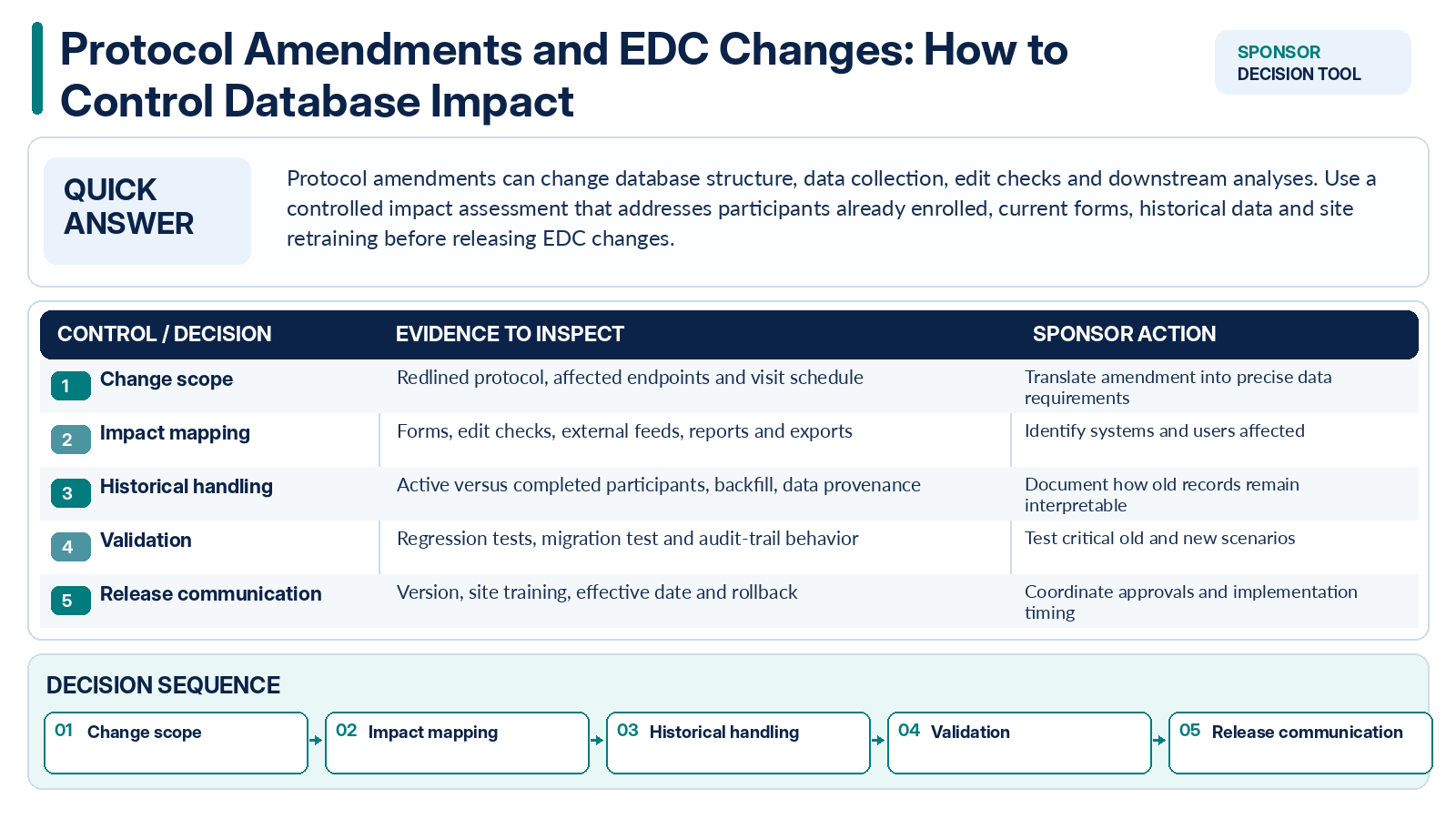
Protocol amendments can change database structure, data collection, edit checks and downstream analyses. Use a controlled impact assessment that addresses participants already enrolled, current forms, historical data and site retraining before releasing EDC changes.
How to apply this workflow in practice
Begin with the most consequential control and the evidence needed to resolve it. The following matrix connects each decision to records and an accountable action, rather than treating the list as a generic compliance checkbox.
| Control / question | Evidence to examine | Sponsor action |
|---|---|---|
| Change scope | Redlined protocol, affected endpoints and visit schedule | Translate amendment into precise data requirements |
| Impact mapping | Forms, edit checks, external feeds, reports and exports | Identify systems and users affected |
| Historical handling | Active versus completed participants, backfill, data provenance | Document how old records remain interpretable |
| Validation | Regression tests, migration test and audit-trail behavior | Test critical old and new scenarios |
| Release communication | Version, site training, effective date and rollback | Coordinate approvals and implementation timing |
For teams that need support implementing this across functions, BioBoston CRO EDC Build and Database Design can help adapt the controls to the study, vendors, and decision calendar.
Working through the controls
1. Change scope
Evidence: Redlined protocol, affected endpoints and visit schedule. Decision: Translate amendment into precise data requirements. Record the responsible function and the approved source version, and keep any remaining exceptions visible to the sponsor before this item is closed.
2. Impact mapping
Evidence: Forms, edit checks, external feeds, reports and exports. Decision: Identify systems and users affected. Record the responsible function and the approved source version, and keep any remaining exceptions visible to the sponsor before this item is closed.
3. Historical handling
Evidence: Active versus completed participants, backfill, data provenance. Decision: Document how old records remain interpretable. Record the responsible function and the approved source version, and keep any remaining exceptions visible to the sponsor before this item is closed.
4. Validation
Evidence: Regression tests, migration test and audit-trail behavior. Decision: Test critical old and new scenarios. Record the responsible function and the approved source version, and keep any remaining exceptions visible to the sponsor before this item is closed.
5. Release communication
Evidence: Version, site training, effective date and rollback. Decision: Coordinate approvals and implementation timing. Record the responsible function and the approved source version, and keep any remaining exceptions visible to the sponsor before this item is closed.
Red flags that should change the plan
- Applying new visit rules retroactively without rationale.
- Losing historical field meaning.
- Site instructions lagging system release.
Decision gate and governance
Approve an amendment-to-EDC traceability matrix and do not deploy until affected critical workflows are tested. The control owner should record the decision, evidence version, date, residual uncertainty and next re-review trigger. Where delegated providers perform the work, the sponsor should retain the relevant oversight and acceptance evidence.
Regulatory note: Applicable regulations, trial commitments and agreements must be distinguished from nonbinding FDA and ICH guidance. Apply this framework to the actual product, jurisdiction and study.
Need practical support?
Use BioBoston CRO EDC Build and Database Design to review the evidence, define decision rights, and build a study-specific action plan for the next milestone.