A protocol to database build process should let a sponsor trace every analysis-critical requirement from an approved protocol through data collection, edit checks, external data interfaces, user acceptance testing (UAT), and the final controlled EDC release. The objective is to preserve what the study intends to measure, when and how each observation is collected, and how the data reach analysis. A database can pass technical tests while still failing this more important scientific traceability test.
This practical guide is for sponsor Data Management, Clinical Operations, Biostatistics, Medical, and system-validation leads overseeing an outsourced EDC build. It is most useful at protocol finalization, before eCRF specifications freeze, and after protocol amendments that change endpoints, visits, eligibility, treatment or safety assessments. The central sponsor deliverable is a version-controlled requirement-to-evidence chain, not a spreadsheet created solely to satisfy an audit.
Establish the source-of-truth hierarchy before designing fields
Start from the approved protocol version and any approved amendment. Link to the current schedule of activities, endpoint and estimand definitions, statistical analysis plan (SAP), safety collection requirements, and applicable sponsor data standards. Where documents disagree, raise a documented decision before build freeze. The database designer should not independently interpret a protocol ambiguity that determines eligibility or a primary analysis variable.
Separate five questions often mixed together: what observation is required; who obtains it; when the observation is valid; where the authoritative source is held; and which validation or review control detects implausible, missing or contradictory data. For a primary endpoint, the answer may span a clinical assessment, vendor device, EDC field, derived dataset and statistical programming rule. For a safety event, the answer may also involve an independent safety database and reconciliation workflow.
FDA’s September 2025 ICH E6(R3) nonbinding guidance supports fit-for-purpose computerized systems, data integrity and proportionate quality controls. FDA’s October 2024 final guidance on electronic systems, records and signatures provides recommendations relevant to trustworthy clinical records. CDISC CDASH is a data acquisition standard that may improve consistent collection and downstream traceability; its use is not automatically mandatory for every study. Evaluate binding predicate and 21 CFR Part 11 obligations where applicable instead of calling every suggested template “FDA-required.”
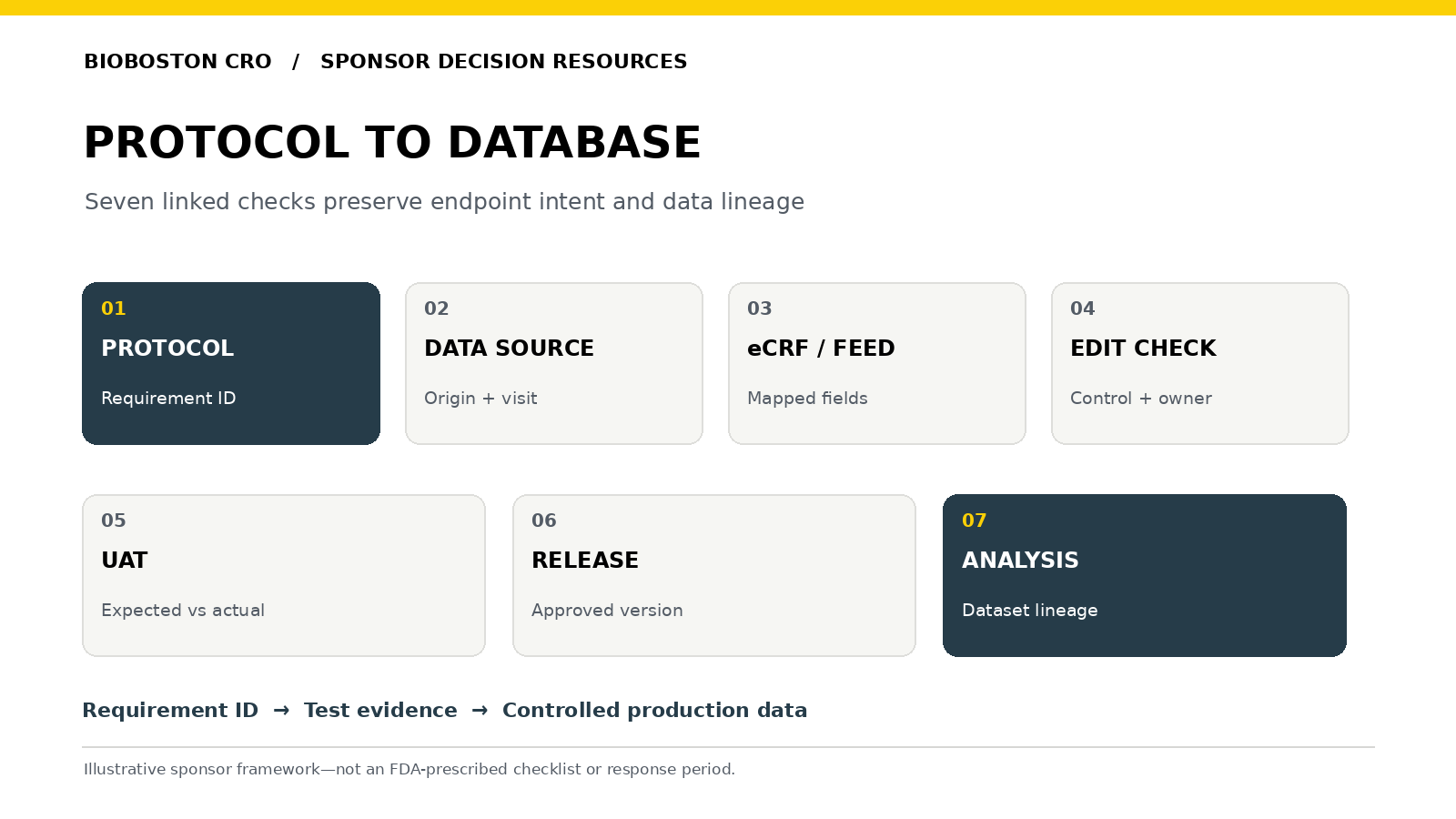
The seven-link protocol-to-build chain
1. Protocol requirement. Give each critical requirement a stable ID and cite the precise protocol section and version. Record the defined measure, timepoint, population and any conditional rule. Use the approved document, not a remembered presentation or site training summary.
2. Operational acquisition. Specify the data-originator, method and source, such as clinician assessment, participant questionnaire, central laboratory or randomization vendor. Define whether the EDC field is direct entry, transcription or imported data. Each path requires different controls and reconciliation responsibilities.
3. eCRF or interface specification. Link the requirement to a form, visit, item variable, allowed values, units, requiredness and applicable skip or repeat logic. If an important datum is held externally, record the controlled transfer specification and receiving dataset rather than inventing an unnecessary CRF field.
4. Edit check and medical review. Describe an evidence-proportionate check: range, chronology, cross-form consistency, missingness, visit window or medically meaningful review. A clean technical check may not detect an implausible clinical combination. Record cases requiring medical judgment rather than auto-correcting them.
5. Traceable UAT test. Provide test cases for valid, invalid and boundary conditions, including incomplete assessments, amendment migration, unplanned visits and vendor-interface failures. Link each critical test to its expected outcome and actual evidence. UAT sign-off must cover study-specific intended use, not merely whether the system opens successfully.
6. Controlled release. Tie the final specification, completed deviations/defect disposition, validation package, training and production configuration to a named authorized release. Preserve version relationships among protocol, forms, checks, exports and external mappings.
7. Analysis handoff. Verify that the accepted dataset and derivation rules support the SAP and required analyses. Record missing values, data conventions and mappings. If analysis variables are derived later, document who owns the transformation and how the provenance is reconstructed.
Copyable traceability matrix with acceptance criteria
Build one row per atomic requirement, not one per form. A single endpoint may require several collection and validation rows. Use an immutable requirement ID, and create a new version rather than silently changing the meaning of an ID after an amendment.
| Requirement ID and source | Data origin and collection | eCRF or interface mapping | Validation/UAT evidence | Approval and downstream use |
|---|---|---|---|---|
| END-01; protocol section for primary endpoint | Defined score at specified visit, collected by trained assessor | Visit-specific assessment items; missingness convention; controlled unit/scale | Correct visit, boundary values, missing required data, repeat assessment tested | Medical + Statistics interpretation; endpoint dataset mapping |
| ELIG-02; inclusion criterion | Screening source and investigator determination | Eligibility question, value, date and override reason | Contradictory or missing eligibility information flagged | Clinical/Medical review; analysis population impact |
| SAFE-03; safety event | Investigator record and safety system | EDC event plus reconciliation mapping; medical coding | SAE timing/term differences and corrections tested | Safety + Medical acceptance; reporting interface |
| LAB-04; external lab value | Central laboratory source with sample identifier | Vendor transfer field, unit conversion and visit mapping | Unknown subject, duplicate sample, unit mismatch and late retransfer tested | Data Lead approval; lab-to-analysis mapping |
| VIS-05; protocol schedule | Planned and unscheduled visits | Dynamic visit/form activation, allowable date windows | Repeated/unscheduled visit and amendment scenarios tested | Clinical Ops + Data acceptance; visit dataset |
| DISP-06; discontinuation | Site-reported status and reason | End-of-treatment and end-of-study forms | Contradiction with dosing/IRT and follow-up tested | Clinical/Statistics acceptance; disposition tables |
The examples are illustrative, not a claim about any specific BioBoston CRO trial. For every actual row, add owner, system version, specification ID, test ID, defect number, status, acceptance date and links to controlled evidence. Different organizations may separate these fields across linked systems; the key is reconstructable traceability, not one required workbook format.
Work backwards from the analysis question
Consider an endpoint defined as change from baseline at a scheduled visit. Ask Statistics to identify baseline and post-baseline source variables, allowable windows, missing-value and intercurrent-event treatment under the current SAP. Ask Medical to confirm that the collected assessment and timing answer the clinical question. Data Management then maps the specific items and visits. An edit check that merely requires a score to be numeric does not test whether the correct baseline/visit pair exists or whether an unscheduled assessment was incorrectly assigned.
For an externally collected biomarker, locate the authoritative specimen record and transfer file, not only the imported EDC column. Confirm specimen and subject identifiers, collection timestamp, unit, assay version, analyte flags, and the mapping into the intended analysis set. A missing specimen or failed assay may require an explicit analysis disposition even if the EDC interface is technically functioning.
For eligibility, distinguish an automated consistency warning from the investigator’s clinical eligibility determination. A programmed edit check should not replace the required human decision. Track overrides, their justification and the affected subjects so the sponsor can understand both data quality and protocol-deviation implications.
Treat edit checks as controlled decisions, not an ever-growing inventory
Prioritize checks that protect participant safety, primary endpoint accuracy, important eligibility rules, treatment exposure and critical data lineage. Some low-risk quality issues may be controlled through central review, source verification, reconciliation or analysis rules rather than onerous on-screen queries. Excessive alerts can obscure meaningful discrepancies and create workload at sites. The sponsor should agree which checks are preventive, detective, manual or external-interface controls.
For every critical check specify trigger, expected behavior, severity, owner, query or escalation route, exception disposition, and UAT proof. Confirm date-time logic, units, conditional forms, missing codes and whether the check operates in an appropriate system state. Validate negative/boundary scenarios. The specification should not allow a high-risk data change to become silently accepted because a contradictory form was never activated.
A failed UAT test should be triaged by scientific or operational impact, not merely severity labels from a software vendor. Retest affected critical requirements after defect correction. Confirm whether the fix created regressions elsewhere, especially when a shared data dictionary, visit scheduler or external mapping changed.
When a protocol amendment changes the database
Open a single change assessment that starts with the amended protocol requirement and ends with accepted production behavior. Identify affected subjects already in follow-up, future visits, form content, external transfer versions, validation checks, listings, extraction rules, training and SAP assumptions. Decide whether existing data must be migrated, recoded, annotated or preserved as collected. Record who has authority to approve interpretation and release timing.
Hypothetical example. A protocol amendment changes a biomarker assessment from a fixed visit day to a visit window and adds a reflex test for a subset of subjects. The eCRF designer updates the visit schedule but forgets that the laboratory transfer still labels results under the original fixed visit. The transfer file loads without errors; the analysis dataset drops records that do not fit the original map. A sponsor traceability review finds this during the requirement-to-interface/UAT check. The resolution includes a controlled mapping revision, test cases for both historical and new schedules, corrected export specifications and a formal risk decision about existing data. This is an illustrative scenario, not an actual client result.
A sponsor design review and release gate
Run a focused four-function review rather than ask everyone to sign every field. Medical confirms clinical meaning and participant protection; Statistics confirms analysis-ready definitions; Data Management confirms forms, interfaces and tests; Clinical Operations confirms practical site workflow and training. Add Safety, Regulatory, QA and system validation reviewers when the requirement touches those functions. Document the specific authority delegated to each reviewer.
Before sign-off, sample critical requirements in both directions. Forward trace: take protocol sections and find their collection mapping, edit-check rationale, test evidence and analysis endpoint. Backward trace: start from an analysis-critical EDC field or dataset variable and reconstruct the protocol purpose, source record, transformations and release version. Investigate any orphan field, undocumented derivation or unmet requirement before deployment.
Define the launch gate: approved protocol and design decisions; completed critical traceability; controlled specifications and versioning; acceptable critical UAT results; resolved or formally dispositioned significant defects; external-interface acceptance; authorized release; user access and training; and a working change-control and backup route. This is a proposed sponsor release checklist, not a substitute for the sponsor’s validated system lifecycle and contractual obligations.
Common defects and the more useful question
A completed CRF specification may still lack endpoint lineage: “Can Statistics reach the expected analysis variable from the protocol ID?” A green UAT dashboard may exclude external transfers: “Were subject, visit, units and file-version mismatches tested?” A signed change request may overlook historical subjects: “What happens to records collected under the previous schedule?” A huge edit-check library may create site burden without improving reliability: “Which critical-to-quality factor does each important check protect?” A released database may be difficult to reproduce: “Which system configuration, specification and test record correspond to the live version?”
The earlier BioBoston CRO Protocol-to-eCRF Traceability Matrix provides a narrow field-by-field crosswalk. This guide goes further through build decisions, change-impact analysis, UAT evidence, vendor interfaces and production release. For hands-on protocol-to-data-collection review, see eCRF Design and Review services. Explore eCRF Design and Review support to assess whether critical endpoints and safety requirements are implemented and tested as intended.
Regulatory distinction: Applicable FDA predicate rules and 21 CFR Part 11 requirements are binding when their conditions are met. FDA’s September 2025 ICH E6(R3) and October 2024 electronic-systems guidance contain nonbinding recommendations; CDISC CDASH is a voluntary industry data-acquisition standard unless otherwise applicable through agreement or specific requirements. The seven-link chain and release checklist are sponsor working tools. Recommended reviewer: senior Clinical Data Management/EDC SME with Biostatistics, Medical, Clinical Operations and QA/CSV expertise. Refresh after protocol/SAP amendments, system migrations, external-vendor changes and primary-source updates.