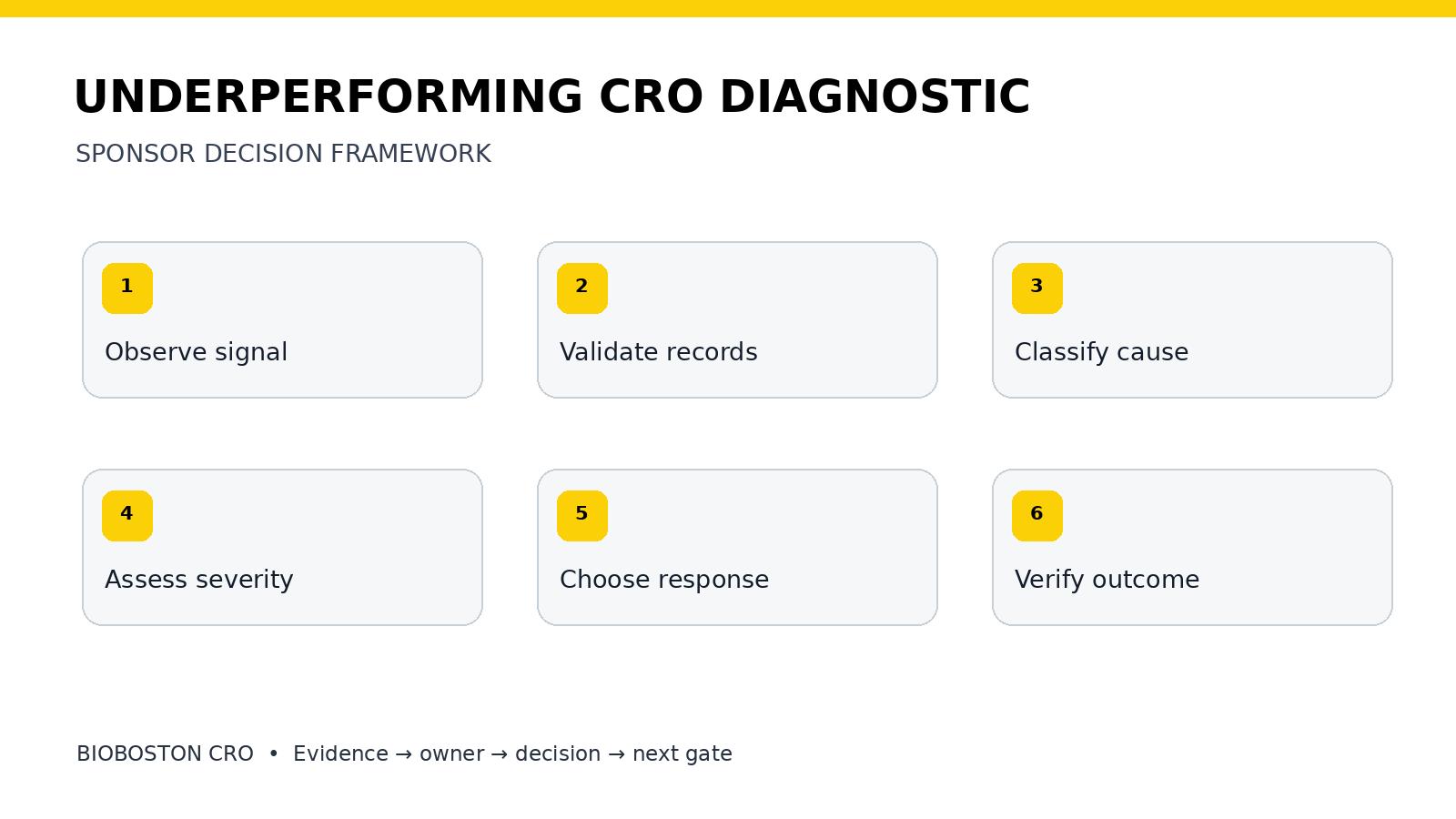
An underperforming CRO should be assessed using objective evidence before the sponsor decides to remediate, augment, or replace the provider. The diagnostic separates a late deliverable from a capability gap, unclear scope, insufficient sponsor decisions, and a material quality or safety failure.
Why this matters to the sponsor
A vendor may be reporting red milestones for reasons that cross organizational boundaries. Sponsors need a cause-and-evidence matrix rather than an emotional performance judgment. This guide provides a practical first assessment for an emerging biotech sponsor in an active study.
Sponsor diagnostic matrix: symptoms to evidence
| Signal / timing | What to verify | Accountable owner | Evidence / escalation |
|---|---|---|---|
| Missed milestone | Critical-path forecast, predecessor records, and signed baseline | Clinical PM | Repeated slippage without owner or recovery action |
| Enrollment behind plan | Site funnel by activation/eligible/screened/enrolled and protocol feasibility | Clinical Operations | Forecast based on unvalidated site estimates |
| Persistent EDC queries | Query aging, data-cleaning plan, edit-check defects | Data Management | High query age affecting endpoints or lock |
| Late safety or quality handling | Applicable safety reports, deviations, escalation records and CAPA | Sponsor Medical/QA | Urgent event not escalated by mandated process |
| Uncontrolled vendor subcontracting | Contracts, transfer of duties, subcontract oversight and quality agreements | Vendor Governance | Unclear sponsor visibility to critical subcontracted activity |
| Budget variance | Approved change orders, unit drivers, forecast-to-complete | Finance/PM | Work without documented authorization |
| Conflicting status reports | Source-system snapshots and sponsor/vendor reconciliations | Program Lead | Progress claimed without verifiable evidence |
How to put the framework into practice
Verify before assigning cause
Check original scope and approved changes; compare each reported issue with source-system records and documented acceptance criteria.
Test four cause families
Scope ambiguity, capability/capacity, process/control failure, and external dependency require different interventions. Do not treat them as synonyms.
Grade urgency by consequence
Participant protection, critical-to-quality data, mandated reporting and material compliance issues demand immediate escalation; ordinary delivery slippage follows a controlled sponsor decision path.
Choose an appropriate response
Remediate with a time-limited corrective plan, strengthen sponsor oversight or functional support, or plan an orderly transition after assessing continuity and records risk.
Set a measurable proof of recovery
Require dated deliverables, accountable owners, evidence links, decision deadlines, and independent verification. Document who is authorized to approve any scope or budget change.
Illustrative scenario (hypothetical)
Hypothetical: a CRO misses a database-cleaning milestone while recruitment remains stable. Review the query aging distribution and source data access before concluding staffing is the problem. A sponsor-side decision log may reveal that a protocol amendment delayed edit-check approvals.
Sponsor action log fields
Issue/risk ID; source evidence; affected milestone; critical-to-quality impact; owner; action due; decision authority; approved recovery option; next verification; status.
Regulatory context and limitations
Clinical program decision-support materials. These matrices are operational examples that require protocol-, jurisdiction-, and study-specific adaptation. ICH E6(R3) is FDA guidance containing nonbinding recommendations; applicable requirements under 21 CFR Part 312 remain binding for covered IND studies. Escalate participant safety, protocol deviations, and data integrity matters through the appropriate established processes rather than waiting for a weekly meeting.
Apply to your program
Make these controls work across teams with BioBoston CRO Trial Rescue Management.