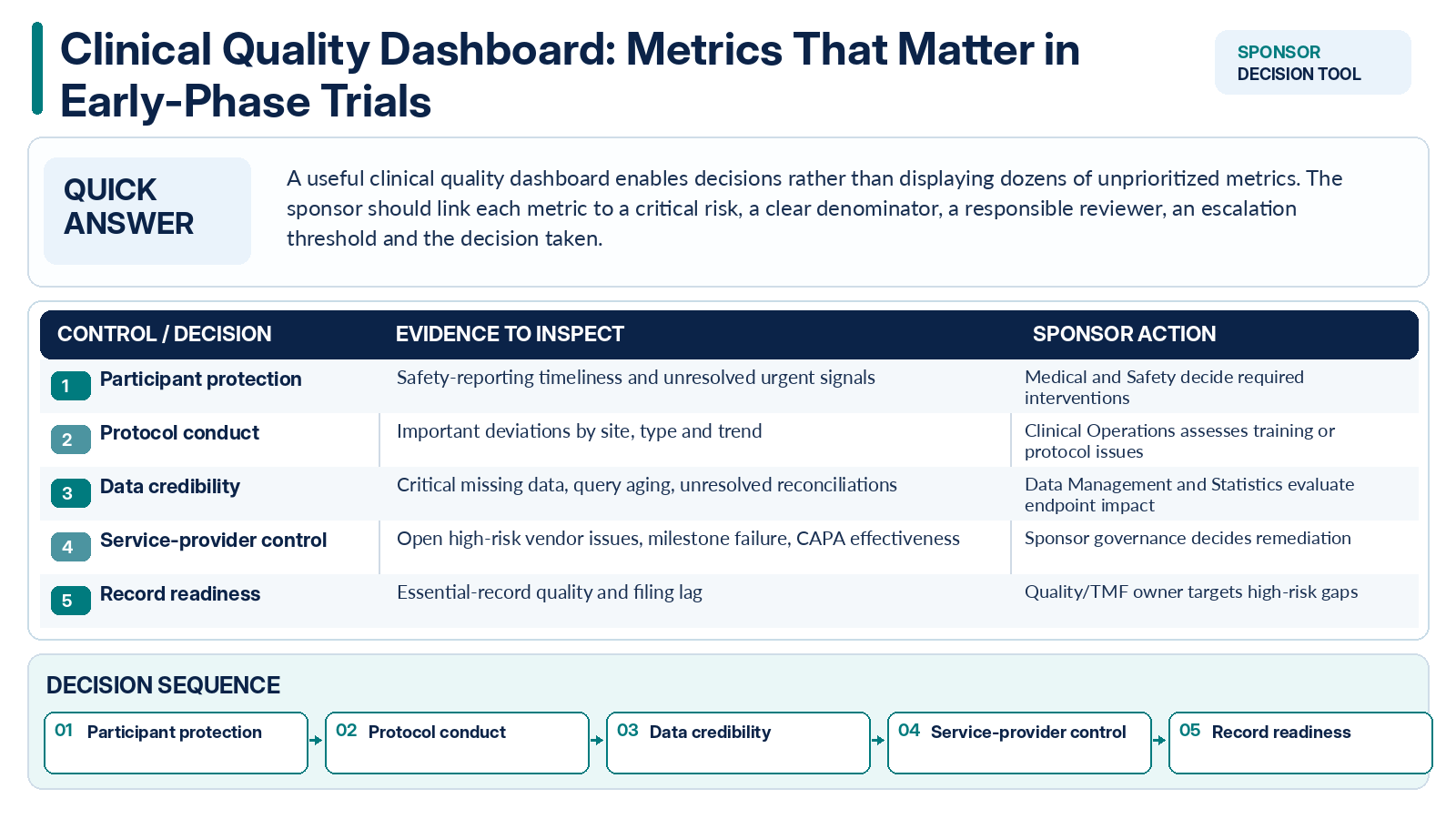
A useful clinical quality dashboard enables decisions rather than displaying dozens of unprioritized metrics. The sponsor should link each metric to a critical risk, a clear denominator, a responsible reviewer, an escalation threshold and the decision taken.
Reusable decision and evidence template
Begin with the most consequential control and the evidence needed to resolve it. The following matrix connects each decision to records and an accountable action, rather than treating the list as a generic compliance checkbox.
| Control / question | Evidence to examine | Sponsor action |
|---|---|---|
| Participant protection | Safety-reporting timeliness and unresolved urgent signals | Medical and Safety decide required interventions |
| Protocol conduct | Important deviations by site, type and trend | Clinical Operations assesses training or protocol issues |
| Data credibility | Critical missing data, query aging, unresolved reconciliations | Data Management and Statistics evaluate endpoint impact |
| Service-provider control | Open high-risk vendor issues, milestone failure, CAPA effectiveness | Sponsor governance decides remediation |
| Record readiness | Essential-record quality and filing lag | Quality/TMF owner targets high-risk gaps |
For teams that need support implementing this across functions, BioBoston CRO Quality Management can help adapt the controls to the study, vendors, and decision calendar.
Working through the controls
1. Participant protection
Evidence: Safety-reporting timeliness and unresolved urgent signals. Decision: Medical and Safety decide required interventions. Record the responsible function and the approved source version, and keep any remaining exceptions visible to the sponsor before this item is closed.
2. Protocol conduct
Evidence: Important deviations by site, type and trend. Decision: Clinical Operations assesses training or protocol issues. Record the responsible function and the approved source version, and keep any remaining exceptions visible to the sponsor before this item is closed.
3. Data credibility
Evidence: Critical missing data, query aging, unresolved reconciliations. Decision: Data Management and Statistics evaluate endpoint impact. Record the responsible function and the approved source version, and keep any remaining exceptions visible to the sponsor before this item is closed.
4. Service-provider control
Evidence: Open high-risk vendor issues, milestone failure, CAPA effectiveness. Decision: Sponsor governance decides remediation. Record the responsible function and the approved source version, and keep any remaining exceptions visible to the sponsor before this item is closed.
5. Record readiness
Evidence: Essential-record quality and filing lag. Decision: Quality/TMF owner targets high-risk gaps. Record the responsible function and the approved source version, and keep any remaining exceptions visible to the sponsor before this item is closed.
Red flags that should change the plan
- Traffic-light colors with no decision rule.
- Comparing sites without case-mix context.
- Reporting percentages with tiny denominators as definitive.
Decision gate and governance
Demand one decision or documented no-action rationale for every breached quality metric at each governance review. The control owner should record the decision, evidence version, date, residual uncertainty and next re-review trigger. Where delegated providers perform the work, the sponsor should retain the relevant oversight and acceptance evidence.
Regulatory note: Applicable regulations, trial commitments and agreements must be distinguished from nonbinding FDA and ICH guidance. Apply this framework to the actual product, jurisdiction and study.
Need practical support?
Use BioBoston CRO Quality Management to review the evidence, define decision rights, and build a study-specific action plan for the next milestone.