Clinical Trial Budget Tracking and Forecast Template for Sponsors
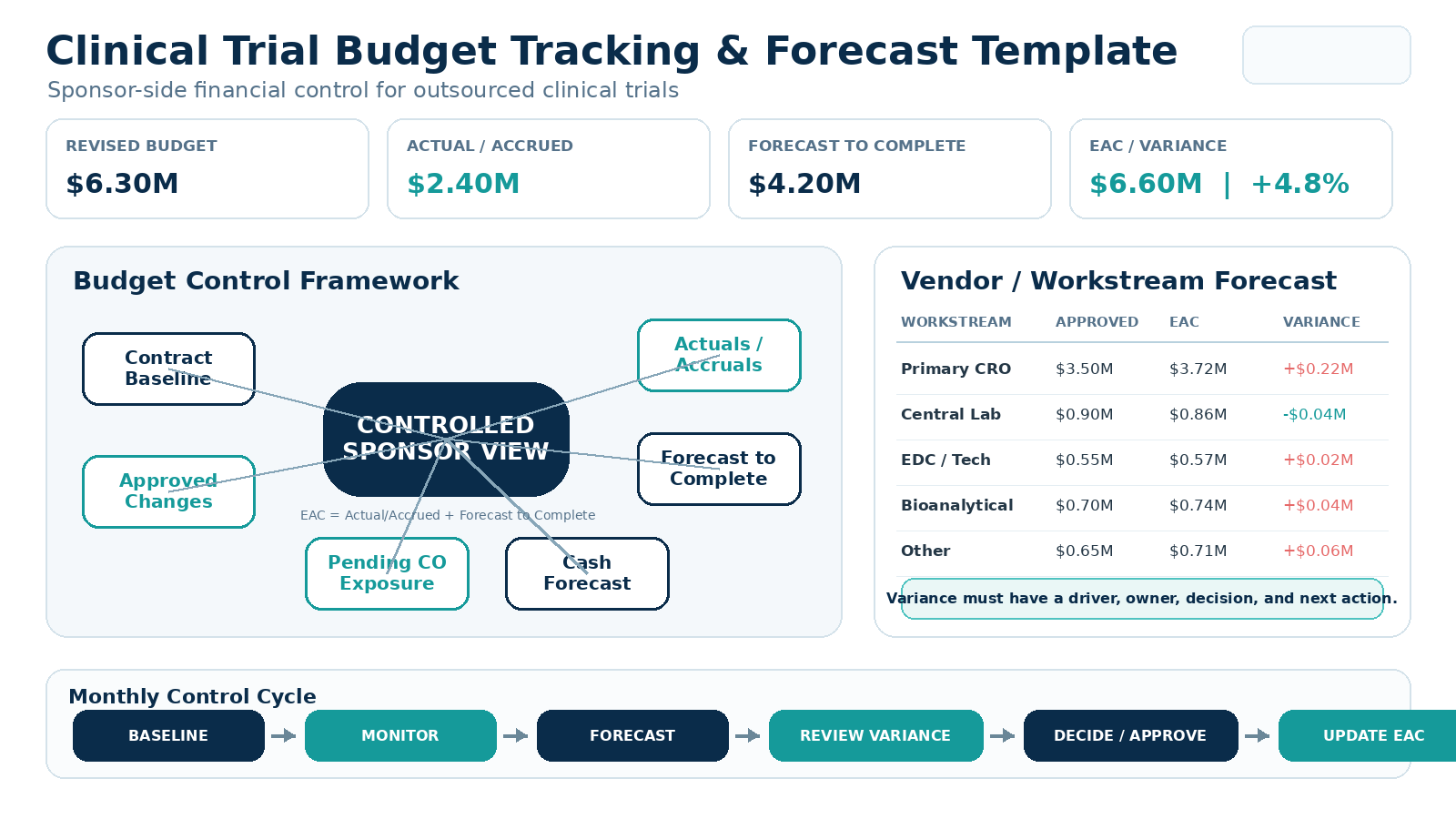
A useful clinical trial budget should tell the sponsor where the study is heading, not only what has already been invoiced. For an outsourced trial, the minimum working view is baseline budget + approved changes + actual/accrued spend + forecast to complete = estimate at completion.
That view should be maintained by workstream and vendor, connected to timeline assumptions, enrollment or activity drivers, pass-through costs, and pending change exposure. The template below is designed for Clinical Operations, Finance, Procurement, Program Management, and executive sponsors who need one controlled financial view from vendor selection through closeout.
This is a BioBoston CRO sponsor-side management framework. It is not an FDA-required template, an accounting standard, or a substitute for the sponsor’s financial controls.
Quick answer: what should a clinical trial budget tracker include?
- A contractual baseline: executed SOWs, budgets, and approved assumptions.
- Approved change orders separated from pending or at-risk changes.
- Actuals and accruals to date, kept distinct from invoice payment status.
- Forecast to complete by vendor, workstream, month, and major activity driver.
- Estimate at completion (EAC) and variance versus the current approved budget.
- Pass-through costs, currency/tax assumptions, and sponsor-controlled reserves where applicable.
- A clear link from financial variance to timeline, enrollment, scope, and vendor-performance drivers.
- Named owners, review cadence, variance commentary, decisions, and corrective actions.
Who this template is for
This framework is designed for lean emerging-biotech and small-pharma sponsors that have a primary CRO plus laboratories, technology providers, central services, consultants, or other specialist vendors. It is especially useful when Clinical Operations owns delivery while Finance or executive leadership needs a reliable forecast without rebuilding the study budget from invoices every month.
The template is strongest from vendor selection through closeout, including proposal normalization, baseline approval, monthly forecasting, change-order review, invoice/accrual reconciliation, and end-of-study cost-to-complete.
The Excel-ready workbook structure
A practical workbook can be built with seven tabs. Keep the summary simple enough for leadership, while retaining line-item detail behind it.
| Tab | Purpose | Key output |
|---|---|---|
| 1. Executive Summary | One-page financial status by study and workstream | Approved budget, EAC, variance, pending exposure, cash outlook |
| 2. Budget Baseline | Original and revised approved commitments | Baseline, approved change orders, revised budget |
| 3. Monthly Forecast | Time-phased forecast by vendor/workstream | Monthly cash and cost forecast, forecast-to-complete |
| 4. Actuals & Accruals | Recognized/invoiced cost tracking | Actual/accrued to date and reconciliation status |
| 5. Change Orders | Approved, pending, rejected, or at-risk scope changes | Change exposure and approval history |
| 6. Assumptions & Drivers | Operational assumptions that drive cost | Enrollment, sites, duration, visits, units, rates, currencies |
| 7. Risks, Decisions & Actions | Financial risks and sponsor decisions | Owner, due date, decision, mitigation, next action |
The point is not to create seven disconnected spreadsheets. The summary should calculate from the controlled source tabs so the sponsor can trace every material variance back to a vendor line, assumption, change, or operational event.
Copyable master budget tracking template
| Field | What to capture | Why it matters |
|---|---|---|
| Workstream / vendor | CRO, sites, central lab, bioanalytical, EDC, imaging, safety, statistics, writing, etc. | Creates a comparable management view across providers. |
| Contract / SOW | Agreement, amendment, PO, or internal cost center | Ties the forecast to an approved commercial basis. |
| Budget basis | Fixed fee, unit-based, FTE, milestone, pass-through, estimate | Explains what drives the cost. |
| Baseline budget | Original approved value | Preserves the starting point. |
| Approved change orders | Cumulative approved changes | Separates authorized scope changes from noise. |
| Revised approved budget | Baseline + approved changes | Current budget authority for comparison. |
| Actual / accrued to date | Cost recognized to the reporting date | Shows economic consumption, not only paid invoices. |
| Open commitments | Contracted amount not yet recognized | Shows committed exposure. |
| Forecast to complete | Expected remaining cost | Captures the forward view. |
| Estimate at completion | Actual/accrued + forecast to complete | Shows expected total cost at completion. |
| Variance $ / % | EAC minus revised budget | Quantifies over/under forecast. |
| Pending CO exposure | Unapproved or under-review change requests | Prevents surprises hidden outside the budget. |
| Primary driver | Enrollment, sites, duration, amendment, unit volume, resource rate, delay | Explains the cause of variance. |
| Owner / next action | Named sponsor owner and required decision | Converts variance into management action. |
Core Excel formulas
Use structured references or equivalent cell references in the workbook. The exact column letters will depend on your implementation.
| Metric | Formula / logic |
|---|---|
| Revised Approved Budget | Baseline Budget + Approved Change Orders |
| Estimate at Completion (EAC) | Actual or Accrued to Date + Forecast to Complete |
| Variance ($) | EAC – Revised Approved Budget |
| Variance (%) | IFERROR(Variance $ / Revised Approved Budget, 0) |
| Remaining Budget | Revised Approved Budget – Actual or Accrued to Date |
| Forecast Headroom | Revised Approved Budget – EAC |
| Pending Change Exposure | Sum of pending / probable change requests not yet approved |
Do not use invoice totals as a substitute for actual or accrued cost unless that is explicitly how the sponsor’s accounting process works. A vendor can be months behind in invoicing while the study has already consumed the underlying services.
Field-by-field instructions
1. Freeze the contractual baseline
Start with the executed SOW, approved vendor budget, payment schedule, and material assumptions. Preserve the original baseline instead of overwriting it when scope changes. This allows the sponsor to distinguish true performance variance from formally approved scope growth.
2. Separate approved changes from pending exposure
A pending change order is not the same as approved budget authority, but it is still financial exposure. Track requested amount, reason, status, owner, date submitted, sponsor decision date, and expected probability or planning treatment. If the request is not yet approved, do not quietly add it to the approved baseline.
3. Forecast using operating drivers
The strongest forecasts connect money to the assumptions that drive activity. Depending on the trial, those may include active sites, enrollment pace, participant visits, monitoring activity, samples, shipments, data volume, amendment work, study duration, vendor FTEs, or milestone dates.
When the key cost driver is timing, link the forecast to the current integrated schedule. BioBoston CRO’s Study Timeline Management can help connect financial assumptions to milestones, dependencies, forecast shifts, and recovery scenarios.
4. Track actuals, accruals, and invoices separately
Keep three concepts distinct: what has been invoiced, what has been paid, and what cost has been incurred or accrued. These views answer different questions. Finance may own the accounting treatment, while Clinical Operations should still understand whether invoices and accruals are consistent with actual study activity.
5. Calculate EAC before discussing variance
Variance should be forward-looking. A study that is under budget today can still finish over budget if the remaining forecast is understated. Estimate at completion brings actual/accrued cost and forecast-to-complete into one number, which makes sponsor decisions more useful.
6. Require a cause and action for material variance
Do not stop at red/amber/green status. For each material variance, document the primary driver, impact, decision required, owner, due date, and whether the forecast has been updated. This turns budget reporting into management rather than accounting commentary.
Budget status and cash status are not the same thing
A sponsor can be within approved budget but face a near-term cash spike, or have comfortable cash timing while the total study is forecasting over budget. Track both.
| View | Question it answers |
|---|---|
| Budget authority | What amount is currently approved? |
| Commitment | What amount has the sponsor contractually committed? |
| Actual / accrued | What cost has been consumed or recognized? |
| Cash / invoice forecast | When is money expected to be paid? |
| EAC | What do we currently expect the trial to cost in total? |
| Change exposure | What additional cost may be coming but is not approved yet? |
Change-order control: a simple sponsor workflow
- Log the request as soon as the vendor identifies a potential scope/cost change.
- Require the vendor to state the operational driver, affected activities, quantities/rates, timeline impact, and commercial basis.
- Check whether the request is already covered by the SOW, assumptions, unit schedule, or another approved change.
- Assess downstream effects across other vendors and workstreams before approval.
- Record sponsor disposition: approve, reject, defer, negotiate, or request more evidence.
- If approved, update the change-order register and revised approved budget; do not overwrite the original baseline.
- Update forecast-to-complete and cash timing separately so the decision is reflected in both cost and payment views.
For sponsors coordinating several outsourced providers, this process should connect with Vendor Governance so commercial changes are evaluated alongside deliverables, dependencies, performance, and escalation rather than as isolated procurement events.
Clearly hypothetical example
Consider a hypothetical Phase II sponsor with a primary CRO, central laboratory, EDC provider, and bioanalytical vendor. The figures below are illustrative only and are not market benchmarks.
| Metric | Illustrative value |
|---|---|
| Original approved budget | $6.00M |
| Approved change orders | $0.30M |
| Revised approved budget | $6.30M |
| Actual / accrued to date | $2.40M |
| Forecast to complete | $4.20M |
| Estimate at completion | $6.60M |
| Forecast variance | +$0.30M (+4.8%) |
| Pending change exposure | $0.15M under review |
A weak monthly report might say that only $2.4M has been spent against a $6.3M approved budget. That looks comfortable. The sponsor-side forecast shows a different picture: the study is currently expected to finish $0.3M above the revised budget, before considering the additional pending change request.
The next management question is therefore not simply “why are costs high?” It is: Which driver changed, which portion is avoidable, what operational decision is available now, and what will the updated EAC be after that decision?
Monthly sponsor budget review cadence
A lean sponsor can usually operate a practical monthly financial review supported by more frequent project updates when material changes occur.
| Review item | What should be ready |
|---|---|
| Baseline and approved changes | Current contract/SOW and change-order register |
| Actuals / accruals | Latest recognized cost and unresolved reconciliation items |
| Forecast to complete | Updated remaining forecast by vendor/workstream |
| EAC and variance | Current total-cost forecast and variance explanation |
| Pending changes | Open vendor requests and likely exposure |
| Operational drivers | Enrollment, sites, duration, timeline, amendment, unit or resource changes |
| Decisions / actions | Named owner, due date, financial impact, next step |
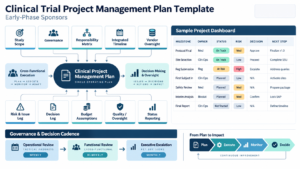
When budget, timeline, and cross-functional delivery are being managed together, a sponsor-side Clinical Project Management structure can integrate financial decisions with milestones, risks, dependencies, actions, and executive governance.
What teams often overlook
- Using the vendor invoice register as the study forecast.
- Losing the original baseline when approved changes are added.
- Failing to time-phase pass-through costs and milestone payments.
- Ignoring pending change requests until they are formally approved.
- Tracking CRO variance without checking downstream laboratory, site, technology, or specialist-vendor effects.
- Leaving currency, tax, inflation, travel, shipping, or other commercial assumptions implicit.
- Using an outdated enrollment or study-duration assumption in the financial forecast.
- Reporting variance without an owner, decision, or recovery action.
- Closing the study without a final reconciliation of open commitments, credits, pass-throughs, and remaining invoices.
Regulatory and GCP context
FDA regulations and ICH GCP do not prescribe a clinical trial budget workbook or sponsor budget-tracking formula. The template in this resource is therefore an operational and financial-management framework, not a regulatory requirement.
Current ICH E6(R3) guidance does reinforce sponsor responsibility for appropriate oversight of important activities transferred to service providers, access to relevant performance information, risk-proportionate oversight, and timely escalation/follow-up of issues. Those principles support disciplined vendor and project governance, but the specific financial fields, formulas, thresholds, and review cadence in this template are BioBoston CRO practical recommendations.
When Budget Tracking support can help
A sponsor may have the right contracts and still lack one reliable view of the study’s financial position. BioBoston CRO’s Budget Tracking support is designed for sponsors that need a controlled view of baseline commitments, forecasts, actuals, accrual inputs, vendor proposals, pass-through costs, change orders, cost-to-complete, and financial risk.
Support can include initial budget review, ongoing tracking, variance analysis, scenario forecasting, invoice and change-order assessment, cost-to-complete review, or recovery of a fragmented trial budget. The financial view can be coordinated with project controls, timelines, and vendor governance while the sponsor retains appropriate commercial and executive decision authority.
Final budget-control checklist
- The original baseline is preserved.
- Approved change orders are separated from pending exposure.
- Actuals/accruals are not confused with invoices or payments.
- Forecast to complete is updated from current operational assumptions.
- EAC and variance are calculated for each material vendor/workstream.
- Pass-through and non-fixed costs have explicit assumptions.
- Timeline and enrollment changes are reflected in the forecast.
- Material variances have a cause, owner, decision, due date, and action.
- Change orders are traceable to scope and approval history.
- Leadership can see total expected cost and near-term cash timing without rebuilding the budget.
Final CTA
Need help turning CRO and vendor budgets, forecasts, actuals, change orders, and variance into one controlled sponsor view? Explore BioBoston CRO Budget Tracking support.
FAQ
Is there a standard FDA clinical trial budget template?
No. FDA does not prescribe a specific clinical trial budget spreadsheet. Sponsors should use financial and project controls appropriate to their organization, agreements, study design, and outsourced operating model.
What is the difference between budget, forecast, and EAC?
The budget is the approved financial baseline. The forecast estimates expected future cost. Estimate at completion combines cost already incurred or accrued with forecast-to-complete to show the current expected total cost of the study.
Should pending change orders be included in the approved budget?
Not until they are approved according to the sponsor’s process. Track them separately as exposure so leadership can see the potential impact without confusing requested cost with authorized budget.
How often should a sponsor update the trial budget forecast?
The appropriate cadence depends on trial activity and financial risk. A monthly formal review is often practical, with off-cycle updates when a material scope, timeline, enrollment, vendor, or change-order event affects the forecast.