Clinical trial outsourcing should begin with the sponsor operating model, not a list of CRO services. A lean biotech team should decide what it must continue to own, what can be transferred or supported externally, how decisions will be made, and what evidence will demonstrate effective oversight.
Quick answer: what should a lean sponsor outsource?
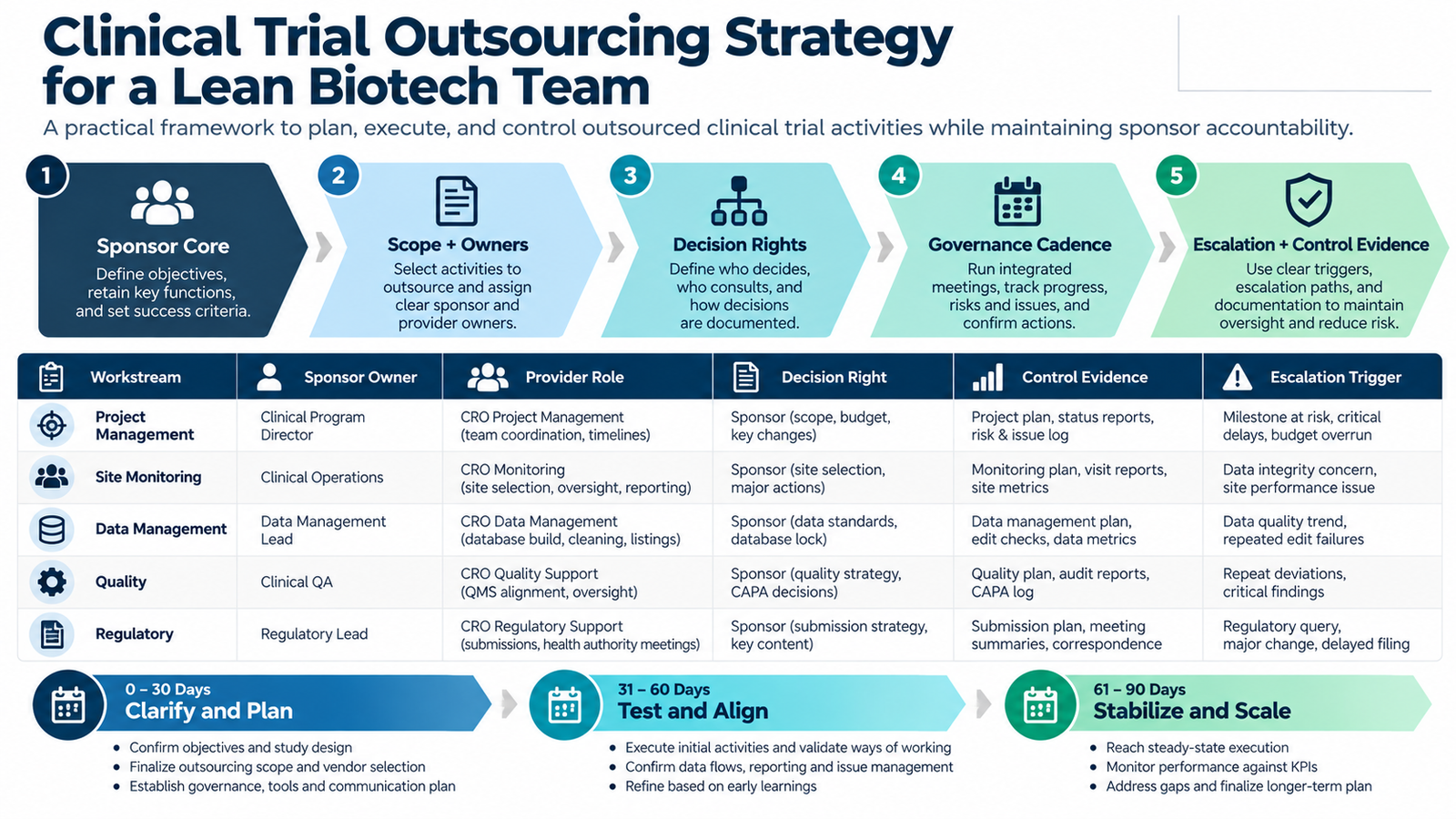
Once the broad sourcing direction is chosen, the operating challenge is to make it executable: retain a small accountable sponsor core, define each provider interface, place decision rights where they belong, and use one integration layer across functions. The goal is not maximum outsourcing. The goal is clear ownership, reliable handoffs, fast decisions, and proportionate oversight.
Who this framework is for
This framework is designed for a VP or Head of Clinical Operations, Clinical Program Director, COO, CMO, or equivalent leader at a funded biotech or small pharmaceutical sponsor with a lean internal team. It is most useful from pre-startup through closeout, especially when a Phase I or Phase II program requires several functions to move together but the sponsor does not want to build a large permanent department.
Use it when a trial is approaching startup, the current vendor model is fragmented, internal ownership is unclear, a new CRO or specialist provider is being selected, or leadership needs a more controlled operating model before a major milestone.
1. Start with the sponsor core: what must remain actively owned?
Outsourcing capacity does not remove sponsor accountability. The practical first step is to name the decisions and controls that remain sponsor-owned even when execution is external. The exact allocation will vary by program, contract, regulation, geography, and company structure.
| Sponsor control area | What the sponsor should be able to decide or demonstrate | Common failure mode |
|---|---|---|
| Development and trial strategy | Why the study exists, what success means, major tradeoffs, and acceptable risk | Strategy is implicitly shaped by vendor convenience or inherited assumptions. |
| Scope and transferred activities | What each provider is responsible for, what remains with the sponsor, and where interfaces sit | Contracts, plans, and team practice describe different ownership. |
| Critical decisions | Who approves protocol-impacting changes, major timeline recovery, significant quality actions, and material spend | Important decisions stall because nobody has explicit authority. |
| Provider selection and oversight | Why a provider is suitable, what performance information is reviewed, and how issues are escalated | Selection ends at contract signature and performance is managed reactively. |
| Quality and participant protection | Critical-to-quality risks, significant deviations, safety-impacting issues, and remediation decisions | Operational urgency outruns quality escalation. |
| Integrated program view | Current milestones, dependencies, risks, decisions, budget signals, and vendor status | Each vendor reports its own work but no one owns the integrated picture. |
2. Before you use this plan: confirm the sourcing direction
This framework assumes the sponsor has already chosen a broad sourcing direction and now needs to operationalize it. If the team is still deciding between full-service CRO, FSP-style, specialist, or hybrid arrangements, use BioBoston CRO’s FSP vs Full-Service CRO comparison first.
For this operating plan, capture only the sourcing choice already made for each workstream and move immediately to the controls that determine whether it will work: sponsor accountability, provider scope, decision rights, evidence of control, dependencies, and escalation.
| Workstream question | What must be explicit before execution starts | Red flag |
|---|---|---|
| Who performs the work? | Named internal team, CRO, specialist provider, embedded resource, or defined combination | The contract names a provider but the delivery team or subcontracting path is unclear. |
| Who remains accountable sponsor-side? | One sponsor role that can answer for the workstream and make or route decisions | Several contributors exist but no accountable sponsor owner is named. |
| What decision stays with the sponsor? | Approval rights for material scope, quality, timeline, budget, or regulatory decisions | Provider execution quietly becomes provider decision-making. |
| What evidence shows control? | Plans, metrics, reviews, logs, approvals, trend data, or other fit-for-purpose oversight evidence | Status is discussed verbally but important decisions and exceptions are not recoverable. |
| What triggers escalation? | Defined threshold, event, delay, quality signal, or dependency failure | Issues escalate only after a milestone has already failed. |
3. Build a Clinical Trial Outsourcing Control Map
The control map is the core tool in this framework. Complete one row for every material workstream before finalizing the operating model. It should align with contracts, study plans, the responsibility matrix, vendor governance, and the integrated timeline.
| Workstream | Delivery model | Sponsor accountable owner | Provider role | Decision right | Control evidence | Escalation trigger |
|---|---|---|---|---|---|---|
| Clinical project management | Embedded / sponsor-side | Head Clinical Operations | Integrated planning, coordination, status and decision tracking | Sponsor approves priorities, major recovery actions and commitments | Integrated plan, risk/issue/decision log, governance minutes | Critical path slip, unresolved cross-functional dependency, decision overdue |
| Site monitoring | CRO / partner-supported | Clinical Operations lead | Monitoring execution and site issue follow-up | Sponsor decides significant escalation and remediation path | Monitoring metrics, issue trends, follow-up evidence | Repeated serious finding, delayed follow-up, site risk trend |
| Data management | Specialist vendor or CRO | Data Management lead | EDC, cleaning, query and database processes per scope | Sponsor approves key plans, major data-risk decisions and lock readiness | DMP, metrics, issue log, readiness criteria | Backlog trend, reconciliation failure, lock-risk milestone |
| Biostatistics | Specialist / integrated CRO | Biometrics lead | SAP, programming and analyses per scope | Sponsor retains interpretation and key analysis decisions | SAP approvals, QC evidence, decision record | Analysis change, dataset issue, missed milestone |
| Clinical quality | Sponsor-led with SME support | Clinical Quality lead | Audit, quality review, CAPA or inspection-readiness support | Sponsor determines quality disposition and escalation | Quality plan, audit/CAPA records, oversight evidence | Participant/data risk, recurring issue, ineffective CAPA |
| Regulatory / medical writing | Internal plus specialist support | Regulatory lead | Submission planning and document development per scope | Sponsor approves regulatory positions and final submissions | Review history, decision log, submission plan | Agency feedback, strategy change, document critical-path risk |
How to complete each control-map field
Delivery model
State the actual model used for that workstream: internal, embedded support, specialist vendor, broad CRO, or a defined hybrid. Avoid labels that hide how work is really performed.
Sponsor accountable owner
Name one role that can answer for the workstream at sponsor level. Contributors can be many; accountable ownership should not be shared vaguely across a committee.
Provider role
Describe the provider’s operational responsibility in plain language. If the description cannot be understood without opening the contract, the operating model is too opaque.
Decision right
Define who can make the decision, who must be consulted, and which decisions cannot be made by the provider alone. This is especially important for scope changes, recovery actions, significant quality issues, and budget-impacting commitments.
Control evidence
List the evidence that demonstrates oversight is actually operating: metrics, minutes, decision records, trend reports, risk logs, deliverable reviews, audit outputs, issue follow-up, or documented approvals.
Escalation trigger
Make escalation objective where possible. Examples include a critical-path milestone slipping beyond tolerance, a repeated high-risk finding, an unresolved dependency across two governance cycles, or a material forecast variance requiring leadership action.
4. Install a decision cadence that matches trial risk
Lean teams often add meetings when coordination feels weak. A better response is to give each governance forum a distinct decision purpose and remove duplicate reporting.
| Cadence | Purpose | Minimum inputs | Expected output |
|---|---|---|---|
| Weekly integrated study operations | Manage near-term milestones, dependencies, issues and decisions | Integrated timeline, top risks/issues, action log, vendor exceptions | Named actions, due dates, decisions and escalations |
| Biweekly or monthly vendor performance | Review provider performance beyond task status | KPIs/KRIs, deliverable quality, trend data, changes, resourcing | Performance actions, recovery commitments, change decisions |
| Monthly sponsor leadership review | Connect trial execution to program, budget and strategic decisions | Milestone forecast, critical risks, budget variance, major decisions | Leadership decisions, risk acceptance, resource changes |
| Milestone / phase-gate review | Confirm readiness before irreversible or high-cost transitions | Readiness criteria, unresolved gaps, assumptions, contingency options | Go / conditional go / no-go decision and documented rationale |
5. Link outsourcing to the integrated timeline, RACI, and vendor controls
The outsourcing strategy should not exist as a standalone slide. It should connect directly to the study schedule, responsibility model, and vendor-governance system. BioBoston CRO’s Study Timeline Management approach focuses on milestones, dependencies, assumptions, critical path, changes, and recovery options. The Responsibility Matrix service can make sponsor, CRO, and vendor accountability explicit, while Vendor Governance establishes performance, escalation, and cross-vendor controls.
These mechanisms should agree with each other. If the contract says the CRO owns a task, the RACI says the sponsor owns it, and the integrated timeline has no named owner, the operating model is already creating avoidable execution risk.
6. Use a 30-60-90 day outsourcing transition plan
| Window | Primary objective | Sponsor actions | Evidence of control |
|---|---|---|---|
| Days 0-30 | Make ownership and interfaces explicit | Confirm scope, decision rights, governance, key plans, systems access, open risks and critical path | Approved responsibility map, governance calendar, baseline integrated plan, initial risk register |
| Days 31-60 | Test the operating model under real workload | Run governance, measure handoffs, track provider performance, close onboarding gaps, test escalation | Decision log, KPI/KRI trend, issue aging, completed escalations, updated plan |
| Days 61-90 | Stabilize and optimize | Remove duplicate reporting, adjust resourcing, refine tolerances, address recurring friction, confirm forecast quality | Stable cadence, clear ownership, action closure trend, credible milestone forecast, improvement plan |
If the transition is happening close to first-patient-in, database lock, a major submission, or another high-risk milestone, compress the timeline and prioritize controls that protect participant safety, data reliability, and the critical path.
7. Clearly hypothetical example: lean Phase I biotech
Consider a hypothetical 28-person biotech preparing a first-in-human oncology study. The company has a CMO, Head of Clinical Operations, one Clinical Trial Manager, a Regulatory lead, and a part-time Quality consultant. It does not have enough internal capacity to run all operational workstreams directly.
| Decision | Hypothetical choice | Why |
|---|---|---|
| Integrated project management | Add an embedded sponsor-side clinical PM | The sponsor needs one cross-functional view across internal leaders, CRO workstreams and specialist vendors. |
| Monitoring and site execution | Use the primary CRO / delivery partner | These activities require scalable operational infrastructure and geographic coverage. |
| Data management | Use a specialist or CRO platform with a named sponsor owner | The sponsor needs external execution but still needs visibility into data quality and lock readiness. |
| Quality | Keep sponsor accountability with independent specialist support | Quality decisions and significant issue escalation should not disappear inside routine vendor governance. |
| Regulatory and medical writing | Use targeted specialist support around milestones | Demand is variable and expertise-intensive, making modular support efficient. |
The key design choice is not the number of vendors. It is whether the sponsor can see the integrated critical path, knows who owns each decision, receives useful performance information, and can escalate quickly when a provider or interface threatens the program.
8. What ICH E6(R3) changes in the outsourcing conversation
ICH E6(R3) places strong emphasis on clarity of roles and responsibilities, documented agreements, fit-for-purpose oversight of service providers, timely issue escalation, and proportionate quality management. In the United States, FDA issued E6(R3) as final guidance in September 2025; the guidance contains nonbinding recommendations.
For IND studies, 21 CFR 312.50 sets sponsor responsibilities such as selecting qualified investigators, ensuring proper monitoring, and ensuring investigations follow the investigational plan and protocols. Under 21 CFR 312.52, a sponsor may transfer responsibilities to a CRO, but the transfer must be described in writing and obligations not covered by that description are not considered transferred.
For a lean sponsor, the operational takeaway is straightforward: outsource execution where it makes sense, but design the oversight system deliberately. Agreements, ownership, performance information, risk controls, escalation, and decisions should fit the importance and risk of the activities being performed.
Clinical trial outsourcing red flags
- The sponsor cannot explain which responsibilities are transferred and which remain internal.
- The CRO project plan is treated as the sponsor’s only integrated program plan.
- Functions report status independently but no one owns cross-functional dependencies.
- Governance meetings consume time but do not produce decisions, owners, or escalation.
- Performance metrics exist but are not tied to thresholds or corrective action.
- Change orders become the mechanism for discovering scope that should have been defined earlier.
- The sponsor receives activity counts but cannot see quality trends, forecast confidence, or critical-path risk.
- Important subcontracted activities are invisible to the sponsor governance model.
- The same issue appears in multiple meetings because no forum has decision authority.
Governance and update rules for the framework
- Review the outsourcing control map whenever scope, vendors, internal staffing, or trial design changes materially.
- Reconcile contracts, responsibility matrices, plans, and operating practice after every major transition or change order.
- Revisit governance cadence when the trial moves from startup to enrollment, database lock, closeout, or another risk profile.
- Retire metrics that do not drive a decision and add measures when new risks or interfaces become material.
- Document significant decisions, assumptions, risk acceptances, and recovery actions so the rationale is recoverable later.
Frequently asked questions
Should a lean biotech outsource the entire clinical trial?
Sometimes, but a full-service contract does not eliminate the need for sponsor decision-making and oversight. The sponsor should keep enough internal or embedded capability to understand performance, make timely decisions, challenge assumptions, and manage risk.
What if the sponsor has not chosen an outsourcing model yet?
Use the sourcing-model decision first, then return to this operating plan. The separate FSP vs Full-Service CRO resource compares integrated, functional, and hybrid approaches; this framework is intentionally focused on what happens after that directional choice.
What should be documented before work starts?
At minimum, document the transferred or delegated activities as applicable, accountability, decision rights, governance, escalation, key deliverables, performance expectations, system and record responsibilities, and how changes will be controlled. The exact documentation should reflect applicable regulations, agreements, and company procedures.
Who should own the integrated outsourcing model?
A single sponsor-side leader should own the integrated operating model, even when functional accountability is distributed. For many early-phase teams, that coordination role sits with Clinical Operations or an embedded clinical project manager.
Need a sponsor-side integration layer across your providers?
BioBoston CRO provides Clinical Project Management support for sponsors that need an experienced project manager embedded into a study, program, vendor relationship, or functional workstream to strengthen cross-functional coordination, governance, risks, decisions, deliverables, and vendor integration.