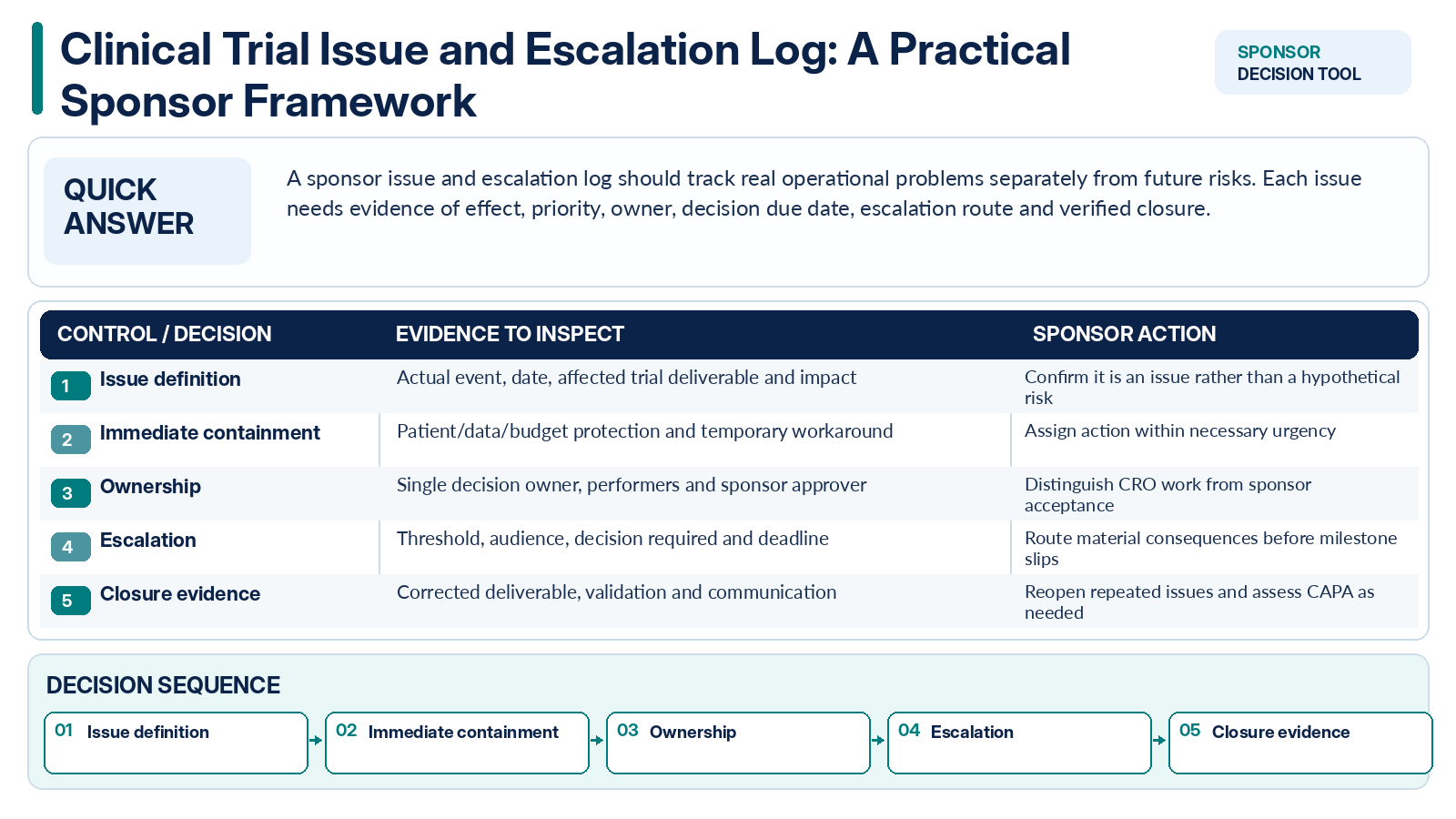
A sponsor issue and escalation log should track real operational problems separately from future risks. Each issue needs evidence of effect, priority, owner, decision due date, escalation route and verified closure.
Reusable decision and evidence template
Begin with the most consequential control and the evidence needed to resolve it. The following matrix connects each decision to records and an accountable action, rather than treating the list as a generic compliance checkbox.
| Control / question | Evidence to examine | Sponsor action |
|---|---|---|
| Issue definition | Actual event, date, affected trial deliverable and impact | Confirm it is an issue rather than a hypothetical risk |
| Immediate containment | Patient/data/budget protection and temporary workaround | Assign action within necessary urgency |
| Ownership | Single decision owner, performers and sponsor approver | Distinguish CRO work from sponsor acceptance |
| Escalation | Threshold, audience, decision required and deadline | Route material consequences before milestone slips |
| Closure evidence | Corrected deliverable, validation and communication | Reopen repeated issues and assess CAPA as needed |
For teams that need support implementing this across functions, BioBoston CRO Clinical Project Management can help adapt the controls to the study, vendors, and decision calendar.
Working through the controls
1. Issue definition
Evidence: Actual event, date, affected trial deliverable and impact. Decision: Confirm it is an issue rather than a hypothetical risk. Record the responsible function and the approved source version, and keep any remaining exceptions visible to the sponsor before this item is closed.
2. Immediate containment
Evidence: Patient/data/budget protection and temporary workaround. Decision: Assign action within necessary urgency. Record the responsible function and the approved source version, and keep any remaining exceptions visible to the sponsor before this item is closed.
3. Ownership
Evidence: Single decision owner, performers and sponsor approver. Decision: Distinguish CRO work from sponsor acceptance. Record the responsible function and the approved source version, and keep any remaining exceptions visible to the sponsor before this item is closed.
4. Escalation
Evidence: Threshold, audience, decision required and deadline. Decision: Route material consequences before milestone slips. Record the responsible function and the approved source version, and keep any remaining exceptions visible to the sponsor before this item is closed.
5. Closure evidence
Evidence: Corrected deliverable, validation and communication. Decision: Reopen repeated issues and assess CAPA as needed. Record the responsible function and the approved source version, and keep any remaining exceptions visible to the sponsor before this item is closed.
Red flags that should change the plan
- Log has no decision due date.
- Issues closed on verbal assurance.
- Persistent vendor defects never escalated to steering group.
Decision gate and governance
Keep one issue register linked to the risk log and action log; no issue closes solely because a meeting was held. The control owner should record the decision, evidence version, date, residual uncertainty and next re-review trigger. Where delegated providers perform the work, the sponsor should retain the relevant oversight and acceptance evidence.
Scope note: The planning and budget fields above are sponsor-side operating recommendations. They are not FDA-prescribed schedules, prices, or numeric thresholds.
Need practical support?
Use BioBoston CRO Clinical Project Management to review the evidence, define decision rights, and build a study-specific action plan for the next milestone.