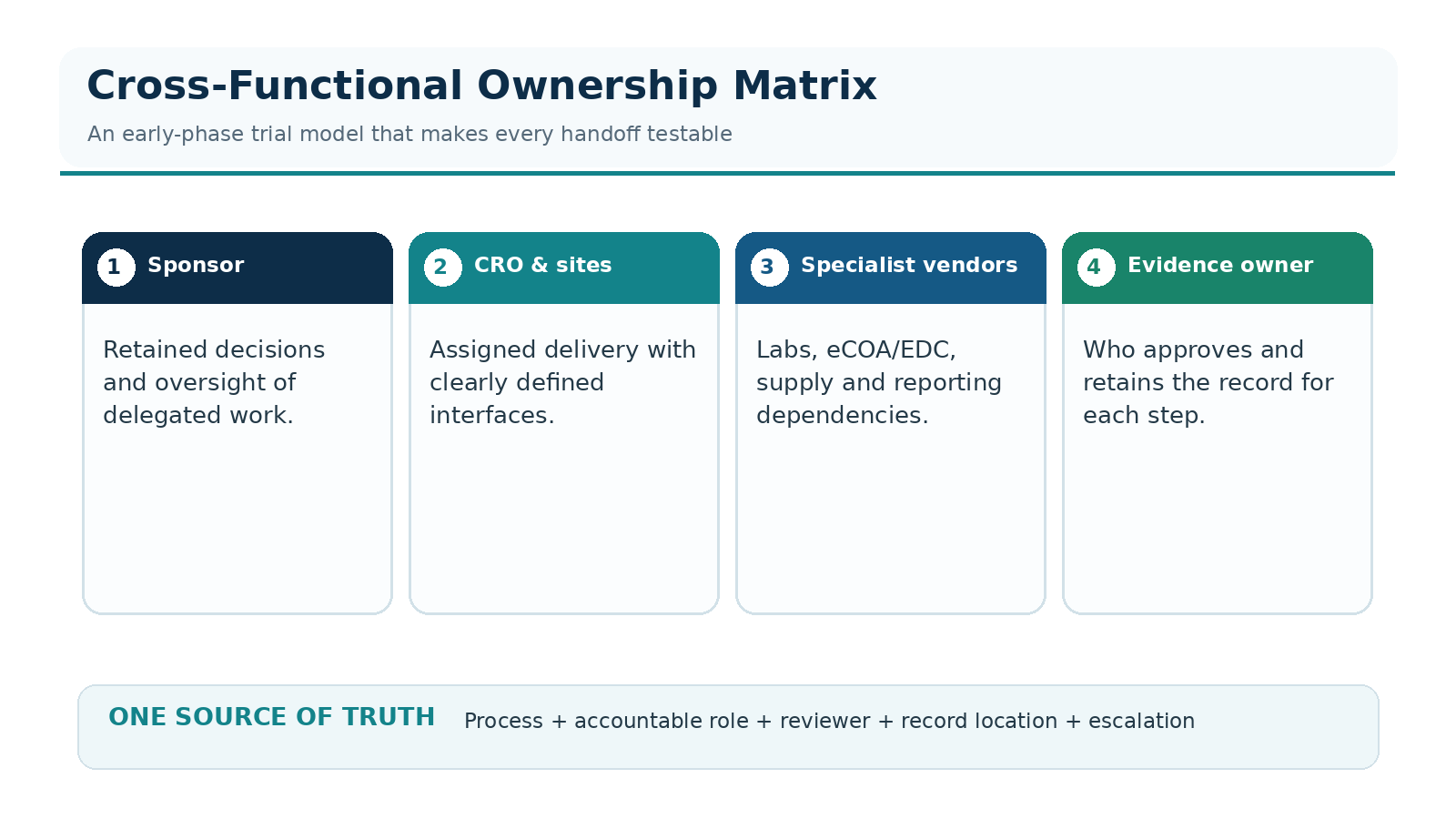
A clinical trial ownership matrix helps a small biotech sponsor record who makes and executes important decisions across Clinical Operations, Medical, Safety, Regulatory, Data, Statistics, Quality, Project Management and external providers. It should show both the responsibility assigned today and the evidence a future reviewer would use to understand the decision. For a lean Phase I team, this often matters more than a large departmental chart.
This resource provides a copyable sponsor-side template with field instructions, a clearly hypothetical example, a governance rule and a release check. It complements a standard RACI but includes work products, handoffs, approval limits and record locations that are usually absent from a four-letter assignment chart.
Template: one decision per row
Duplicate the table below for every key operational decision and handoff in the trial. Replace role placeholders with actual sponsor and provider positions, then connect the row to applicable controlled documents. Avoid listing only company names. One CRO may coordinate a study but use separate data, monitoring, safety and startup teams, while the sponsor retains important oversight decisions.
| Field | What to enter | Sponsor-side verification |
|---|---|---|
| Workstream / decision ID | Unique ID, e.g., O-001 | Does it describe one decision or deliverable? |
| Performer (R) | Named function responsible for execution | Can this team perform the work with current access? |
| Operational approver (A) | Named role with decision rights | Is this authority documented and available? |
| Consulted / informed | Required review participants and recipients | Is input needed before release, not after? |
| Evidence and acceptance | Approved output, record ID, quality check | Can another reviewer retrieve the accepted version? |
| Handoff and predecessor | Input dependency, next recipient and deadline | Is responsibility clear across provider boundaries? |
| Contract / regulatory reference | Relevant agreement, SOP or written transfer | Is this consistent with actual regulated obligations? |
| Escalation and backup | Trigger, decision owner, alternate | Is there a controlled route if the owner is absent? |
| Review trigger / version | Amendment, scope change, personnel change | Who maintains the matrix and approves revisions? |
The clinical trial ownership matrix should be a living governance artifact. Where the work spans many parties, create one shared view with links to the detailed plans rather than duplicating different versions of the same responsibilities in every workstream.
Suggested role headings for a lean Phase I sponsor
Use the following functional headings only where applicable to the study: Sponsor Clinical Development; Sponsor Clinical Operations/Project Lead; Sponsor Medical/Safety Representative; Sponsor Regulatory Affairs; Sponsor Quality; Sponsor Data Management; Biostatistics; CRO Project Management; Site Startup/Operations Partner; Central Laboratory; Interactive Response Technology/EDC Supplier; Drug Supply Partner; and Investigator/Site. The study-specific contract and organization determine the actual parties. Do not imply a site-facing partner is a BioBoston CRO in-house function when delivery is partner-supported.
Distinguish an internal sponsor reviewer who provides input from the person authorized to sign the protocol, accept a database lock or approve a material budget change. If the sponsor uses interim fractional leadership, record the delegated authority and sponsor oversight explicitly rather than assuming the consultant holds corporate approval rights.
Hypothetical early-phase ownership example
Illustrative only: these assignments are not defaults for every clinical trial. Assume a Phase I sponsor retains overall program decisions, appoints a CRO project manager and outsources central laboratory and EDC operations. The table demonstrates how to capture an accountable decision and acceptance evidence instead of simply assigning the work to a company.
| Decision | Execution owner | Operational approver / oversight | Evidence and handoff |
|---|---|---|---|
| Final site schedule package | Clinical operations lead + startup partner | Sponsor Clinical Operations | Approved site-ready package and version sent to sites |
| EDC form amendments | EDC/data-management provider | Sponsor Data Management | Signed UAT and controlled release notice to sites/statistics |
| Safety data reconciliation | Safety and data providers | Sponsor Medical/Safety oversight | Reconciliation log, issue disposition, safety review minutes |
| Critical protocol deviation CAPA | Investigator/site with QA support | Qualified sponsor oversight role | Deviation assessment, CAPA approval and effectiveness follow-up |
| Interim statistical outputs | Statistical programming team | Sponsor Statistics/Clinical Development | Versioned TLF package, QC and sign-off record |
| Study-level milestone change | CRO PM proposes impact | Sponsor program/finance decision authority | Approved change request, dependency map and vendor notification |
A row can be split when different regulated approvals exist. For instance, the person deciding a project milestone may not be authorized to accept a medical assessment. Describe both decisions rather than marking two parties Accountable without further explanation.
Field-by-field completion instructions
1. Identify the task at decision level. "Manage trial" is too broad; "approve site activation readiness" or "accept validated lab data transfer" can be tested. Use a short unique ID that remains stable in change logs.
2. Define R versus A. Responsible performs or coordinates. Accountable has the operational decision authority defined by the governance model. The chart does not independently modify regulatory responsibility or absolve the sponsor of oversight.
3. Add the output and acceptance criteria. A deliverable must have a reviewer, quality check, final record location and method of confirming receipt by the next team. If the output is electronic, include system ownership and access.
4. Specify the predecessor and successor. An EDC configuration depends on protocol definitions and feeds site training and statistics. Record who sends the approved information, when and in what version. If deadlines are uncertain, use an evidence-based milestone trigger rather than an arbitrary calendar date.
5. Reconcile the contract and oversight record. For U.S. IND drug trials, 21 CFR 312.52 describes the written transfer of sponsor obligations to a CRO. A template cannot substitute for that writing. ICH E6(R3) Good Clinical Practice guidance recommends clearly documented activities and appropriate sponsor oversight of service providers. Evaluate applicable requirements for each jurisdiction and trial type.
6. Define a fallback. Identify who may act when a decision maker is unavailable, what authority the substitute holds, and how urgent safety or data-integrity issues are escalated.
Governance: how to keep the ownership matrix current
Choose one custodian, usually a sponsor or delegated project-management function, to control revisions. Review it at kickoff, after material protocol amendments, when vendors or responsibilities change, after a persistent handoff failure, and before critical release milestones such as site activation or database lock. The custodian proposes changes, but the competent business, technical and quality authorities should approve the rows they own.
Control each version with a date, change summary and approval. Preserve prior accepted versions with the sponsor’s essential records according to applicable procedures. When a provider exits, ensure records, access and custody transitions are addressed in the matrix and the contract closeout plan.
Release test: five questions
Before labeling the matrix approved, answer: (1) Can each critical task identify a performer and competent decision authority? (2) Is its acceptance evidence locatable? (3) Are provider-to-provider handoffs and backups explicit? (4) Do applicable contracts and written transfers agree with the chart? (5) Has the sponsor defined and recorded the oversight of important delegated activities? Record the disposition of every failed item with an owner, due date and evidence of closure.
For a review of provider interfaces, see Vendor Governance. For independent controls around delegated quality responsibilities, see Sponsor Oversight. These links help distinguish the operating chart from the broader governance and oversight system.
Need a study-specific ownership framework?
BioBoston CRO Responsibility Matrix support can help turn the template into a controlled, sponsor-approved matrix connected to contracts, handoffs, evidence and change control before critical work begins.