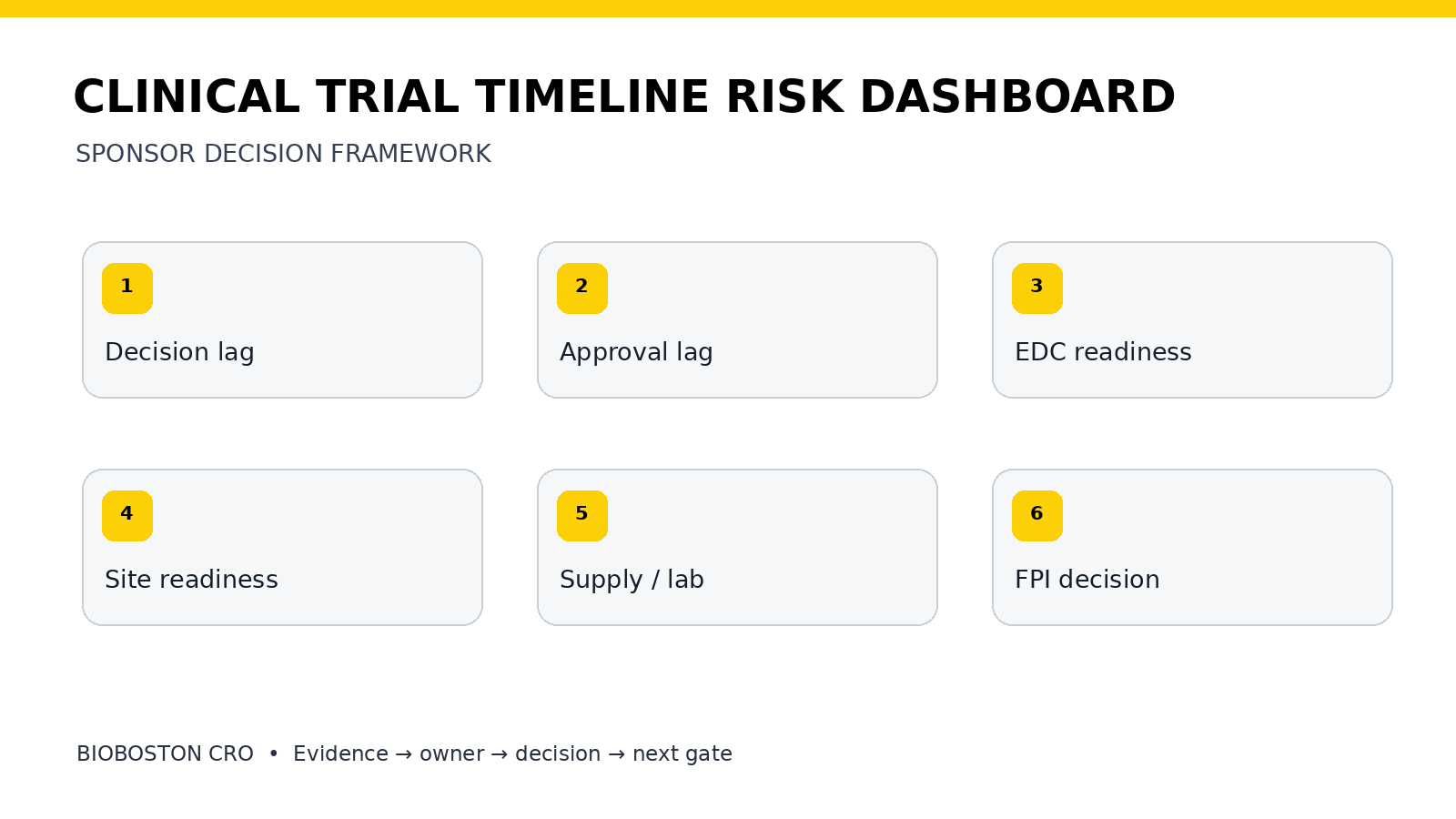
A clinical trial timeline risk dashboard should warn a sponsor about foreseeable missed milestones before a date has already slipped. Track the status of predecessor evidence, forecast movement, accountable owners, and decision lead time—not just percentages complete.
Why this matters to the sponsor
For a lean clinical sponsor, the central task is to distinguish a milestone that is genuinely executable from one that is only shown as green on a status slide. The dashboard below uses operational leading indicators, each tied to primary evidence and an escalation decision.
Seven early warning indicators
| Signal / timing | What to verify | Accountable owner | Evidence / escalation | |
|---|---|---|---|---|
| Protocol decision latency | Open clinical/protocol decisions on the critical path | Medical/Clinical | Version-controlled decision log | Decision deadline occurs after dependent work must begin |
| Regulatory/ethics approvals | Applications, responses, and final authorizations by site | Regulatory | Authority/IRB/IEC correspondence | Activation planned before required permission |
| EDC/UAT readiness | Unresolved critical UAT defects and release approval | Data Management | UAT report and release record | System release forecast moves inside visit preparation |
| Site activation | Contract, training, essential records and qualification evidence | Clinical Operations | Site readiness log | Nominal activation rate hides incomplete critical sites |
| Supply and lab setup | IMP release, label, pharmacy, laboratory manual/logistics | Supply/Vendor lead | Approved supply and lab records | FPI forecast assumes unconfirmed vendor capability |
| Recruitment yield | Consented, screen-failed and enrolled numbers vs assumptions | Clinical Ops | Site-reported audited recruitment data | Repeated forecast changes without updated funnel |
| Decision capacity | Open items requiring sponsor budget/medical/quality approval | Program Lead | Decision/approval register | Decision owner missing or due date passed |
How to put the framework into practice
1. Establish a controlled baseline
Record baseline date, last-approved forecast, successor milestones, each predecessor and assumption. Label unsupported dates as estimates.
2. Convert status to evidence
For every milestone define what record proves readiness, who signs it, where it lives, and what acceptance criteria apply.
3. Define forward-looking triggers
Use e.g. a critical predecessor later than its need-by date, a delayed approval, or a forecast change exceeding approved tolerance. Set tolerance to study context.
4. Separate routine risk from urgent quality issues
Patient safety and critical data issues follow immediate quality/safety escalation procedures; the dashboard never substitutes for them.
5. Hold decision owners accountable
Review each amber/red item with dated evidence, response option, owner, decision due, next verification and budget implication.
Illustrative scenario (hypothetical)
Hypothetical: an FPI date remains unchanged, yet the lab manual approval is seven days late and packaging release lacks evidence. The dashboard flags an early schedule threat, identifies the owner and required sponsor decision, and marks the forecast as conditional until dependencies clear.
Sponsor action log fields
Issue/risk ID; source evidence; affected milestone; critical-to-quality impact; owner; action due; decision authority; approved recovery option; next verification; status.
Regulatory context and limitations
Clinical program decision-support materials. These matrices are operational examples that require protocol-, jurisdiction-, and study-specific adaptation. ICH E6(R3) is FDA guidance containing nonbinding recommendations; applicable requirements under 21 CFR Part 312 remain binding for covered IND studies. Escalate participant safety, protocol deviations, and data integrity matters through the appropriate established processes rather than waiting for a weekly meeting.
Apply to your program
Make these controls work across teams with BioBoston CRO Study Timeline Management.
Discuss sponsor-side Clinical trial timeline risk dashboard support