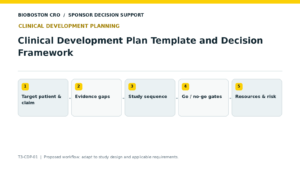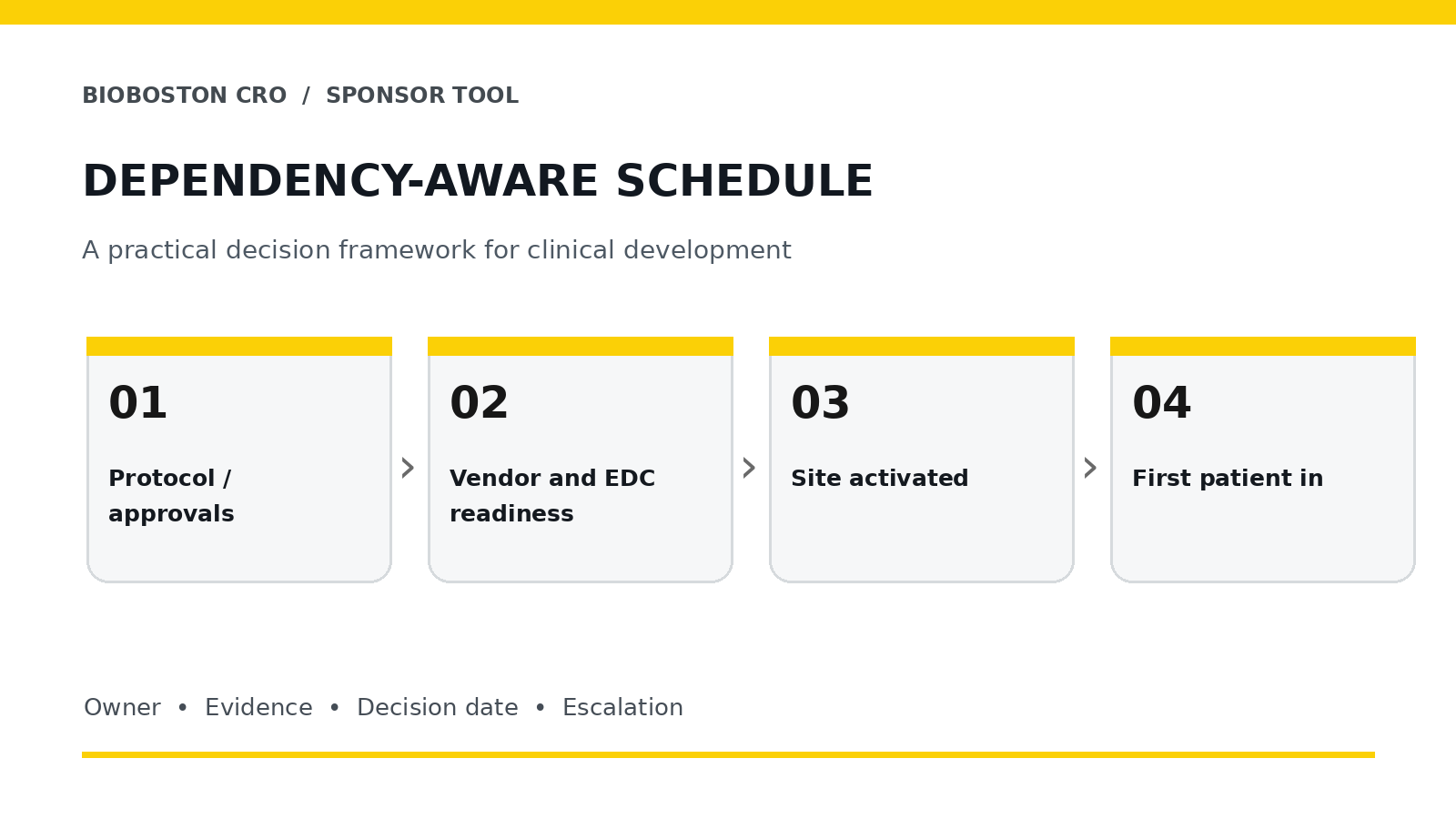
A clinical trial timeline template is useful only when milestones are linked to predecessors, evidence, decision owners, and realistic lead times. Build the schedule backward from first patient in (FPI) or another sponsor decision date, and distinguish a target date from an evidence-supported forecast.
Copyable sponsor working matrix
| Milestone | Dependency / proof | Owner | Decision / date |
|---|---|---|---|
| Final protocol | Approval/version-controlled release | Sponsor Medical | Approve before build freeze |
| Regulatory/ethics package | Submission and applicable approvals | Regulatory | Review lead time |
| EDC release | UAT evidence and sign-off | Data Management | Go/no-go before use |
| Vendor readiness | Training, manuals, contracts | Vendor Management | Escalate blockers |
| Site activation | Essential records, training, approvals | Clinical Operations | Approve activation |
| First patient in | Eligible participant; all prerequisites met | Sponsor Clinical Ops | Confirm actual FPI |
Start with a milestone contract
For each milestone record what done means, the accepting authority, the evidence link and the latest responsible decision date. Distinguish milestone owners from workstream contributors. Avoid a calendar that shows an approval milestone without the review and submission work needed to achieve it.
A reusable clinical trial timeline template
Copy the fields below into a controlled project schedule. The date labels are relative planning illustrations, not standard industry durations or guaranteed regulatory timelines.
Find the real critical path
Identify predecessors that cannot run in parallel. Protocol finalization can gate consent documents, database build and vendor training; country-specific approvals and site activation may gate enrollment. Examine handoffs in both directions because a late upstream change can require downstream rework. Flag zero-float and constrained tasks explicitly.
Use two dates for each important deliverable
Record a sponsor target and a latest credible forecast, with the date evidence was updated. Where dates diverge, name the recovery option, decision-maker, and consequences for cost, quality, or scope. Never silently rebaseline a contractual or board-level milestone.
Decision gates require explicit approvals
A decision gate differs from a delivery date. Name the person or committee authorized to accept a plan, authorize additional spend or adjust a milestone. Do not equate a task owner with a budget owner. Put an escalation date earlier than the date on which a missed decision would block the path.
Scenario: first-patient-in dependency chain
For a hypothetical first-in-human trial, protocol approval may precede final EDC configuration, consent package approval and vendor training. Site activation also depends on local approvals, essential records and site readiness. FPI cannot be forecast solely from a vendor start-date promise; confirm each critical predecessor with evidence.
Weekly schedule-control routine
Review the next 30-60 days of gates, open critical dependencies, forecast variance, and newly created rework. Record changes in a decision log. When an amber signal emerges, compare recovery choices rather than asking teams to compress all remaining work indiscriminately.
Regulatory and quality context
ICH E6(R3) describes proportionate quality management, appropriate sponsor oversight and documented allocation of activities. It does not prescribe this spreadsheet layout or a universal FPI timeline. Applicable country and product-specific regulatory requirements remain controlling.
How to populate each schedule row
Give each activity a stable milestone ID, accountable owner, definition of done, predecessor ID, planned start, planned finish, latest credible finish, evidence link, decision date and escalation threshold. Mark whether a row is a regulatory permission, document approval, technical release, vendor deliverable or operational event. That classification clarifies which tasks are legally gated and which are planning assumptions.
Calculate dependencies without inventing durations
Use actual vendor lead-time quotes, documented institutional reviews, validated build estimates and prior study assumptions where legitimately available. Avoid treating an example FPI timeline as a promised lead time. A task may be in parallel only if the protocol, system design and applicable approvals allow it. Check predecessor links after any protocol amendment.
Define schedule confidence
For each critical milestone, label evidence current, provisional or unverified. Current means the owner has checked a reliable source record within the reporting period. Provisional means a forecast with known constraints; unverified means it is only an expectation. A green date without current predecessor evidence is not a defensible forecast.
Change-control and baseline governance
Retain the sponsor-approved baseline and report variance separately from forecasts. Explain the trigger, affected workstreams, recovery choices, commercial consequences and authorized approver. Document the date and rationale for any formally accepted baseline revision. A revised target does not make historical slippage disappear.
Practical dependency example — hypothetical
Assume a protocol wording change affects eligibility, the informed-consent form and an EDC edit check. Add the three dependent updates as separate rows; identify who approves each, whether an IRB/IEC revision is needed and what release must precede site use. A single “protocol finalized” tick would hide the rework and overstate readiness.
Weekly 30-day control window
Filter the schedule for tasks due in 30 days, predecessors with less slack than the agreed escalation threshold, unresolved decisions and evidence older than the reporting period. Assign next action and deadline. Consider resequencing or adding capacity only after assessing subject protection, data quality, vendor agreements and budget authority.
When to ask for a recovery decision
Escalate when a required approval is missing, the milestone forecast crosses a contractual or clinical gate, the date depends on an unsupported assumption, or recovery needs incremental spend. Present at least two viable options with trade-offs rather than silently compressing review or validation activities.
Apply to your program
For sponsor support with milestones, evidence and decision ownership, explore BioBoston CRO Study Timeline Management.