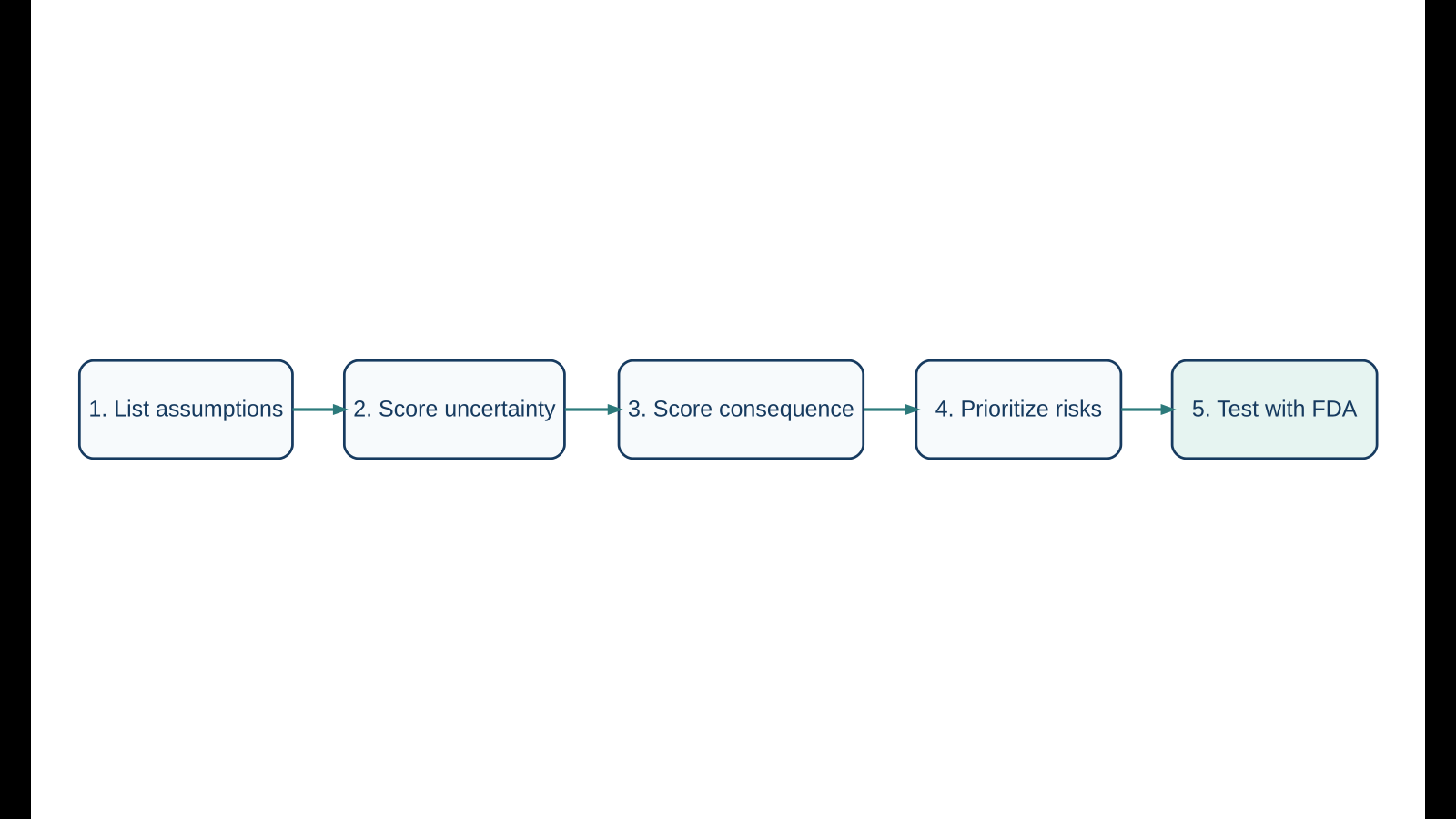
A regulatory pathway assessment identifies assumptions that could change claims, evidence expectations, development sequencing, or submission route. This risk framework ranks uncertainty by consequence and assigns a decision owner and next verification step.
Quick answer: which pathway risks should be scored?
| Domain | Key question |
|---|---|
| Classification / jurisdiction | Is product type, center, class, or application route sufficiently clear? |
| Precedent | Is there a reliable prior regulatory precedent or predicate? |
| Evidence | What new nonclinical, clinical, analytical, or performance evidence is required? |
| Claims / indication | Is the intended claim broader than current evidence supports? |
| CMC / manufacturing | Could product changes alter comparability, safety, or route? |
| Authority interaction | Which assumption should be tested with FDA before major spend? |
1. Score uncertainty and consequence separately
| Score | Uncertainty | Consequence |
|---|---|---|
| 1 | Well supported by current evidence/precedent | Limited effect on program |
| 2 | Some open questions | Manageable rework |
| 3 | Material uncertainty | Could change study, submission, or timeline |
| 4 | Major unresolved assumption | Could invalidate current pathway or evidence plan |
2. Build a pathway risk register
| Risk | Evidence now | Decision needed | Owner | Trigger |
|---|---|---|---|---|
| Classification uncertain | Product description + precedent search | Confirm likely classification / FDA interaction | Regulatory | Before pivotal study design |
| Claim may exceed evidence | Clinical/performance concept | Narrow claim or expand evidence | Clinical + Regulatory | Before protocol lock |
3. Prioritize “expensive-to-be-wrong” assumptions
- Clinical study design.
- Manufacturing scale or formulation.
- Predicate or reference-product strategy.
- Intended use / indication.
- Need for pivotal clinical evidence.
- Combination-product jurisdiction.
4. Use authority interaction as a risk-control tool
FDA feedback is most valuable when it addresses a material, decision-ready uncertainty. The sponsor should define what it will do under each plausible response before requesting the interaction.
For sponsors that need hands-on support applying this framework, BioBoston CRO Regulatory Pathway can support the underlying regulatory and cross-functional work.
5. Update the assessment as evidence changes
- New nonclinical or clinical finding.
- Product design or formulation change.
- New predicate, precedent, or guidance.
- Change in target indication or market.
- FDA feedback that alters an assumption.
Final decision rule
A low aggregate score does not override one catastrophic assumption. Escalate any single pathway uncertainty that could force a new clinical program, new submission type, or major product redesign.
BioBoston CRO Regulatory Pathway support can help convert this risk register into a focused regulatory strategy and authority-interaction plan.