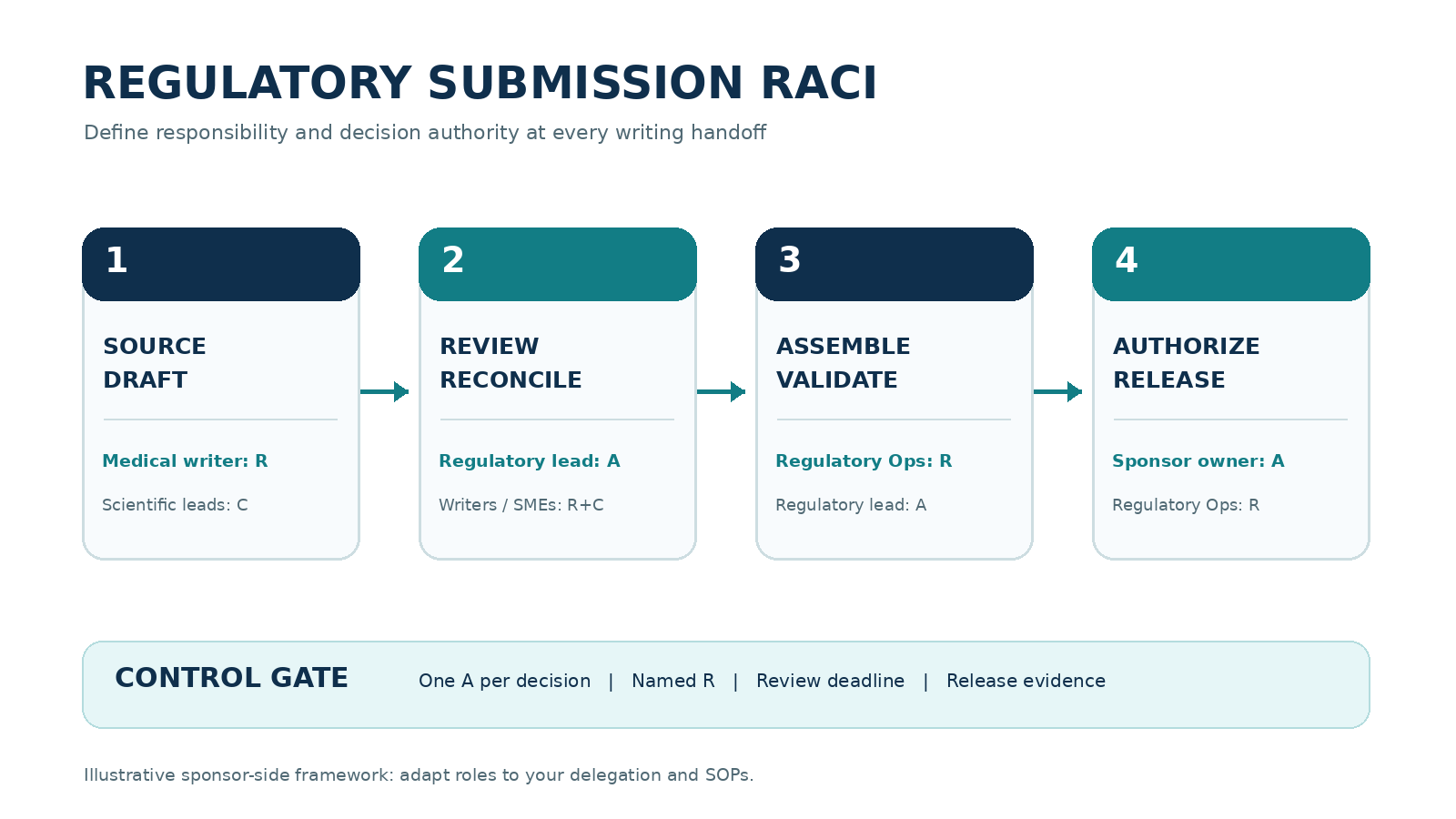
Regulatory submission RACI makes the writing and publishing workflow explicit before a deadline exposes unclear handoffs. For each deliverable, assign one person or role Accountable (A) for the decision, identify who is Responsible (R) for doing the work, and name the people Consulted (C) or Informed (I). This template focuses on source ownership, authoring, review, approval, technical publishing, and release. It is deliberately narrower than a program-level submission responsibility matrix.
Use it when a lean sponsor is working with external medical writers, Regulatory Operations contractors, CMC specialists, clinical reviewers, and multiple approval functions. The example below is a starting point, not a regulatory-prescribed allocation of roles.
Decide the rules before filling the matrix
- Accountable (A): One role signs off the outcome or makes the decision for that row. A is not necessarily the person who executes the task. If two roles claim final authority, split the deliverable or clarify governance.
- Responsible (R): The role or roles performing the work and providing the output. Every activity needs at least one R.
- Consulted (C): A specialist whose input is necessary before the decision; consultation has a real review deadline.
- Informed (I): A role that needs the decision or final version but does not hold the task open for approval.
A vendor can draft and technically publish while the sponsor retains its applicable regulatory responsibilities. The exact approvals must follow the sponsor’s procedures, delegation arrangements, and filing requirements; a RACI does not transfer legal accountability by itself.
Copyable submission-writing RACI template
Use the role legend: RA = sponsor Regulatory Affairs lead; MW = medical writer; CMC = CMC/Quality lead; NC = nonclinical lead; CL = clinical lead; QA = quality reviewer; RO = Regulatory Operations/publisher; SP = authorized sponsor submission owner. A dash means the role has no assigned action in the sample and can be changed to fit the program.
| Deliverable or decision | RA | MW | CMC | NC | CL | QA | RO | SP |
|---|---|---|---|---|---|---|---|---|
| Confirm submission scope and section map | A | C | C | C | C | I | R | I |
| Complete source inventory and version baseline | A | R | R | R | R | C | C | I |
| Draft quality narrative | A | R | C | I | I | C | I | I |
| Draft nonclinical narrative | A | R | I | C | C | C | I | I |
| Draft clinical narrative | A | R | I | C | C | C | I | I |
| Reconcile cross-section critical claims | A | R | C | C | C | C | I | I |
| Adjudicate unresolved scientific comments | A | R | C | C | C | C | I | I |
| Approve source freeze and version baseline | A | R | C | C | C | C | R | I |
| Complete editorial and technical document QC | A | R | C | C | C | R | C | I |
| Assemble and validate electronic sequence | A | C | I | I | I | C | R | I |
| Authorize final submission release | R | I | I | I | I | C | R | A |
| Archive receipt, release files, and decision log | A | I | I | I | I | C | R | I |
Example only: In some organizations, the CMC or clinical lead will be accountable for scientific content approval while the regulatory lead approves dossier integration. If so, separate these into different rows rather than forcing one role to approve work outside their authority.
Add five fields that make the RACI operational
A letter matrix alone often fails in practice. Add these fields beside each activity:
- Output and acceptance criteria. Define the file, dataset, log, or decision required to close the row.
- Source/version reference. Link to the controlled material used for the deliverable and its effective cutoff.
- Review window and backup. Record the time reserved for the consultation and the named delegate.
- Escalation trigger. State what event changes a green task to an issue, such as an unapproved data change or a missed decision.
- Evidence of closure. Record the approval, technical report, or release receipt rather than a verbal ‘done.’
Define the handoffs between writing and Regulatory Operations
Handoff 1: Source inventory to writing. MW receives controlled documents and a list of open facts, not an unstructured document dump. RA owns prioritization; scientific owners confirm their data.
Handoff 2: Draft to scientific review. MW provides a version-identified draft, specific questions, and a response date. Each reviewer returns comments against the same controlled baseline.
Handoff 3: Scientific review to regulatory sign-off. RA resolves conflicting conclusions and decides whether remaining uncertainty is appropriately qualified. A documented decision log travels with the package.
Handoff 4: Approved files to publishing. RO gets the exact release files, approved names, placement instructions, and expected validation criteria. After assembly, RO provides a report that traces findings to dispositions.
Handoff 5: Release to submission record. SP or another duly authorized sponsor role confirms the final release decision; RO records transmission and receipt evidence. Responsibility for transmission is not the same as authority to change scientific content.
Handle late changes without reopening every approval
A late change should be assessed for scope: does it change a critical scientific claim, a citation/reference, a controlled identifier, or only a non-substantive formatting detail? RA assigns the change owner and specifies the affected activities. Scientific reviewers reapprove affected conclusions; Regulatory Operations republishes and revalidates the changed package. Do not treat all changes as equivalent, and never bypass applicable sponsor approval procedures because the change appears small.
Common RACI failure patterns
- Everyone is listed as consulted, but no one is accountable for reconciling comments.
- A vendor is marked accountable for a sponsor-only regulatory authorization without documented delegation or authority.
- A release row has two As, so nobody knows whose decision is final.
- The project plan includes publishing dates but not source-freeze and approval milestones.
- The last published file differs from the one reviewed by subject-matter experts.
- RACI letters are assigned to company names instead of specific roles and named delegates.
A clearly hypothetical example
A first-time IND sponsor hires a medical-writing contractor and an eCTD publishing specialist. The writer is responsible for preparing the approved narrative; CMC and nonclinical leads are consulted for source interpretation; Regulatory Affairs is accountable for cross-functional dossier integration; the authorized sponsor submission owner approves release; Regulatory Operations assembles, validates, transmits, and archives the sequence as assigned. The actual structure may differ depending on the submission, sponsor, contracted responsibilities, and documented authority.
How to adopt this template in one meeting
Put the proposed matrix on screen with the Regulatory Affairs lead, writing lead, each scientific function, and Regulatory Operations. Review the rows with major decisions first. Confirm one accountable owner per row, a responsible executor, a response deadline, and the evidence that closes it. Record exceptions. Circulate the agreed version alongside the controlled dossier map and change log, and review it whenever team membership or submission scope changes.
For a broader regulatory workplan, see Submission Planning and Regulatory Pathway. For authoring handoffs linked to the clinical plan, see Protocol Writing.
Need support coordinating submission authors and publishers?
BioBoston CRO Submission Writing support can help define document owners, cross-functional review gates, source controls, and the handoffs between writing, regulatory review, approval, and electronic publishing.