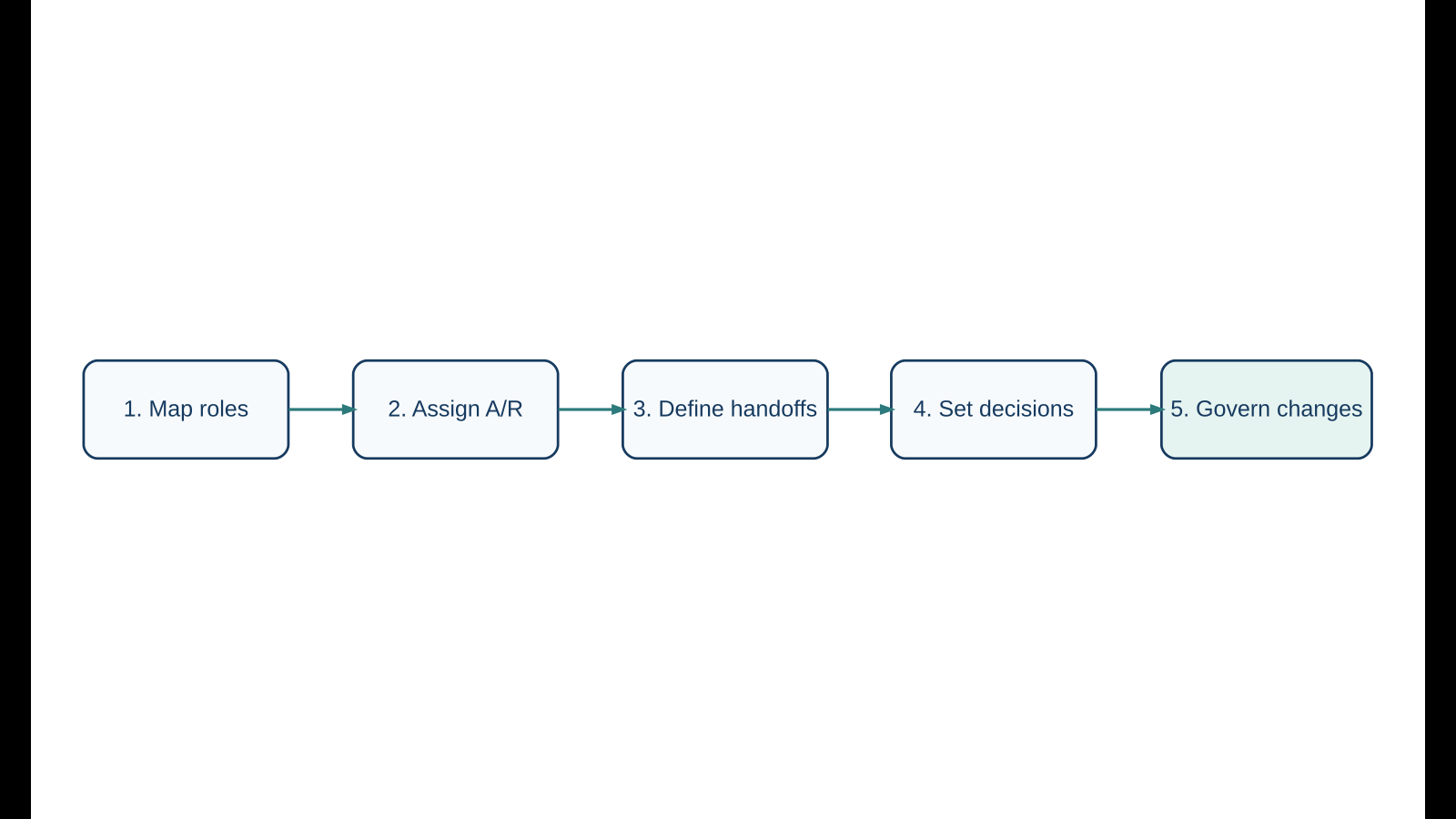
regulatory submission responsibility matrix planning should help the sponsor make a controlled decision, not merely create another document. A practical RACI framework for complex regulatory submissions. It clarifies document ownership, scientific decisions, review responsibilities, approvals, and publishing handoffs.
Quick answer: which roles should be mapped?
- Regulatory lead / submission owner.
- CMC, Nonclinical, Clinical, Safety, and Statistics leads.
- Medical/Regulatory Writing.
- Quality review where applicable.
- Regulatory operations / publishing.
- Program management for schedule and dependencies.
- Executive or governance approver for defined high-impact decisions.
1. Use RACI only where it clarifies work
| Code | Meaning | Rule |
|---|---|---|
| R — Responsible | Performs the work | May be more than one when collaboration is explicit |
| A — Accountable | Owns final outcome/decision | Prefer one accountable role |
| C — Consulted | Provides required input before decision | Define consultation point |
| I — Informed | Receives decision/output | Do not overload the matrix with passive observers |
2. Separate document ownership from decision ownership
| Activity | R | A | C | I |
|---|---|---|---|---|
| Clinical summary authoring | Medical Writing | Regulatory Lead | Clinical, Statistics, Safety | Program Management |
| CMC section content | CMC author/SME | CMC Lead | Regulatory, Quality | Publishing |
| Indication / labeling position | Regulatory + Clinical input | Regulatory decision owner | Statistics, Safety, Medical | Writing, Publishing |
| Submission publishing | Reg Ops / Publishing | Regulatory Lead | Document owners | Program team |
3. Map the handoffs that usually fail
- Source evidence → author.
- Author → functional reviewer.
- Functional reviewer → regulatory decision owner.
- Approved content → QC.
- QC → publishing.
- Publishing validation → transmission owner.
- FDA question → response owner and approver.
4. Add a decision-rights table
For high-impact topics, name who decides when functions disagree: study inclusion, data cutoff, safety interpretation, indication wording, late change acceptance, or whether the application is ready to file. A RACI without conflict resolution can still leave the program stalled.
For sponsors that need hands-on support applying this framework, BioBoston CRO Submission Planning can support the underlying regulatory and cross-functional work.
5. Governance rules
- One accountable role per critical deliverable.
- No “all functions” ownership.
- Update the matrix when scope or vendor responsibilities change.
- Keep delegated activities distinguishable from sponsor accountability.
- Tie the matrix to the submission plan and decision log.
Need help defining the operating model?
BioBoston CRO Submission Planning can help align the content plan, RACI, decision rights, and publishing handoffs.