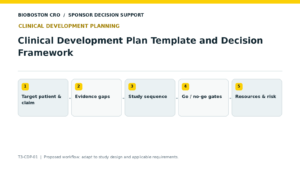
A sponsor oversight model for a lean biotech company should define a small number of retained decision and assurance functions even when almost all study activities are outsourced. The sponsor needs reliable access to critical evidence, timely escalation of participant-safety and data-integrity concerns, and a record showing how important delegated work was overseen. It does not need to replicate the CRO’s entire operational organization.
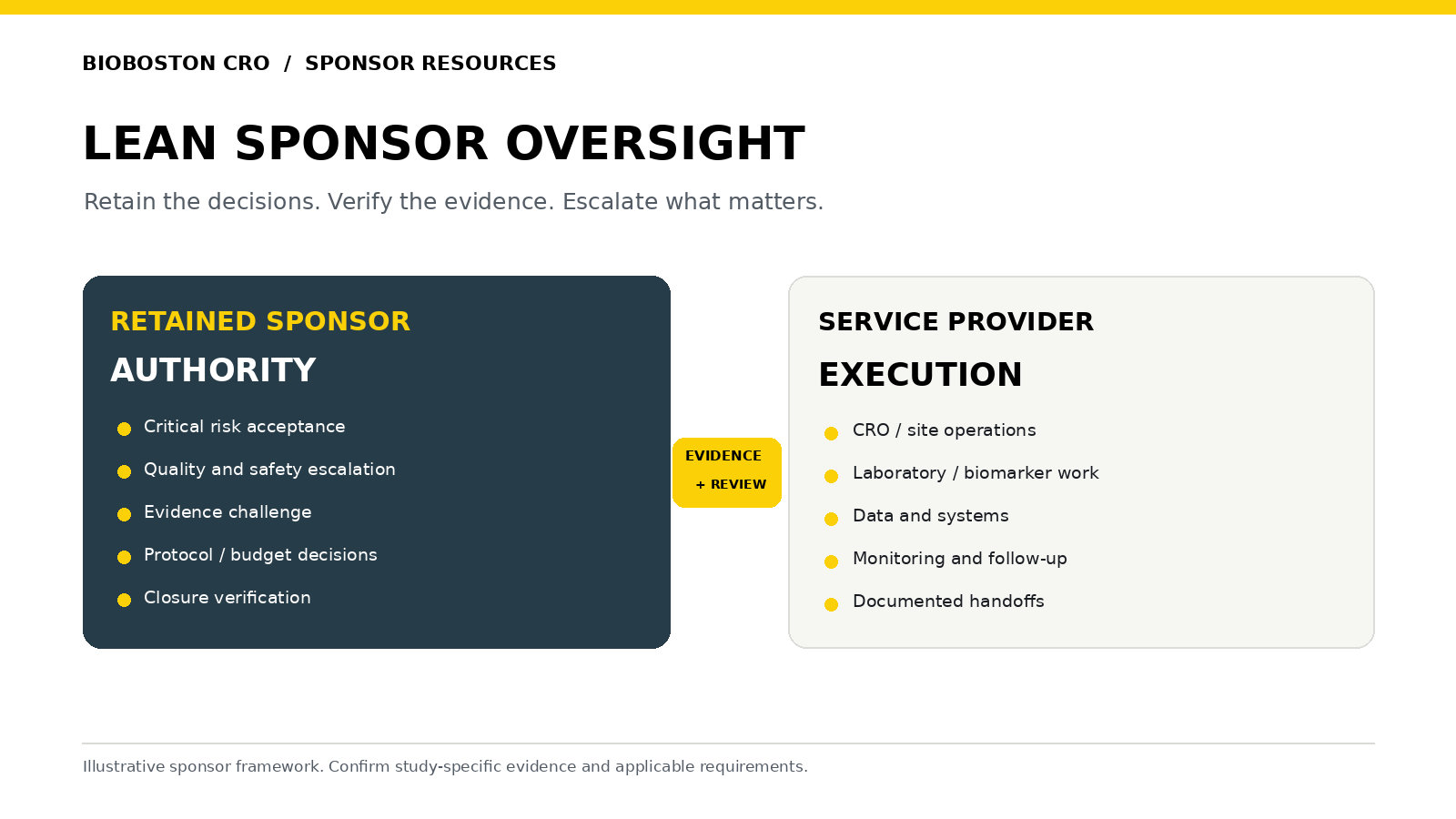
This framework is for a sponsor Head of Clinical Operations, Clinical Quality lead, COO or CMO running an outsourced Phase I or II trial with limited internal headcount. It explains how to assign retained responsibility, prioritize oversight according to study risk, and check provider outputs without trying to personally manage every task. The specific staffing model depends on the trial and the sponsor’s actual qualifications and capacity.
Decide what must remain visibly owned by the sponsor
Even when a CRO performs an important trial activity, the sponsor must understand its contractual and regulatory role. For an applicable US IND, 21 CFR 312.50 describes general sponsor responsibilities. Under 21 CFR 312.52, transfers of sponsor obligations to a CRO must be in writing, and obligations not covered by the description are deemed not transferred. FDA’s September 2025 ICH E6(R3) is nonbinding guidance that recommends proportionate sponsor oversight of important service-provider activities, including subcontracted work, while maintaining focus on participant protection and credible data.
A lean sponsor’s oversight is therefore built around decision rights, risk visibility, assurance and retained evidence. The CRO may own the operational plan and send reports, but the sponsor needs an accountable reviewer for major risk changes, critical quality actions, new safety signals, deviations affecting reliability, protocol changes, important vendor switches and material budget or timeline changes. Exactly who approves a given step follows applicable law and the agreed responsibility map, not a generic infographic.
Separate sponsor accountability from sponsor execution. An internal clinical lead can review evidence that a CRO’s monitoring strategy is fit for the protocol without directing every CRA visit. Clinical QA can verify an important corrective action was properly addressed without becoming the person who performs the CRO’s deviation investigation. A Medical/Safety representative must have an appropriate pathway for clinical and safety questions even if medical-monitoring activities are supplied externally.
A five-role retained sponsor model
One person may cover several roles on a small team when qualified and when independence, conflicts and backup coverage have been evaluated. Some services may be performed by contracted experts, but their scope, authority and access should be explicit. This table is a planning template rather than a mandatory organizational chart.
| Sponsor role | Retained decision or assurance | Evidence to review | Backup or escalation route |
|---|---|---|---|
| Executive/decision sponsor | Material priorities, capital allocation and risk acceptance within authority | Decision log, critical-path options, budget exposure | Named deputy or authorized committee |
| Clinical Operations owner | Trial execution, CRO performance and cross-vendor handoffs | Milestone evidence, site status, monitoring follow-up and issue log | Executive sponsor and functional lead |
| Clinical Quality / GCP assurance | Fit-for-purpose QMS oversight, important CAPA and audit signals | Findings, trends, remediation evidence and quality risk | Independent route to sponsor leadership |
| Medical/Safety owner | Participant protection, clinical concerns and safety interfaces | Medical review, safety escalations and applicable reporting evidence | Medical deputy and established urgent pathway |
| Data/Statistics/Regulatory leads | Critical data decisions, endpoint integrity and submissions | Data-flow reconciliation, controlled documents, protocol and submission decisions | Named cross-functional reviewers |
The model does not mean each line needs a full-time employee. It means somebody qualified must be reachable, assigned and able to challenge the evidence. Staffing assumptions need to be tested against complexity: one early-phase trial may be manageable with a small team and senior fractional support, while multiple regions, complex safety monitoring or several independent data streams increase the burden.
Map obligations and interfaces before measuring performance
Build a sponsor responsibility register using each important activity as a row. Record the contractual operator, any written transfer of regulatory obligations where applicable, the sponsor reviewer, provider or subcontractor dependencies, escalation procedure, acceptance evidence and document location. Compare the register to the current SOW, quality agreement, protocol, monitoring and data-management plans, and any subcontractor agreements within the sponsor’s access rights.
Pay particular attention to interfaces, because gaps occur when each provider assumes another party owns an activity: laboratory results to EDC, safety information to the medical reviewer, protocol changes to eCRF specifications, and site activation to clinical supply. Require an accepting receiver for each essential handoff. A provider’s “complete” status is insufficient when the receiving system or owner has not accepted the output.
If the sponsor does not have access to relevant procedures, metrics or essential records needed for oversight, first determine what contractual access and alternative evidence mechanisms are available. Some confidential proprietary documents may be reviewed through supervised access or summaries plus independent assurance. Lack of direct full-document access is not automatically noncompliance; the sponsor must still have a reasonable basis for oversight.
Risk-tiered oversight: where to spend scarce sponsor attention
Define critical-to-quality factors from the protocol and study context before choosing dashboards. Prioritize effects on participant rights, safety, endpoint integrity and reliability of key trial data. Then consider operational threats to the next critical milestone. A sponsor should not spend the same review effort on routine document formatting and an unresolved safety-reporting interface.
| Oversight tier | Example concern | Sponsor response | Evidence of control |
|---|---|---|---|
| Immediate safety/critical quality | Potential participant harm, serious data-integrity issue | Activate applicable safety/quality pathway without waiting for committee | Dated escalation, accountable medical/QA disposition, follow-up |
| High impact to critical-to-quality factor | Key endpoint data reconciliation fails or a site is not qualified for a required procedure | Sponsor-led focused review; confirm recovery plan before affected release | Root-cause rationale, corrective action and acceptance test |
| Material program delivery | Critical vendor handoff is late or milestone forecast changes | Obtain options, accountable decisions and revised dependencies | Approved change, owner commitments, current forecast |
| Routine delivery | Noncritical administrative task is delayed | Manage in operational reporting by exception | Updated tracker and agreed next check |
These are illustrative internal tiers, not FDA regulatory classifications. Do not use a combined health score to offset urgent safety or data issues with unrelated green metrics. Escalation decisions must also follow applicable reporting requirements and the sponsor’s established procedures.
Build an oversight cycle around evidence, challenge and closure
Prepare a small evidence package. For each reporting cut-off, obtain the current critical-path status, a small set of defined CRO/vendor metrics, outstanding important protocol and quality issues, safety-interface confirmation where relevant, and decisions due before the next milestone. Link to controlled source records and identify stale or unavailable data.
Challenge the exceptions. In a recurring sponsor review, ask what changed from the previous accepted snapshot. Focus on important dependencies, data that have not reconciled, recurring findings and assumptions that could invalidate an enrollment or supply forecast. The goal is to verify the conclusion, not merely witness the CRO’s presentation. Request a focused deep dive when a signal is material; proportionate oversight does not mean taking every assertion at face value.
Approve or escalate through the correct authority. Distinguish a workstream recommendation from an approved plan, budget, scope or protocol change. Urgent medical, safety or quality concerns should proceed through the designated route independently of the reporting cycle. Record who owns the decision, its effective date, conditions and affected downstream workstreams.
Verify implementation and close the loop. Ask for the receiving party’s acceptance, corrected controlled document, system-release record, accepted CAPA effectiveness evidence when applicable, or other objective proof. Do not close a high-impact concern solely on the CRO’s promise that a task is finished. Preserve the historical decision and forecast baseline so later reviewers can reconstruct the course of events.
A sponsor-owned evidence pack for an outsourced study
A sponsor does not need to reproduce all vendor databases. It should maintain a reliable index to the records required for oversight and agreed access routes. The following compact pack can be used as an internal weekly or monthly starting point, adjusted for phase and critical risks:
| Evidence pack item | Sponsor control question |
|---|---|
| Delegation/transfer and provider register | Who is actually doing each important activity, including subcontractors? |
| Critical-to-quality and issue summary | Which participant/data threats changed, and what process handled them? |
| Integrated milestones and handoffs | What is the evidence-supported forecast, and what predecessor is limiting it? |
| Quality and CAPA view | Which serious findings or repeat deviations lack acceptable disposition? |
| Data and safety reconciliation view | Which critical data flows or safety obligations remain unverified? |
| Sponsor decision log | What was approved, by whom, with which conditions and affected records? |
| Provider and personnel changes | Did a change trigger new qualification, training, data/access or transition risk? |
Use controlled links rather than duplicate uncontrolled attachments where possible. Retention and essential-record requirements depend on applicable law, study context and documented agreements. The pack should support inspections and transitions, but the existence of a folder alone does not prove effective oversight.
Hypothetical lean sponsor: a quiet laboratory handoff risk
Imagine a five-person biotech sponsoring a multisite early-phase trial. The CRO handles site operations; an independent central laboratory generates key biomarker data; an EDC vendor manages the clinical database. The sponsor receives on-time monthly slides. Yet the data manager finds that a subset of lab results cannot be mapped to protocol visit identifiers and the issue has no agreed receiving owner.
A sponsor oversight model surfaces the problem through a critical data-interface owner and an exception-based evidence report. Clinical Operations checks impact on the next readout; Data Management evaluates reconciliation and traceability; Quality reviews whether a broader deviation or CAPA action is warranted; Medical/Statistics assess the impact on interpretation. The sponsor documents the resolution route, data acceptance criteria and the decision to proceed or delay affected activity. This is a hypothetical demonstration, not an actual BioBoston CRO case or reported outcome.
What to retain in-house versus contract for
It is often reasonable for a small sponsor to retain the authority for strategic and critical decisions while obtaining experienced fractional operational, quality, medical, regulatory or data support. The contracted role should have a defined mandate and sponsor access to evidence, not just an hourly assignment. Avoid designing an oversight model that depends on a single consultant with no backup or clear reporting line.
Start by confirming the skills the sponsor can genuinely supply. Allocate critical review functions where accountability, expertise and availability intersect. Identify any activities whose performance or independent review might be limited by conflicts of interest. Set a periodic capacity check as studies expand: a model appropriate for one Phase I protocol may need changes for multiple Phase II studies, several countries or a larger vendor ecosystem.
This resource complements the more detailed Vendor Governance services, which focus on the interfaces and contracts among providers. The sponsor oversight model focuses instead on the retained sponsor roles, their evidence and the decisions they must own.
A 30-day implementation sequence
Week 1: inventory. Map delegated tasks, provider and subcontractor relationships, critical-to-quality factors, current agreements and gaps in sponsor access. Assign provisional owners for urgent safety and quality escalation.
Week 2: authority. Agree the responsibility map, named medical/clinical/QA reviewers, budget and change approval rules, and backups. Resolve contradictions among the charter, contract, quality agreement and operational plan.
Week 3: visibility. Establish the small evidence pack, reporting cut-offs, decision log and escalation process. Run a real or simulated cross-vendor handoff through the review to confirm the correct recipient can accept it.
Week 4: test. Select a few high-consequence issues, trace them from original signal through sponsor challenge, action and closure evidence, and correct any gaps. These weeks are a suggested planning rhythm, not a guaranteed or regulatory implementation deadline.
A sponsor oversight model is working when the company can answer what critical work has been delegated, where the evidence resides, who challenges important exceptions and who can authorize the next step. If the answer depends on a particular person remembering an email, the system needs strengthening.
BioBoston CRO’s Sponsor Oversight services can support retained-role design, objective evidence reviews and proportionate oversight controls for outsourced trials. Explore Sponsor Oversight support to discuss a model aligned with your program’s risk, vendor structure and internal resources.
Regulatory distinction: 21 CFR 312.50 and 312.52 are binding where applicable to US IND trials; FDA’s September 2025 ICH E6(R3) is nonbinding guidance. The operating roles, tiers, evidence pack and 30-day sequence are illustrative sponsor tools. Recommended reviewer: senior Clinical QA/GCP specialist with Clinical Operations, Medical/Safety, Data/Statistics, Regulatory and executive input as appropriate. Refresh annually or after major protocol, vendor, organization or regulatory changes.