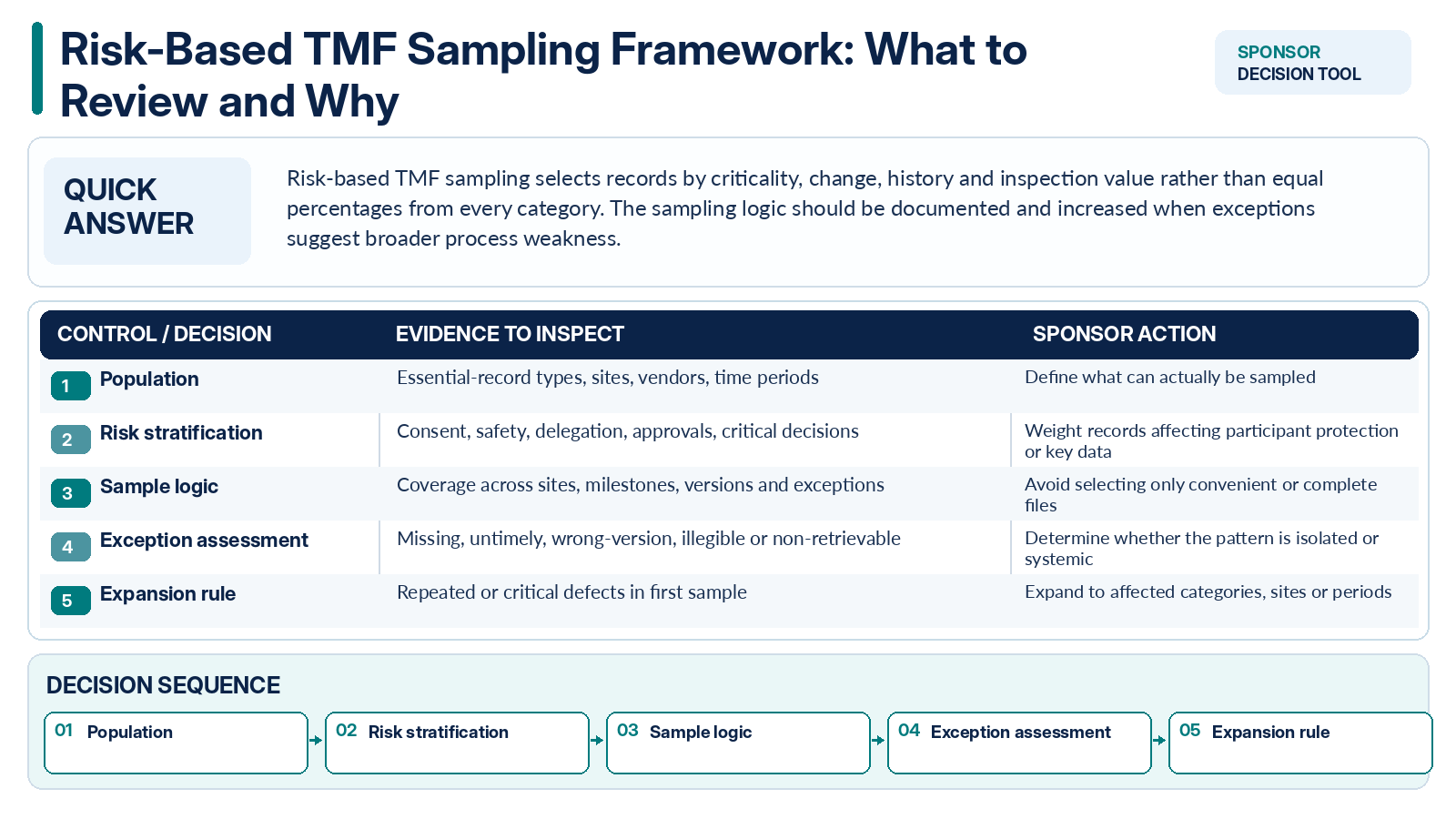
Risk-based TMF sampling selects records by criticality, change, history and inspection value rather than equal percentages from every category. The sampling logic should be documented and increased when exceptions suggest broader process weakness.
Reusable decision and evidence template
Begin with the most consequential control and the evidence needed to resolve it. The following matrix connects each decision to records and an accountable action, rather than treating the list as a generic compliance checkbox.
| Control / question | Evidence to examine | Sponsor action |
|---|---|---|
| Population | Essential-record types, sites, vendors, time periods | Define what can actually be sampled |
| Risk stratification | Consent, safety, delegation, approvals, critical decisions | Weight records affecting participant protection or key data |
| Sample logic | Coverage across sites, milestones, versions and exceptions | Avoid selecting only convenient or complete files |
| Exception assessment | Missing, untimely, wrong-version, illegible or non-retrievable | Determine whether the pattern is isolated or systemic |
| Expansion rule | Repeated or critical defects in first sample | Expand to affected categories, sites or periods |
For teams that need support implementing this across functions, BioBoston CRO TMF Audits can help adapt the controls to the study, vendors, and decision calendar.
Working through the controls
1. Population
Evidence: Essential-record types, sites, vendors, time periods. Decision: Define what can actually be sampled. Record the responsible function and the approved source version, and keep any remaining exceptions visible to the sponsor before this item is closed.
2. Risk stratification
Evidence: Consent, safety, delegation, approvals, critical decisions. Decision: Weight records affecting participant protection or key data. Record the responsible function and the approved source version, and keep any remaining exceptions visible to the sponsor before this item is closed.
3. Sample logic
Evidence: Coverage across sites, milestones, versions and exceptions. Decision: Avoid selecting only convenient or complete files. Record the responsible function and the approved source version, and keep any remaining exceptions visible to the sponsor before this item is closed.
4. Exception assessment
Evidence: Missing, untimely, wrong-version, illegible or non-retrievable. Decision: Determine whether the pattern is isolated or systemic. Record the responsible function and the approved source version, and keep any remaining exceptions visible to the sponsor before this item is closed.
5. Expansion rule
Evidence: Repeated or critical defects in first sample. Decision: Expand to affected categories, sites or periods. Record the responsible function and the approved source version, and keep any remaining exceptions visible to the sponsor before this item is closed.
Red flags that should change the plan
- Using a fixed percentage as an FDA requirement.
- Treating all filing deficiencies as equally consequential.
- Ignoring metadata and retrieval.
Decision gate and governance
Predefine triggers for expanding the sample; preserve selected record IDs and defect classifications for repeatability. The control owner should record the decision, evidence version, date, residual uncertainty and next re-review trigger. Where delegated providers perform the work, the sponsor should retain the relevant oversight and acceptance evidence.
Regulatory note: Applicable regulations, trial commitments and agreements must be distinguished from nonbinding FDA and ICH guidance. Apply this framework to the actual product, jurisdiction and study.
Need practical support?
Use BioBoston CRO TMF Audits to review the evidence, define decision rights, and build a study-specific action plan for the next milestone.