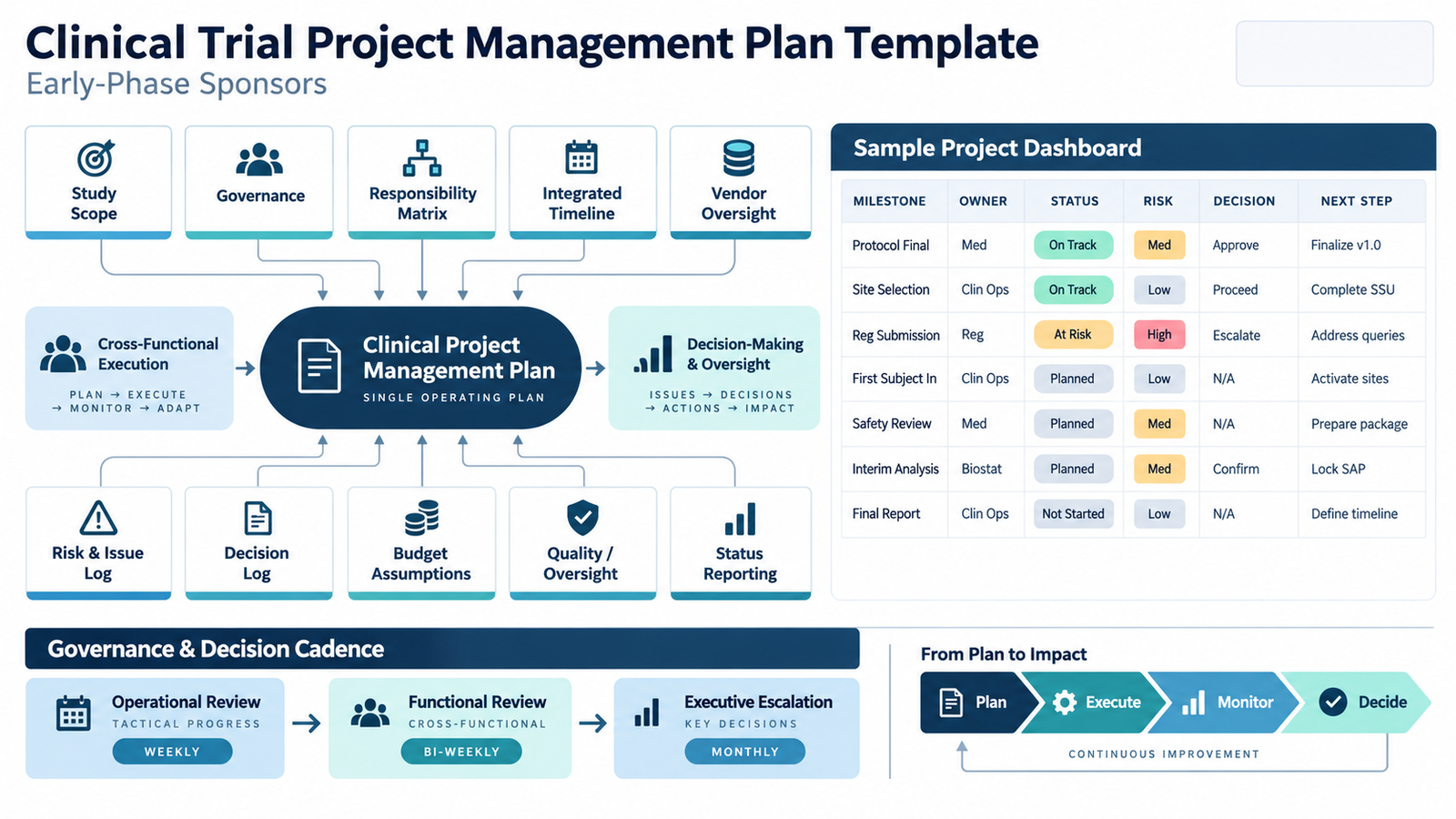
Clinical Trial Project Management Plan Template for Early-Phase Sponsors
A clinical trial project management plan should answer a simple operational question:
How will the sponsor, CRO, specialist vendors, and internal functions work together to reach the next study milestone without losing ownership of decisions, risks, dependencies, or escalation?
For a lean early-phase sponsor, the plan does not need to become a large administrative document. It needs to create one trusted operating baseline.
At minimum, the plan should define:
- study scope and assumptions;
- project-management authority;
- responsibilities and decision rights;
- milestones and critical dependencies;
- vendor interfaces;
- governance and meeting cadence;
- risks, issues, actions, and decisions;
- budget and change-control interfaces;
- quality and sponsor-oversight interfaces;
- escalation rules; and
- transition and closeout expectations.
This template is a BioBoston CRO sponsor-side project-management framework. It is not an FDA-required document or a prescribed ICH template. It is designed to help sponsors operationalize responsibilities, risk-based management, oversight, and cross-functional execution in a practical way.
Quick answer: what belongs in a clinical trial project management plan?
A useful plan should contain these 11 control areas:
| Control area | What the plan should establish |
|---|---|
| 1. Study context | What study or program is being managed and what milestone matters next |
| 2. Scope | What the project manager and team will – and will not – control |
| 3. Governance | Who makes which decisions and how they are documented |
| 4. Responsibilities | Who performs, reviews, approves, supports, and escalates each activity |
| 5. Timeline | Milestones, dependencies, assumptions, decision dates, and critical path |
| 6. Vendors | Deliverables, interfaces, dependencies, metrics, and escalation |
| 7. Risks and issues | How risks, active issues, actions, and mitigations are controlled |
| 8. Decisions and changes | How decisions and material changes are documented and approved |
| 9. Budget interface | How scope, forecasts, invoices, and changes connect to project decisions |
| 10. Communication | Meeting cadence, reporting, executive visibility, and escalation |
| 11. Transition / closeout | How responsibilities, records, open work, and knowledge are handed over |
The plan should connect these elements rather than create another independent tracker.
Who this template is for
This framework is designed primarily for:
- VP or Head of Clinical Operations;
- Clinical Program Directors;
- sponsor-side Clinical Project Managers;
- COOs or CMOs at lean biotechnology companies; and
- functional leaders coordinating several external providers.
It is especially useful when a Phase I or Phase II sponsor has a primary CRO plus laboratories, technology providers, data vendors, specialist consultants, or other outsourced functions.
The need becomes particularly clear when teams have multiple timelines, meeting decks, issue logs, vendor reports, and spreadsheets – but no single operating view that connects them.
How to use the template
Do not try to reproduce every functional plan inside the project management plan.
The project management plan should act as the integration layer.
For example:
- the detailed Data Management Plan remains owned by Data Management;
- the monitoring plan remains a clinical-operations document;
- the statistical analysis plan remains owned by Statistics;
- the quality plan remains within the quality system; and
- detailed vendor agreements remain contractual records.
The project management plan should identify where those workstreams interact, which milestones depend on them, who makes decisions, and what happens when an assumption changes.
A lean sponsor can maintain the plan as a controlled document, workspace, or structured operating package. The format matters less than maintaining one agreed source for project control.
Copyable clinical trial project management plan template
Use the following structure as a starting point.
| Section | What to document | Minimum useful evidence |
|---|---|---|
| Study identification | Protocol/program, phase, indication, product, sponsor, project lead | Current protocol/program identifier and approved study context |
| Purpose and next milestone | Why the plan exists and what milestone it is controlling toward | Named milestone and decision date |
| Scope | Included workstreams, vendors, geographies, systems, deliverables | Approved scope and exclusions |
| Key assumptions | Enrollment, vendor timing, review cycles, data availability, supply, approvals | Assumption owner and validation date |
| PM authority | What the PM can coordinate, decide, recommend, or escalate | Named sponsor decision owners |
| Governance | Operational, functional, executive, and vendor governance | Meeting model, participants, decision rights |
| Responsibilities | Perform, review, approve, decide, inform, escalate | Approved responsibility matrix |
| Integrated timeline | Milestones, dependencies, critical path, decision points | Baseline plus current forecast |
| Vendor controls | Deliverables, dependencies, metrics, issues, changes | Vendor matrix or dashboard |
| Risk register | Risk, impact, likelihood, mitigation, owner, trigger | Current risk status |
| Issue register | Active issue, impact, containment, action, owner, due date | Evidence of closure or escalation |
| Action log | Agreed action, owner, due date, status | Meeting or decision source |
| Decision log | Decision, rationale, decision owner, date, affected workstreams | Approved decision record |
| Dependency log | Upstream/downstream relationship, owner, required date | Linked milestone |
| Change control | Scope, timeline, vendor, protocol, resource, system, or budget change | Impact assessment and approval |
| Budget interface | Baseline, forecast, major variance, change-order linkage | Current approved financial position |
| Quality interface | Quality risks, deviations, CAPAs, oversight dependencies | Quality owner and escalation path |
| Reporting | Weekly/monthly status, dashboard, executive decisions | Current reporting package |
| Escalation | Trigger, first level, executive level, required response | Named escalation owner |
| Transition / closeout | Open items, records, ownership, successor, lessons, archive | Handover acceptance criteria |
This is deliberately broader than a task list. A task list tells the team what is due. A project management plan explains how the study will remain controlled when those tasks interact.
Field-by-field instructions
1. Define the purpose around the next decision
Do not begin with a generic statement such as “manage the clinical trial successfully.” Name the operating objective.
For example:
Maintain an integrated sponsor-side operating baseline through first patient in, with defined responsibilities, vendor dependencies, decisions, risks, and escalation.
The purpose should tell leadership what the project-management structure is expected to control.
2. Document assumptions explicitly
Early-phase plans depend heavily on assumptions. Examples include:
- protocol finalization date;
- regulatory or ethics review timing;
- CRO startup assumptions;
- laboratory readiness;
- database-build timing;
- drug-supply availability;
- site activation assumptions;
- participant recruitment rates;
- sponsor review cycles; and
- availability of critical vendors.
Do not hide these assumptions inside timeline dates. Assign each important assumption an owner, validation date, impact if false, and response. This makes the plan easier to update when reality changes.
3. Separate coordination authority from sponsor decision authority
A project manager may coordinate nearly every workstream without owning every decision. Scientific, medical, safety, regulatory, quality, contractual, and financial decisions should remain with the appropriate designated sponsor owners unless authority has been explicitly assigned.
For complicated sponsor/CRO structures, a formal Responsibility Matrix can map who performs, reviews, approves, decides, receives information, and escalates each important process.
The project plan should reference that matrix rather than recreate it inconsistently.
4. Build one integrated milestone view
The project timeline should show more than dates. For each important milestone, capture:
- target date;
- current forecast;
- responsible owner;
- predecessor;
- downstream dependency;
- required sponsor decision;
- key assumption;
- status; and
- recovery action when applicable.
When the timeline itself becomes the principal control problem, Study Timeline Management can provide a deeper integrated schedule, critical-path analysis, milestone scenarios, and recovery controls.
The project management plan should reference the current baseline and forecast rather than maintaining conflicting schedule versions.
5. Map vendor dependencies, not just vendor names
A vendor list does not show how work actually moves. For each important CRO, laboratory, technology vendor, central provider, or specialist supplier, document:
- contracted role;
- important deliverables;
- sponsor owner;
- upstream dependencies;
- downstream dependencies;
- performance information;
- recurring governance;
- open issues; and
- escalation path.
For programs with several outsourced providers, Vendor Governance should connect these interfaces to deliverables, performance metrics, meetings, decisions, actions, dependencies, and escalation.
The minimum control logs
A lean sponsor does not need dozens of trackers. A practical project-control package can often operate from six connected logs:
| Log | Primary question |
|---|---|
| Risk log | What might happen? |
| Issue log | What is happening now? |
| Action log | What did we agree to do? |
| Decision log | What did the sponsor decide? |
| Dependency log | What cannot move until something else happens? |
| Change log | What has changed from the approved baseline? |
These categories should not become isolated repositories. A meaningful issue may create actions, require a sponsor decision, alter a dependency, trigger a timeline change, and ultimately require a budget change. The project manager should preserve those connections.
Use escalation triggers instead of vague “high-risk” labels
Escalation works better when the team knows what causes it. Examples of project-specific escalation triggers may include:
- a critical milestone forecast moving beyond an agreed tolerance;
- a vendor deliverable becoming overdue with downstream impact;
- a dependency threatening participant safety or data reliability;
- a decision remaining unresolved beyond the required decision date;
- an issue requiring scope or budget authority above the project team;
- repeated vendor performance failure;
- an unresolved conflict in responsibility;
- a quality event requiring sponsor quality involvement; or
- a material change affecting several functions.
The exact thresholds are sponsor- and study-specific. The project management plan should define the mechanism and owner rather than invent universal thresholds.
Clearly hypothetical example
Consider a hypothetical emerging biotech sponsor preparing a first-in-human Phase I study. The sponsor has:
- a primary CRO;
- a central laboratory;
- an EDC provider;
- a bioanalytical laboratory;
- internal Clinical Operations and Regulatory leads; and
- part-time Quality and Data Management support.
A weak project plan might list: Final protocol -> database build -> site startup -> first participant dosed.
A stronger project plan would show the dependency structure:
| Milestone | Key dependency | Decision owner | Risk / issue trigger | Evidence |
|---|---|---|---|---|
| Protocol final | Cross-functional comments resolved | Sponsor clinical lead | Open critical comments at decision date | Approved protocol |
| EDC design approval | Protocol + eCRF review complete | Sponsor DM owner | Critical fields unresolved | Approved eCRF specification |
| Lab readiness | Transfer specifications and kits ready | Clinical Ops owner | Validation or shipping dependency delayed | Readiness confirmation |
| Site ready | Contracts, training, systems, supplies complete | Clinical Ops owner | Critical startup item open | Site readiness record |
| First participant dosed | Required startup conditions complete | Named sponsor owner | Any blocking safety/operational condition | Sponsor readiness decision |
The value is not the number of rows. It is that assumptions, dependencies, responsibilities, evidence, and decisions are visible before a missed handoff becomes a delay.
Governance cadence for a lean sponsor
The right cadence depends on study risk, phase, complexity, and current issues. A useful structure may include:
Working-level project review
- milestones;
- dependencies;
- actions;
- issues;
- upcoming decisions; and
- cross-functional handoffs.
Vendor governance
- contracted deliverables;
- performance;
- quality/timeliness;
- open dependencies;
- corrective actions;
- changes; and
- escalation.
Sponsor leadership review
- decisions requiring authority;
- major risk;
- forecast changes;
- budget exposure;
- scope changes; and
- milestone confidence.
Avoid repeating the same status information in three meetings. Each level should exist because it makes different decisions.
ICH E6(R3): what it means for the project plan
ICH E6(R3) is nonbinding guidance in the United States, not a requirement to create a document called a “Clinical Trial Project Management Plan.”
However, several E6(R3) principles are highly relevant to how sponsors should organize trial execution. The guidance emphasizes:
- assigning trial-related activities before initiation;
- using appropriately qualified individuals;
- quality by design;
- identifying and managing risks that matter to participant protection and trial-result reliability;
- sponsor oversight of important service-provider activities;
- access to relevant provider performance information;
- oversight proportionate to trial complexity and risk; and
- timely escalation and follow-up of important issues.
A well-designed project management plan can help the sponsor operationalize these concepts by making responsibilities, risks, vendors, decisions, dependencies, and escalation visible. It should support the sponsor’s controlled processes, not replace required functional plans, procedures, or quality-system records.
Common project-management-plan mistakes
Treating the plan as a one-time document
If the plan is approved at startup and never revisited, it quickly stops representing the study.
Duplicating every functional plan
The project-management plan should integrate the work, not become a second Data Management Plan, monitoring plan, quality plan, or statistical plan.
Tracking actions without decisions
Many actions exist because a decision is unresolved. Track the decision owner and required date.
Showing milestones without dependencies
A green milestone can still be at risk when the work it depends on is slipping.
Leaving vendor handoffs implicit
The largest gaps often occur between organizations or functions rather than inside one workstream.
Escalating only after a deadline is missed
Define conditions that trigger attention early enough for the sponsor to choose a response.
When to update the plan
Review the plan whenever a material change affects the operating baseline, including:
- protocol amendment;
- CRO or vendor change;
- change in sponsor leadership;
- material scope change;
- new system;
- major milestone shift;
- significant new risk;
- budget or resource change;
- new geography;
- governance change;
- quality event affecting execution; or
- transition into the next development phase.
At a minimum, the project manager should confirm periodically that the plan still reflects actual working practice. A controlled plan that no longer matches the study can create more confusion than no plan at all.
When an embedded project manager can help
Some sponsors can create this framework internally but do not have enough capacity to operate it consistently across functions and vendors.
BioBoston CRO’s Clinical Project Management support can provide an outsourced, embedded, interim, fractional, or supplemental project-management role for a defined study or workstream.
The role can include maintaining integrated project controls, coordinating functions and vendors, preparing governance meetings, following decisions and actions, managing risks and dependencies, escalating material issues through named sponsor owners, and preparing an orderly transition when the assignment ends.
The sponsor retains the appropriate scientific, medical, regulatory, safety, quality, budget, contractual, and executive decision authority.
Final project-management-plan checklist
- the next critical milestone is explicit;
- scope and exclusions are understood;
- important assumptions are documented;
- sponsor decision owners are named;
- responsibilities agree with contracts and working practice;
- the integrated timeline has dependencies and decision dates;
- key vendors and handoffs are visible;
- risks and active issues are separated;
- actions have owners and due dates;
- important decisions are retained;
- changes are evaluated against the approved baseline;
- escalation triggers and routes are defined;
- governance meetings have distinct purposes;
- reporting supports decisions rather than status alone; and
- transition and closeout responsibilities are understood.
A good project management plan should make the study easier to run. If the team needs several meetings to explain what the plan means, simplify it.
Need help turning your study plans, vendors, milestones, risks, and decisions into one usable operating model? Explore BioBoston CRO Clinical Project Management support.
FAQ
Is a clinical trial project management plan required by FDA?
FDA does not prescribe a document with this specific title. The framework is an operational project-management tool. Applicable regulations, sponsor procedures, ICH GCP guidance, contracts, and controlled functional plans remain separate authorities.
What is the difference between a project management plan and a clinical trial timeline?
The timeline primarily controls sequence, dates, milestones, assumptions, and dependencies. The project management plan connects the timeline to responsibilities, vendors, risks, issues, decisions, governance, changes, and escalation.
Who should own the project management plan?
Usually the sponsor-side project manager or designated project lead maintains it, but its content should be reviewed by the relevant functional and decision owners. Ownership of the plan does not transfer scientific, medical, regulatory, safety, quality, or commercial authority to the project manager.
Should the CRO’s project plan replace the sponsor’s plan?
Not necessarily. A CRO may maintain its own operational plan, but the sponsor still needs enough visibility to understand its decisions, responsibilities, outsourced activities, interfaces, risks, and important milestones. In heavily outsourced studies, the sponsor may use a concise sponsor-side integration layer rather than duplicate the CRO’s operational documentation.