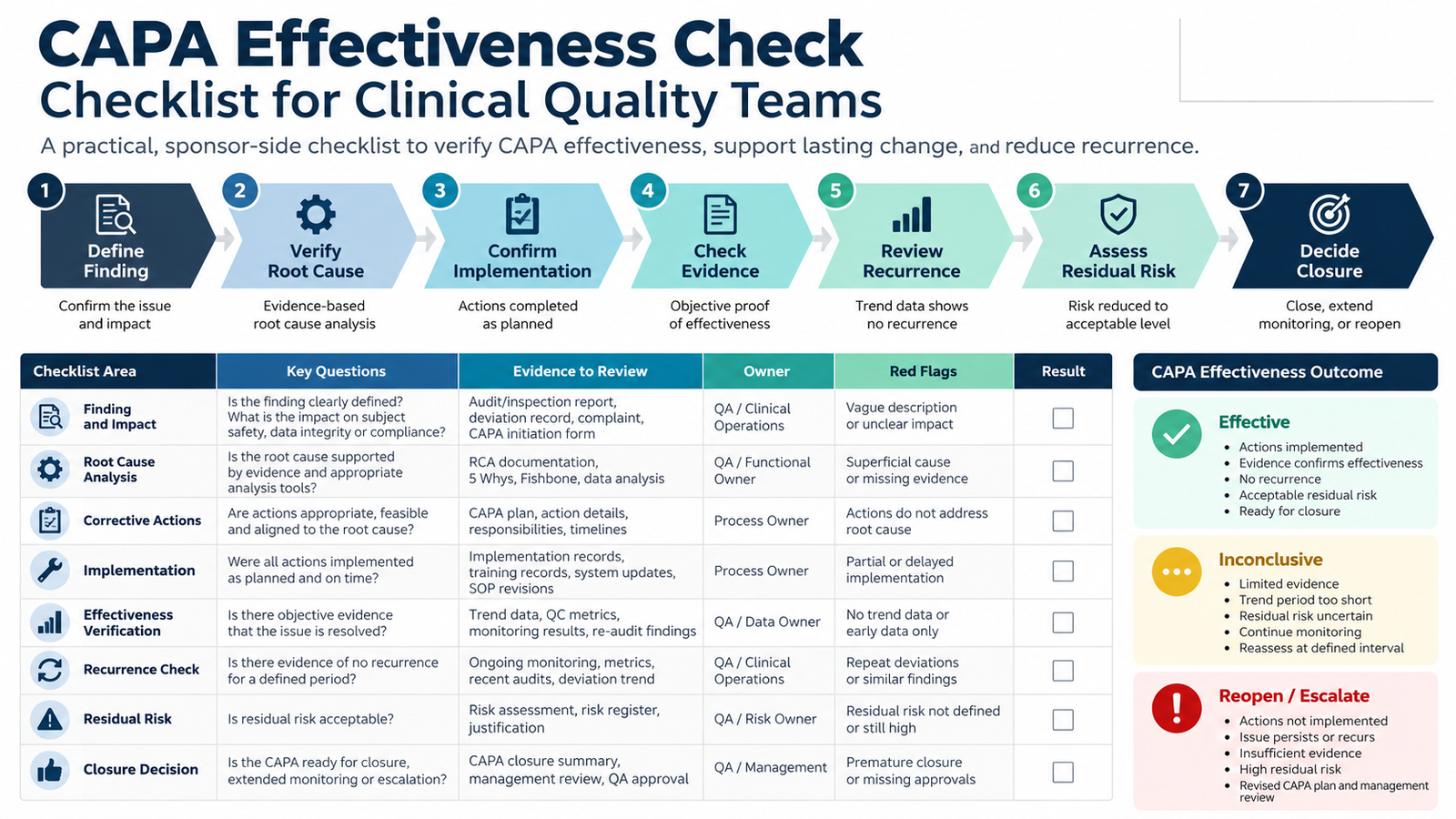
CAPA Effectiveness Check Checklist for Clinical Quality Teams
CAPA effectiveness check planning should confirm that corrective and preventive actions did more than get completed: they addressed the defined cause, produced the intended improvement, reduced recurrence risk, and did not create an unacceptable new problem.
For clinical quality teams, the strongest effectiveness check connects the original finding or deviation to a predefined question, objective evidence, an appropriate observation window, a named owner, and a clear pass/fail/inconclusive decision. The checklist below is designed for sponsors managing GCP findings, deviations, audit observations, inspection observations, recurring quality signals, and site or vendor remediation.
This is a BioBoston CRO sponsor-side quality framework. It is not an FDA-prescribed form, a required ICH template, or a substitute for the sponsor’s controlled CAPA procedure.
Quick answer: what should a CAPA effectiveness check prove?
The effectiveness review should answer five practical questions:
- Was the corrective action implemented as approved?
- Did the action address the verified root or contributing cause?
- Did the targeted problem, recurrence rate, or control failure improve under representative conditions?
- Did the action create any new or shifted risk?
- Is the evidence strong enough to support closure, or is additional action required?
Completion evidence such as an approved SOP, a training record, or a closed action item can show that work was performed. It does not, by itself, show that the CAPA was effective.
Who this checklist is for
This resource is intended for Clinical Quality, Clinical Operations, sponsor oversight, site/vendor oversight, Regulatory, and program leaders who need to evaluate whether remediation actually held after a clinical finding or recurring issue.
Typical triggers include:
- GCP audit findings;
- inspection observations;
- significant or repeated protocol deviations;
- monitoring or oversight findings;
- TMF quality or timeliness trends;
- vendor performance failures;
- data-quality or process-control issues; and
- recurring deficiencies after earlier remediation.
CAPA effectiveness check checklist
Use the following sponsor-side checklist as a decision tool. The evidence, owners, thresholds, and timing should be adapted to the specific finding, risk, study, vendor, and quality system.
| Checkpoint | Evidence to expect | Typical owner | Red flag |
|---|---|---|---|
| 1. Finding is clearly defined | Specific problem statement, affected process, scope, requirement, event population, and impact | Quality / process owner | CAPA addresses a vague symptom rather than a defined problem |
| 2. Root or contributing cause is supported | Investigation evidence linking the cause to the observed failure | CAPA owner with Quality review | Cause is assumed, generic, or based only on opinion |
| 3. Action maps to the cause | Clear explanation of how each action interrupts the causal pathway or strengthens the failed control | CAPA owner | Action is limited to retraining or document revision without a causal rationale |
| 4. Implementation is verified | Approved/released procedure, system configuration, completed qualification, training/competency evidence, deployed control | Action owner | Effectiveness review starts before the action is fully active |
| 5. Effectiveness question is predefined | Specific statement of what outcome must improve and how it will be judged | Quality + process owner | Criteria are written after results are known |
| 6. Acceptance criteria are measurable | Metric, threshold, denominator/population, method, and decision rule | Quality / data owner | Criterion says only “no recurrence” without defining exposure or review scope |
| 7. Observation window is justified | Time or exposure window long enough for the failure condition to reoccur if the CAPA is ineffective | Quality + process owner | Window is calendar-based but contains little or no relevant process exposure |
| 8. Data source is representative | Defined records, sites, participants, visits, vendor outputs, monitoring results, system reports, or audit samples | Functional owner | Only favorable or convenient records are reviewed |
| 9. Pre- and post-action evidence is comparable | Baseline and post-CAPA data use comparable definitions and populations where appropriate | Quality / analytics owner | Improvement is claimed from non-comparable data |
| 10. Recurrence and related signals are checked | Deviation trends, repeat findings, related complaints/signals, vendor/site patterns, or downstream errors | Quality | No search for related recurrence outside the original record |
| 11. Unintended consequences are assessed | Evidence that the new control did not shift risk, create workarounds, or weaken another process | Process owner + Quality | Only the intended metric is reviewed |
| 12. Residual risk is reassessed | Updated risk evaluation based on effectiveness results and remaining exposure | Quality / sponsor owner | CAPA is closed even though material risk remains unexplained |
| 13. Result is classified | Documented effective, partially effective, ineffective, or inconclusive conclusion with rationale | Quality approver | Automatic “effective” conclusion because actions were completed |
| 14. Failure response is defined | Containment, re-investigation, revised root cause, additional action, broader scope, or new check | CAPA owner + Quality | Failed check is closed with narrative justification only |
| 15. Closure is traceable | Evidence package, approvals, linked records, unresolved items, ongoing monitoring, and closure date | Quality | Supporting evidence cannot be reconstructed later |
Why implementation verification is not the same as effectiveness
Clinical teams often close the gap between finding and action but not the gap between action and outcome.
| Stage | Question | Example evidence |
|---|---|---|
| Action completion | Was the assigned task completed? | SOP revised, training assigned, configuration changed |
| Implementation verification | Is the approved change active and being used? | Effective SOP, competency check, system release, field observation |
| CAPA effectiveness verification | Did the change reduce the targeted failure or risk? | Trend, re-audit, representative sample, performance metric, recurrence review |
| Ongoing monitoring | Does the control remain reliable after closure? | Periodic trending, oversight metrics, subsequent audits, management review |
A revised procedure can be perfectly implemented and still fail to correct the real cause. Effectiveness therefore needs outcome evidence, not only implementation evidence.
How to design a defensible effectiveness verification
1. Start with the failure mechanism
Restate what failed, why it failed, and what the CAPA is expected to change. The check should test the expected effect of the action, not an unrelated metric that happens to be easy to collect.
2. Define the decision rule before results are available
Prospective criteria reduce hindsight bias. Define the metric, acceptance threshold, population or sample, observation window, evidence source, reviewer, and what happens if the result is not clearly acceptable.
3. Make the observation window exposure-based
A 30-day or 90-day window is only meaningful if the corrected process was actually exercised. For an infrequent event, the right trigger may be a defined number of participant visits, monitoring cycles, vendor deliverables, reconciliations, database events, or other real opportunities for recurrence.
4. Check the broader system when the issue may be systemic
A site-specific finding can reflect a sponsor or vendor process problem. A vendor-specific issue can affect several studies. Define whether the effectiveness review is limited to the original scope or should include related sites, studies, systems, vendors, or processes.
When the finding came from an audit or indicates broader compliance risk, BioBoston CRO’s GCP Audits can provide an independent view of whether the corrected process is operating as intended across the relevant scope.
5. Keep evidence traceable to the CAPA decision
The final conclusion should let a reviewer reconstruct the reasoning: original finding, cause, action, implementation evidence, effectiveness criteria, records reviewed, results, limitations, residual risk, and closure decision.
Evidence examples for clinical quality CAPA
The right evidence depends on the failure mode. Examples include:
- Protocol deviation trend: compare the defined deviation type before and after the CAPA using a consistent denominator such as participant visits or applicable procedures.
- Site process deficiency: targeted re-review of representative source or essential records after staff competency and process changes are active.
- Vendor oversight failure: review deliverable timeliness, recurring escalation, quality metrics, issue aging, and sponsor follow-up across an appropriate operating window.
- TMF quality issue: review timeliness, completeness, quality findings, and recurrence after the corrected workflow has processed enough documents to be meaningful.
- Training-related gap: use competency or observed performance evidence rather than attendance alone.
- Monitoring deficiency: verify that the revised control detects, documents, escalates, and resolves the targeted issue in practice.
For recurring or cross-functional quality signals, Quality Management support can help connect CAPA evidence with trending, governance, risk review, and the sponsor’s broader clinical quality system.
Effectiveness-verification red flags
- The check is defined only after the CAPA actions are complete.
- The only evidence is “training completed” or “SOP updated.”
- The observation period contains no meaningful opportunity for recurrence.
- The sample excludes difficult sites, vendors, records, or negative results.
- The metric changed at the same time as its definition, denominator, or data source.
- The team checks only the original symptom and not related quality signals.
- Partial improvement is recorded as “effective” without explaining residual risk.
- A failed check triggers a new due date but not re-investigation or revised action.
- The original issue recurs under a new deviation or finding number and is not linked back to the CAPA.
- Closure approval cannot be traced to the evidence reviewed.
What to do when effectiveness verification fails
A failed or inconclusive result should not be treated as an administrative delay. It is new evidence about the problem or the remediation.
- Contain any immediate risk if the failure affects participant protection, data reliability, or a critical process.
- Reassess the root-cause analysis. The action may have addressed only a contributing factor or symptom.
- Assess scope expansion. Determine whether related sites, vendors, studies, systems, or processes may be affected.
- Revise the action plan. Add or replace controls based on what the new evidence shows.
- Define a new prospective effectiveness check. Avoid reusing criteria that were incapable of distinguishing success from failure.
- Escalate when appropriate. Material or repeated failures may require sponsor leadership, Quality, Medical, Regulatory, or executive review depending on the risk.
Clearly hypothetical clinical example
Consider a hypothetical sponsor that identifies repeated visit-window deviations across several sites. The investigation finds that the scheduling worksheet used by sites does not calculate one protocol window correctly, and monitors are detecting the problem only after visits occur.
The CAPA includes a corrected scheduling tool, controlled release, user training with competency confirmation, and an updated monitoring check.
A weak effectiveness check would verify that all sites completed training.
A stronger check could define:
| Element | Hypothetical approach |
|---|---|
| Effectiveness question | Does the corrected workflow prevent the targeted visit-window error under routine study use? |
| Population | Applicable participant visits after the corrected tool is implemented |
| Evidence | Scheduling records, monitoring review, deviation log, related issue trend |
| Window | Enough applicable visits across affected sites to create meaningful exposure |
| Decision rule | Predefined recurrence/escape criterion plus review for unintended scheduling errors |
| Failure response | Containment, re-investigation, tool/process revision, scope expansion if needed |
The example is intentionally non-numeric because the appropriate threshold and sample depend on the protocol, event frequency, severity, exposure, and sponsor quality system.
GCP and FDA context
ICH E6(R3) describes risk-based quality management and states that sponsor quality assurance should include strategies to identify potential or actual causes of serious noncompliance so corrective and preventive actions can be enabled. It also calls for periodic review of risk-control measures to determine whether quality-management activities remain effective and relevant.
For U.S. drug studies, 21 CFR 312.56 requires sponsors to monitor ongoing investigations and, when investigator noncompliance is identified, promptly secure compliance or take specified action. For device investigations, 21 CFR 812.46 contains comparable sponsor responsibilities to secure compliance or terminate investigator participation when required.
These requirements and guidance support disciplined remediation and oversight, but they do not prescribe a specific effectiveness-check document. The checklist in this resource is a practical sponsor-side method for generating and reviewing the evidence needed to support a quality decision.
When GCP CAPA Support can help
Some findings are straightforward to correct. Others are difficult because the cause is uncertain, several organizations are involved, recurrence has already occurred, or the sponsor lacks an independent view of whether the remediation is strong enough.
BioBoston CRO’s GCP CAPA Support can help sponsors, sites, and clinical vendors with problem definition, containment, root-cause analysis, CAPA planning, implementation oversight, evidence review, and effectiveness checks.
When the trigger is an FDA inspection or a broader inspection-readiness concern, Mock FDA Inspection support can help test whether remediation evidence and associated clinical quality controls are inspection-ready.
Final CAPA effectiveness check checklist
- The finding and affected scope are clearly defined.
- The root or contributing cause is evidence-based.
- Each action maps to the identified cause or control failure.
- Implementation is verified before effectiveness measurement starts.
- The effectiveness question and acceptance criteria are predefined.
- The observation window includes real exposure to the failure condition.
- The sample or data source is representative and traceable.
- Pre- and post-CAPA evidence is comparable where appropriate.
- Recurrence and related quality signals are reviewed.
- Unintended consequences and residual risk are considered.
- The result is documented as effective, partially effective, ineffective, or inconclusive.
- Failed or inconclusive checks trigger defined action rather than narrative closure.
- The evidence package supports an independent review of the closure decision.
Need help determining whether a clinical CAPA is ready for closure or requires stronger evidence? Explore BioBoston CRO GCP CAPA Support.
FAQ
What is a CAPA effectiveness check?
It is a planned review of objective evidence used to determine whether implemented corrective and preventive actions achieved the intended result, reduced the targeted recurrence or risk, and support closure.
Is CAPA closure the same as completing all actions?
No. Completing assigned actions shows that implementation work was performed. Closure should also consider whether the actions were effective, whether residual risk is acceptable, and whether additional monitoring or action is needed under the sponsor’s quality system.
When should effectiveness criteria be defined?
Ideally, define the effectiveness question, evidence source, observation window, and acceptance criteria when the CAPA plan is approved, before the effectiveness result is known.
What if there is no recurrence during the review period?
No recurrence can be meaningful only when there was enough relevant exposure for recurrence to be possible and the review scope was representative. A quiet period with little or no exposure may be inconclusive rather than effective.