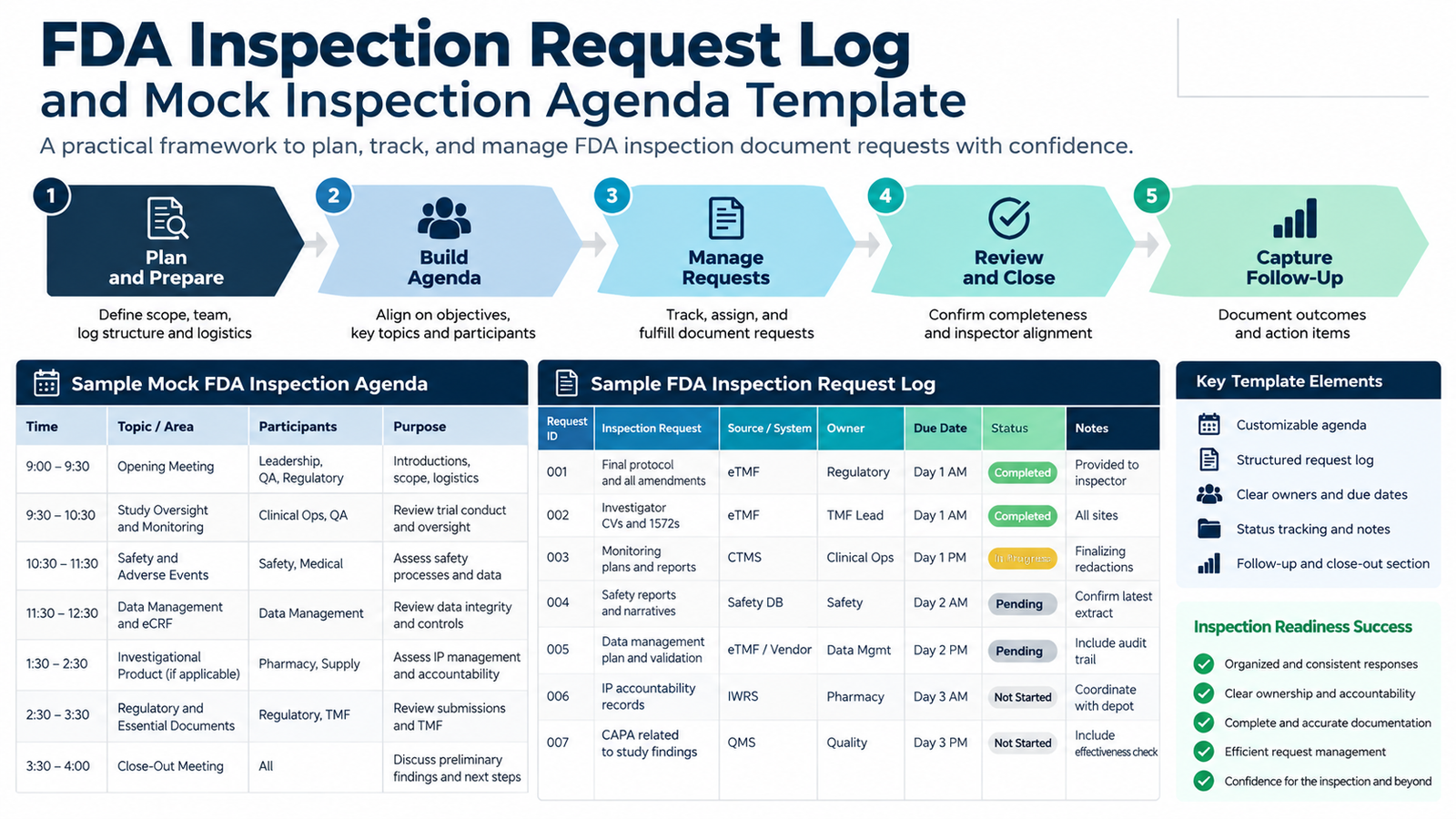
FDA inspection request log controls should make every regulatory request traceable from the moment it is received through clarification, ownership, document review, delivery, follow-up, and closure. The log is an operational control tool, not an FDA-required form. Its value is that the front room, back room, document owners, reviewers, and leadership can work from the same request history without losing context or sending an unchecked record.
Quick answer: what should the request log control?
A practical request log should capture the exact request, any clarification, a unique request ID, the responsible owner, where the evidence will come from, who reviewed the response, the target response time, the actual delivery time, follow-up requests, issues or escalations, and final closure. The companion mock inspection agenda should test that process under realistic time pressure rather than act as a rigid script for how FDA will conduct an actual inspection.
Who this template is for
This resource is designed for Clinical Quality, Regulatory Affairs, Clinical Operations, inspection-readiness leads, and executive sponsors preparing for a BIMO or other FDA clinical inspection. It is most useful when an inspection is announced or reasonably anticipated, a major filing or study milestone is approaching, or leadership wants evidence that the team can manage requests accurately under pressure.
Use it alongside a broader mock FDA inspection and clinical inspection readiness exercise, not as a substitute for inspection-specific planning.
Mock inspection agenda template
The agenda below is intentionally flexible. A mock inspection should test the likely scope and the organization’s response system, but FDA is not required to follow your planned sequence.
| Time | Mock activity | Purpose | Typical participants |
|---|---|---|---|
| 08:30-09:00 | Internal readiness check | Confirm roles, rooms, systems, backups, and open risks | Inspection lead, QA, coordinator |
| 09:00-09:30 | Mock opening meeting | Practice introductions, scope confirmation, logistics, and initial requests | Leadership, QA, Regulatory, key functional leads |
| 09:30-10:30 | Sponsor oversight and governance | Test oversight evidence, issue escalation, monitoring, and service-provider controls | Clinical Quality, Clinical Operations |
| 10:30-11:30 | Study conduct and subject protection | Test protocol, consent, IRB, safety, deviations, and investigator oversight records as applicable | Clinical Operations, Safety, Regulatory |
| 11:30-12:15 | Data and systems | Test data handling, access, audit trails, validation evidence, and issue management as applicable | Data Management, IT/CSV, QA |
| 13:00-14:00 | TMF and record retrieval | Stress-test record location, version control, completeness, and retrieval | TMF owner, document control, QA |
| 14:00-15:00 | Interviews and follow-up requests | Practice concise, truthful responses and controlled follow-up | Selected SMEs, inspection lead |
| 15:00-16:00 | Request-log pressure test | Create overlapping requests, dependencies, clarifications, and escalations | Front room, back room, document reviewers |
| 16:00-16:30 | Daily debrief | Reconcile open requests, observations, commitments, and next-day priorities | Inspection leadership team |
FDA inspection request log template
Use one line per discrete request. If FDA narrows, expands, or materially changes a request, create a linked follow-up ID rather than overwriting the original history.
| Field | What to capture | Control point / red flag |
|---|---|---|
| Request ID | Unique sequential identifier, such as R-001 | Never reuse IDs or silently replace a prior request. |
| Date and time received | When the request was made or clarified | Missing timestamps make turnaround and sequence hard to reconstruct. |
| Request source | Investigator name or inspection team source, if appropriate | Use the actual source; do not rely on memory later. |
| Exact request | Record the request as accurately as practical | Avoid summarizing so heavily that the scope changes. |
| Clarification / agreed scope | What was clarified, narrowed, expanded, or confirmed | If scope is unclear, clarify before retrieving broadly. |
| Owner | Single accountable response owner or SME | Multiple unnamed owners often means no owner. |
| Record / evidence source | System, TMF location, repository, department, or source record | Confirm the correct version and supporting attachments. |
| Reviewer / approver | Person who checks completeness, consistency, privacy, and scope | Do not deliver unreviewed records simply to move fast. |
| Status | Open, retrieving, under review, ready, delivered, follow-up, blocked, closed | Use defined status values rather than free-text ambiguity. |
| Target response time | Internal target based on priority and complexity | Do not promise an arbitrary deadline the team cannot meet. |
| Delivered date/time | When the response or record was actually provided | Status "done" is not a substitute for delivery evidence. |
| Delivery method / package | Controlled copy, secure electronic transfer, view-only access, or other approved method | Confirm what exactly was provided. |
| Follow-up request ID | Linked child request, if any | Do not bury follow-ups in notes. |
| Issue / escalation | Delay, missing record, discrepancy, privacy concern, inconsistency, or quality issue | Escalate material concerns before delivery or commitment. |
| Closure note | Why the request is considered complete | Reconcile open items at least daily during a mock or live inspection. |
Field-by-field operating rules
1. Capture the request before retrieval starts
The scribe or request coordinator should record the request immediately, then confirm whether the team understands the scope. The most common avoidable error is launching several people to retrieve records before anyone has established exactly what FDA asked for.
2. Keep one accountable owner
The request can involve several contributors, but one person should own coordination. That owner is responsible for knowing what is missing, what is under review, and what is ready for delivery.
3. Separate retrieval from approval
Finding a document is not the same as approving it for delivery. The review step should confirm the requested scope, correct study or system, current or relevant version, attachments, legibility, consistency with prior responses, and appropriate handling of confidential or participant-identifiable information.
4. Track follow-up requests as new work
A follow-up may look small but can materially change the inspection trail. Give it a new ID and link it to the parent request so the team can reconstruct the sequence later.
5. Reconcile the log every day
Before the internal debrief ends, reconcile every open, delivered, blocked, or follow-up request. Confirm any commitments, emerging issues, unresolved questions, and documents expected the next day.
Inspection room roles and handoffs
| Role | Primary responsibility | Red flag |
|---|---|---|
| Lead host / inspection lead | Manages inspection flow, communications, priorities, and escalation. | Requests bypass the control process or several people give conflicting direction. |
| Scribe / log owner | Records questions, requests, clarifications, observations, and commitments. | Material requests remain in personal notes or memory. |
| Request coordinator | Routes each request, tracks status, and keeps front room and back room aligned. | No one can state what is open, late, or blocked. |
| Document owner / SME | Locates evidence and explains process within their expertise. | SMEs over-answer, speculate, or send records directly. |
| QA reviewer | Checks scope, version, completeness, consistency, and quality concerns before delivery. | Review becomes a rubber stamp or a bottleneck with no backup. |
| Escalation owner | Decides how to handle discrepancies, missing evidence, serious deviations, privacy issues, or commitments. | The team hides, delays, or improvises around a material issue. |
Clearly hypothetical request-log example
The example below is illustrative only. It is not based on a BioBoston CRO client or completed inspection.
| ID | Request | Owner | Status | Control note |
|---|---|---|---|---|
| R-001 | Provide the sponsor monitoring plan and evidence of current implementation. | Clinical Operations | Under review | QA noted one superseded appendix; current version located and cross-checked before delivery. |
| R-002 | Provide evidence of IRB approval for Protocol Amendment 3 at Site 104. | Regulatory / TMF | Delivered | Approval letter and related submission evidence delivered as a controlled package. |
| R-003 | Explain how the sponsor identified and followed repeated visit-window deviations at Site 207. | Clinical Quality | Follow-up | Linked follow-up R-003A opened for trend analysis and CAPA effectiveness evidence. |
Red flags the mock inspection should deliberately test
- Verbal document requests that never reach the log.
- Two teams independently answering the same request with different records.
- Uncontrolled, outdated, incomplete, or unreadable records.
- Documents delivered without the attachments needed to interpret them.
- Follow-up requests hidden in notes rather than linked to the parent request.
- Requests marked complete without a recorded delivery time or package.
- Long delays with no explanation, priority decision, or escalation.
- Employees guessing when they do not know the answer.
- Overproduction of records that were not requested and are not needed to answer the question.
- Patient-identifiable or confidential information handled without the intended controls.
- Inspection questions revealing an actual quality issue that is discussed but not routed into the appropriate quality process.
If a mock inspection uncovers recurring or systemic quality problems, route them through the appropriate process rather than treating them as rehearsal notes. BioBoston CRO’s GCP CAPA Support can help structure investigation, remediation, evidence review, and effectiveness checks where appropriate.
How this fits FDA BIMO and ICH E6(R3)
For drug and biologic programs under an IND, 21 CFR 312.58 requires a sponsor, upon request from an authorized FDA employee and at reasonable times, to permit access to and copying and verification of records and reports relating to the clinical investigation. 21 CFR 312.57 establishes specific sponsor recordkeeping and retention obligations, while 21 CFR 312.56 addresses ongoing sponsor monitoring and actions when investigator noncompliance is identified.
FDA’s BIMO compliance program for sponsors and CROs focuses on sponsor practices and procedures related to clinical trial oversight, including areas such as site monitoring, vendor audits, training, data collection, handling, management, and record custody. ICH E6(R3), as nonbinding international GCP guidance unless adopted or otherwise made applicable in a jurisdiction, emphasizes sponsor quality management and the ability to maintain essential records so that they are identifiable, retrievable, and accessible for regulatory inspection.
Parts 50 and 56 provide the FDA regulatory framework for human subject protection and IRBs. The exact inspection scope also depends on the product type and study-specific requirements. Device programs, for example, have additional obligations under 21 CFR Part 812.
The practical implication: the request log itself is not the compliance objective. The objective is controlled, accurate, timely access to the records and people that demonstrate how the clinical program was governed and conducted.
Before the mock inspection starts
- Define the likely inspection type, organization, study or application context, systems, sites, and high-risk processes.
- Name primary and backup front-room and back-room roles.
- Confirm how requests will be logged, clarified, assigned, reviewed, approved, delivered, and closed.
- Test access to critical repositories and remote systems using the actual accounts and permissions expected during the exercise.
- Confirm how protected, confidential, or blinded information will be handled.
- Prepare a controlled evidence index or retrieval map without creating artificial records for the inspection.
- Review unresolved audits, deviations, CAPAs, monitoring issues, vendor concerns, and TMF gaps so leadership understands known risk.
- Agree on escalation rules for missing records, conflicting evidence, significant noncompliance, safety concerns, and data-integrity issues.
- Schedule internal debriefs and define who can make inspection commitments on behalf of the organization.
A focused TMF audit can help test whether essential records are complete and retrievable, while a GCP audit can independently assess the underlying trial processes and evidence that a mock inspection may probe.
Governance and update rules for the template
- Use controlled ownership and versioning for the blank template.
- Define who may edit request status and who may authorize delivery.
- Do not delete closed or superseded requests from the active inspection history; preserve traceability according to the organization’s controlled process.
- After each mock or real inspection, review where handoffs failed and update roles, training, fields, and escalation rules.
- Re-test the process after material remediation, system changes, team turnover, or changes to the expected inspection scope.
Frequently asked questions
Is an FDA inspection request log required by regulation?
No specific FDA regulation cited here mandates this particular log format. It is an inspection-management control designed to help a sponsor manage requests consistently while meeting the underlying obligation to make applicable records available and demonstrate compliant trial oversight.
Should every inspector question become a document request?
No. Track material questions and commitments in the inspection notes, but distinguish interview questions from requests for records, data, explanations, or follow-up evidence. When a question creates a new deliverable, assign a request ID.
How should follow-up requests be handled?
Create a new request ID linked to the original. This preserves chronology and makes it clear whether the follow-up was answered, superseded, or still open.
Can the request log replace a TMF index or inspection-readiness checklist?
No. The request log manages demand during the inspection. A TMF index, evidence map, readiness checklist, audit trail, and other controlled records serve different purposes.
Need to pressure-test the process before FDA does?
BioBoston CRO can help sponsors test inspection-room roles, interviews, request control, evidence retrieval, escalation, and remediation through a risk-based Mock FDA Inspection.