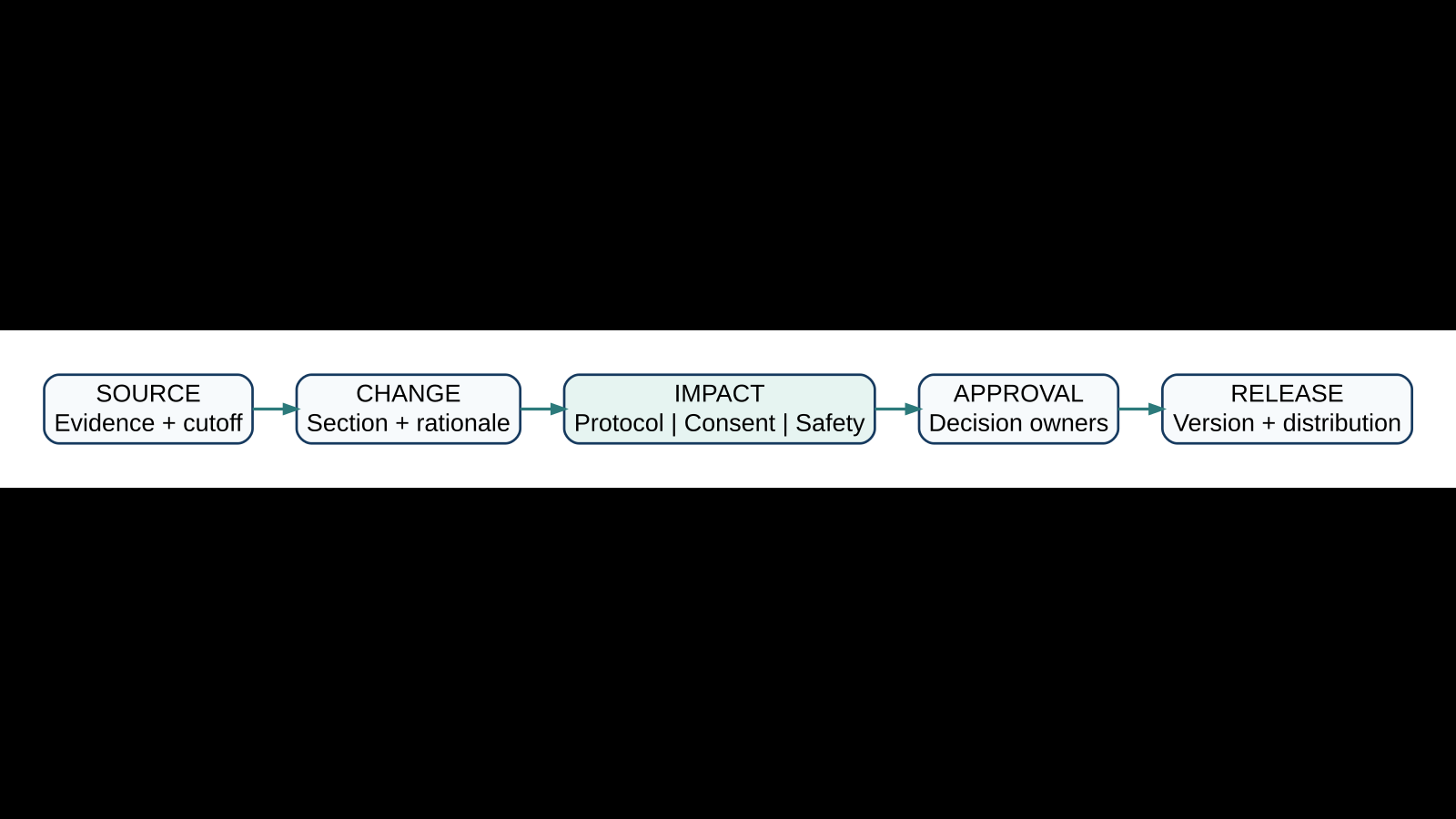
Investigator brochure version control should do more than identify the latest file. A useful control system lets a sponsor reconstruct what changed, why it changed, which evidence triggered the change, who approved it, which dependent documents were assessed, and when the revised brochure became effective.
That matters because an Investigator’s Brochure (IB) is a living safety and development document. Under current ICH E6(R3), sponsors should update the IB as significant new information becomes available, and the brochure should be reviewed at least annually and revised as necessary. A change-summary framework helps the sponsor turn that expectation into a controlled, reviewable process.
Quick answer: what should an IB version-control framework contain?
At minimum, maintain a controlled register with the prior and current version, effective date, change category, affected section, source evidence, rationale, safety/regulatory impact, dependent-document impact, approval owner, distribution status, and any follow-up action. The register should be updated as part of the IB revision workflow, not reconstructed after approval.
Who this framework is for
This framework is designed for Clinical Development, Medical Writing, Safety, and Regulatory leaders preparing an initial IB, annual review, or controlled update during pre-IND through active Phase I/II development. It is especially useful for lean sponsors where safety data, nonclinical reports, CMC changes, protocol amendments, and regulatory interactions move on different timelines.
1. Use one controlled IB change register
| Field | What to record | Why it matters |
|---|---|---|
| Version | Prior and new controlled version | Prevents ambiguity about which brochure is current |
| Effective date | Date the approved version becomes effective | Supports distribution and site/IRB/IEC traceability |
| Change category | Safety, clinical, nonclinical, CMC/product, administrative, regulatory | Allows risk-based review and routing |
| Affected section | Exact IB section/table/figure | Links the change to the controlled document |
| Source evidence | Report, dataset, safety signal, protocol, correspondence, product information | Provides traceability to the basis for the change |
| Change rationale | Why the information was added, removed, or revised | Distinguishes substantive change from editorial cleanup |
| Impact assessment | Safety, benefit-risk, protocol, consent, training, regulatory, labeling impact | Prevents IB updates from being treated as isolated writing changes |
| Approval owner | Functional and final approver | Clarifies decision rights |
| Distribution | Who receives the current version and when | Supports controlled implementation |
2. Classify changes before drafting them
Not every change needs the same review path. A typo correction and a new serious safety finding should not enter the same workflow with the same urgency. Use a simple classification model before authoring begins.
| Class | Typical examples | Control expectation |
|---|---|---|
| Critical / safety-driven | New important risk, clinically meaningful safety signal, urgent precaution | Immediate cross-functional assessment; determine whether other trial documents or communications require action |
| Major scientific | Material clinical, nonclinical, PK, or product information affecting interpretation | Formal scientific review, impact assessment, and controlled revision |
| Routine periodic | Annual cumulative updates, completed study summaries, expected development progression | Planned review cycle with source freeze and approval calendar |
| Administrative | Formatting, contact, terminology, non-substantive corrections | Document-control review; confirm no scientific meaning changed |
3. Build the change summary around evidence, not prose
A useful change summary should let a reviewer understand the evidence chain quickly. The record should identify the source, data cutoff or report version, affected conclusion, and the resulting IB edit. This reduces the risk that a polished narrative is approved while the underlying data lineage is unclear.
For safety-driven changes, record whether the new information changes the known or potential risks, monitoring approach, investigator instructions, protocol controls, or participant-facing information. For product changes, consider whether manufacturing, formulation, device, or administration information affects clinical use or interpretation.
4. Use a cross-document impact field
An IB update often has downstream consequences. Add a mandatory impact field that asks whether the same change affects the protocol, informed consent materials, safety-management documents, pharmacy/manual instructions, training materials, regulatory submissions, or other controlled product information.
If the protocol itself needs revision, BioBoston CRO’s Protocol Writing support can help keep the protocol and IB aligned. If the update changes the submission sequence or regulatory commitments, Submission Planning may also be relevant.
5. Copyable change-summary template
| Change ID | IB section | Prior state | New state | Evidence / version | Impact | Owner | Status |
|---|---|---|---|---|---|---|---|
| IB-CHG-### | [section] | [brief summary] | [brief summary] | [controlled source] | [safety/protocol/consent/etc.] | [name/role] | Open / approved / implemented |
Use the table as a control record, not as a substitute for the revision itself. The level of detail should be proportionate to the significance of the change.
6. Hypothetical example
Hypothetical only: a sponsor receives a finalized repeat-dose toxicology report that changes the interpretation of a previously described finding. The change register identifies the new report version, the affected nonclinical and risk sections, the revised interpretation, the impact on the clinical monitoring rationale, and the Regulatory/Safety owners. The sponsor then assesses whether the protocol, informed consent, or investigator training needs revision before the new IB version is released.
7. Governance rules that keep the framework useful
- Do not overwrite prior change records when a new revision is approved.
- Use controlled source versions and explicit data cutoffs.
- Separate substantive scientific changes from purely editorial changes.
- Require an impact assessment for protocol, consent, safety, regulatory, and training materials.
- Identify the final decision owner for conflicting functional comments.
- Link approval and distribution to the same effective version.
- Review the IB at least annually and also when significant new information emerges.
8. Common failure modes
- A new IB version is issued without a consolidated explanation of what changed.
- Change summaries describe wording edits but not the source evidence.
- Safety and Clinical use different data cutoffs.
- Protocol or consent implications are discovered only after IB approval.
- Sites receive the revised brochure but distribution status is not controlled.
- Annual review is treated as the only trigger for revision even when significant new information arises earlier.
Investigator brochure version control: final readiness check
- Current and superseded versions are identifiable.
- Every substantive change is tied to controlled evidence.
- Change rationale and affected sections are documented.
- Cross-document impact has been assessed.
- Functional and final approvals are traceable.
- Distribution and effective date are controlled.
- Open follow-up actions have owners and due dates.
Need help applying the framework to your program?
Explore BioBoston CRO Investigator Brochure Support for initial authoring, controlled updates, cross-document consistency review, and revision governance.